Blog

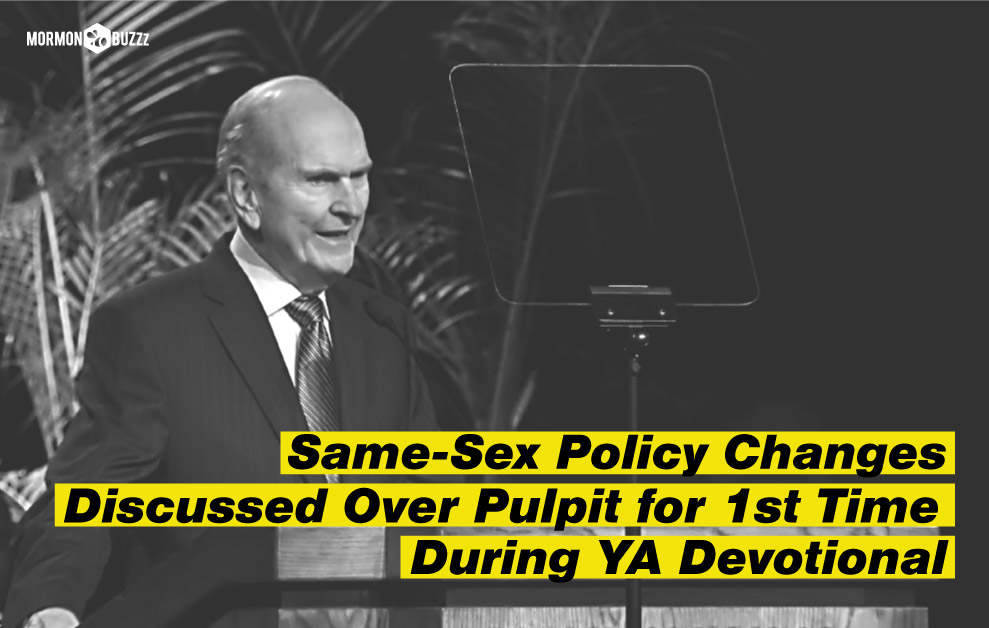
  • Same-Sex Policy Changes Discussed Over Pulpit for 1st Time During YA Devotional

    Same-Sex Policy Changes Discussed Over Pulpit for 1st Time During YA Devotional

    For the first time since November, the new church policy postponing the age of baptism for children of same-sex couples was addressed over the pulpit by Russell M. Nelson, president of the Quorum of the Twelve Apostles. In Sunday’s LDS Devotional for young adults. Nelson, rather than discussing the specifics of the new policy, instead addressed how the decision was made to enact it.

    “Filled with compassion for all, and especially for the children, we wrestled at length to understand the Lord’s will in this matter, ever mindful of God’s plan of salvation and of his hope for eternal life for each of his children,” Nelson said.

    Nelson remarked that the decision to enact the policy, which requires children of same-sex couples to wait until the age of 18 for baptism and renounce same-sex relationships, was made the same way the 2012 decision to lower the age of missionary service was made.

    “We considered countless permutations and combinations of possible scenarios that could arise. We met repeatedly in the temple in fasting and prayer and sought further direction and inspiration,” he said. “When the Lord inspired his prophet, President Thomas S. Monson, to declare the mind of the Lord and the will of the Lord, each of us during that sacred moment felt a spiritual confirmation.”

    Nelson noted that the decision to sustain the prophet in this matter was made by each individual after diligently seeking to hear the voice of the Lord and personally wrestling with the issue.

    Speaking to young members of the church affected by this decision and others made my the Quorum of the Twelve, Nelson said that some may question why the church does what it does. He added that asking these questions and seeking answers at an individual level is critical to spiritual progression.

    “Seeking to learn, understand, and recognize truth is a vital part of our mortal experience,” he said. “Revelation from the Lord to his servants is a sacred process, and so is your privilege of receiving personal revelation. You have as much access to the mind and will of the Lord for your own life as we apostles do for his church. Just as the Lord requires us to seek, ponder, fast pray, and wrestle with difficult questions, he requires you to do the same as you seek answers to your own questions.”

    Nelson’s remarks to millennial members of the church included encouragement to spend more time in sacred places, seek answers from the Lord rather than social media, follow the prophets, and accomplish challenging obstacles in life. He also urged them to be true to the millennial they were born to be.

    His talk was preceded by a talk given by his wife, Sister Wendy Nelson, who encouraged young single adults to desperately seek the will and guidance of the Lord and apply the Atonement of the Savior in their lives.

    Both President and Sister Nelson’s talks can be accessed on lds.org.

  • Jamesthemormon Raps Up the Holidays With An Amazing Service Project

    Jamesthemormon Raps Up the Holidays With An Amazing Service Project

    James Curran, also known as Jamesthemormon on social media, decided to ‘rap’ his christmas gift this year with a brand new song and video. His latest project, entitled “Angels We Have Heard On High,” is less about Christ-centered rap and more about Christ-centered Christmas, and it’s one you need to see.

    The music video was filmed in downtown Salt Lake City, where Curran and his collaborators passed out free food and clothing to the homeless. The song is an arrangement of “Angels We Have Heard On High,” featuring Junior Maile, Yahosh Bonner, Jay Warren, and Curran leading with an original rap. While the vocals are impressive and the rap inspiring, the arrangement was quickly thrown together to simply act as a backdrop for the video (beautifully produced by Cameron Gade from Catchlight Productions), made to inspire Christlike charity this holiday season.

    Curran teamed up with local businesses Bam Bams BBQ, Catchlight Productions, Traeger Grills and Stay Clothing, who donated clothing and food to create an unforgettable afternoon for over 300 people. He told Mormon Buzzz, “My purpose is to bring charity to Christmas, because that is the pure love of Christ.” Curran had the opportunity of doing a similar service project last year (you can watch that video here), where he bought dozens of pizzas and passed out clothing. This year, however, he knew he could go a little bit bigger. “I would love to go bigger and bigger in the coming years,” he said. Some ideas Curran has are to invite every food truck in Provo to donate food and to involve even more businesses to make that much more of an impact.

    Jamesthemormon’s willingness to share his talents as well as his example of Christlike charity are a call for all of us to do more for others this holiday season. Let’s think a little more outside of ourselves this Christmas and share the pure love of Christ through simple or big acts of charity. We never know what lives we’ll touch for good.

  • 6 Simple DIY Gifts for Mormons

    6 Simple DIY Gifts for Mormons


    1. Frame Your Own Printable Home Decor


    This is a simple custom gifts idea that will cost you little more than a frame, a sheet of glossy stock paper, and a little creativity. If you’ve been gifted with graphic design skills, make a classy and unique piece of home decor out of your favorite quote from a general authority. If you’re like the rest of us, just download and print one of the many free designs available online with help from services like Vinylcuttingmachineguide.

    We particularly liked these Articles of Faith posters available at It’s Always Autumn.

    Difficulty: ★☆☆☆☆

    printables

    Source: It’s Always Autumn


    2. Sew a Homemade Scripture Tote


    The perfect personal touch to gift along with a new set of scriptures is a homemade scripture tote. Here’s two different styles with instructions. Each one takes a minimal amount of sewing know-how, but they’re certainly not unattainable for the DIY beginner.

    Difficulty: ★★★★☆

    DSC_0714_thumb

    Source: Lemon Squeezy Home

    Handy-Dandy-Scripture-cover

    Source: Crafty Cupboard


    3. Make a Framed Temple Print

    Here’s another simple project. Amy Robinson over at Craftsy.com has put together an simple guide for do-it-yourself gold foil. This project could easily be adapted to make a modern LDS temple print. If you endeavor to do it yourself you can download a vector file of the Salt Lake Temple here. Other temples are available online with a little bit of digging. Instructions for a possibly easier alternative using metallic spray paint instead of foil are available over at todayscreativelife.com.

    gold-foil-example

    Source: Craftsy.com

    We also found you can buy these pre-made for fairly cheap over at Collectivity Lane if you’re not in a DIY mood.

    Difficulty: ★★☆☆☆

    gold temple print

    Source: Etsy.com


    4. Sew a Homemade Necktie


    At least half the Mormon population needs a new necktie on occasion, so why not gift them a homemade one and save yourself a bit of cash to boot. We found these detailed instructions over at purlsoho.com if you want to start completely from scratch. An easier alternative is to buy an old thrift store tie that has the width and length you want, and then unfold it to use as a template to cut your fabric. You can even reuse the inner padding if you’re happy with the thickness.

    homemade-ties

    If you’re feeling particularly trendy, here’s some additional instructions to colorblock your new homemade tie.

    Difficulty: ★★★☆☆

    colorblock

    Source: ispydiy.com


    5. Make a Personalized Scripture Study or Missionary Journal


    This is the perfect personalized gift for your favorite missionary or YSA. We found instructions for these simple and beautiful journals available over at lilblueboo.com. Perhaps you could put a favorite scripture on the front, or your missionary’s mission motto.

    Difficulty: ★☆☆☆☆

    Journals42

    Source: Ashley Hackshaw


    6. Make your Elder a Shirt and Tie Stocking


    We couldn’t find any instructions for these, but let’s be real, if you can’t figure this one out then DIY just might not be your thing.

    Difficulty: ☆☆☆☆☆

    missionary-stocking

    Source: Unknown

  • A Special Thanksgiving Message from Al Fox & JamesTheMormon

    A Special Thanksgiving Message from Al Fox & JamesTheMormon

    We absolutely adore Al Fox and JamesTheMormon. Having them together in the same video is almost too much for our delicate fanboy minds to handle. For your viewing pleasure:

    Did you like this? Check out JamesTheMormon’s latest video: Found a Friend


  • What My Anxiety Taught Me About Christ

    What My Anxiety Taught Me About Christ

    My legs bounced up and down as I sat on the train that would take me to Salt Lake City and, from there, my brand new job. It was September of 2014, and I had just moved away from home to take a position as a writing/editing intern for a lifestyle magazine. I found myself feeling excited and overwhelmed at the change. Within a few months, I had gone from being a stuck college grad with very little to look forward to to having multiple life events hit me all at once. I was in a new city with a new job, attending a new ward, and, at the time, exploring a new relationship, which, out of necessity, became long distance. As I sat on the train that first day, dwelling on all of it with a small smile, I thought, I have the greatest life.

    Two weeks later, I had a massive anxiety attack that left me mentally, emotionally, and physically crippled. I couldn’t manage to eat anything and, as a result, lost 10 pounds in a 2-3 week period. For days, I couldn’t get up to leave my house. I would lie in bed and shake and pray for sleep. When I finally got myself to fall asleep, I’d toss and turn in pain. It escalated to the point where, a month after starting my job, I quit and moved back home, desperate for relief. For a short time, relief came, but within a few days, I was mentally right back to where I started. If you also struggle with anxiety, you can consider trying CBD products, such as those available at biocbd.

    There were days when I could do nothing more than lie on my couch and stare at the ceiling and beg for the Lord to just end it. I didn’t really care how He did it, only that He did. If I let myself, I’d end up in very dark places where life felt meaningless and where the length of life was so daunting to me that I didn’t want to have to go through it. I felt completely broken and completely alone.  

    Moving beyond the weight of this particular trial took strength that I did not have and hours of begging for the ability to know how to overcome it. No one seemed to understand the situation I was in, one I later learned was escalated by worry, then false and destructive beliefs I had convinced myself were true. My mind could not bear the burden of these things alone. It took many hours on my knees, many brutal runs and bike rides to fight it off, and many long conversations with people I trusted to move forward and be okay. Occasionally, when I am not careful and avoiding the things that trigger it, anxiety is still a very real trial for me, one I often deal with quietly.

    As I think back on the trials of the past year, I find myself reminded of the story in the New Testament about the father who brings his possessed son to the Savior. Do you remember? In the middle of a crowd of people, a father, who I imagine was cradling his son in his arms, speaks up and says, “Master, I have brought unto thee my son, which hath a dumb spirit; and wheresoever he taketh him, he teareth him: and he foameth, and gnasheth with his teeth, and pineth away: and I spake to thy disciples that they should cast him out; and they could not” (Mark 9:17-18). The father tells the Savior that his son has had this spirit in him his whole life, and that “ofttimes it hath cast him into the fire, and into the waters, to destroy him” (Mark 9:22). He begs the Lord to be compassionate, to which the Lord responds, “If thou canst believe, all things are possible to him that believeth” (Mark 9:23). In the most humbling and poignant moment of this story, the father, tears streaming down his face, cries out, “Lord, I believe; help thou my unbelief.”

    In my moments of deepest pain and despair, I realize that I am both the son and the father in this story. I am broken and burdened by trials that, frankly, I am not strong enough to get through alone. Like the father, I lay myself before the Savior and beg for help, sometimes so weak that it’s all I can do to muster the faith that He is there and willing. As I’ve come to know in quiet moments, He is always there, and He is always willing. His Atonement gives Him the ability to be both things.

    The most humbling thing about the Atonement for me is often not that Christ suffered for all of our sins, though that is incredibly humbling and the overarching purpose of it. Our sins would separate us from our Heavenly Father completely if not for the grace of His son. What Christ was willing to do to eliminate that distance for us is incomprehensibly important. The most humbling thing about the Atonement for me, though, is realizing that, because of it, the Savior knows what it’s like to have anxiety. He knows what it feels like to struggle with mental illness, to fight depression, to go through the hardest mental and emotional trials all of us have ever faced, some which, like those of the young boy, have been with us a lifetime. He has felt every insecurity, every ounce of defeat or darkness, and every crippling worry we have ever had and will ever have. And he did it twice. A good friend once told me that when Christ was left entirely alone on the cross to bear the pain of living without his Father’s presence, he must have again known how it felt to be burdened by mental and emotional anguish, by deep depression. His whole purpose, life, and motivation was his Father. Can you imagine the darkness he must have felt to face those last moments without Him?

    My anxiety has taught me that Christ is infinitely compassionate. I have no idea how he could carry my burdens along with every burden anyone has ever had, or how it could even be worth it for him. To be willing to do what he did, you would have to selflessly, endlessly love someone. The crazy thing is that he feels that way about all of us.

    Trials are difficult, and often, they are crippling. Often, they leave us convinced that we are alone and that there is no way out. Like the father, desperate for help and relief, we forget that there is a way: that way is Jesus Christ. He is the only one who knows exactly what we feel and has promised to be with us every step of the way. I can’t help but think of the joy and relief we will feel one day when, if we’ve done what he’s asked us to do and believe in him, we will be healed of all the things that hurt, cleansed of all the darkness that gets in. We, like the child in Mark, will be completely set free. Our task, until then, is to believe in Christ, and believe Christ. When he says he is the way, he means it.

    The scope of the Savior’s love goes beyond my anxiety, beyond your trials, and beyond the heartache of this life. We are always healable, and he, because he loves us, is always there waiting to heal us, even if it takes one stumbling step at a time. The darkest of nights cannot keep him away. We need only have faith in him.


  • We’re Tired of the New Policy Debate Too, but Here’s Something Important

    We’re Tired of the New Policy Debate Too, but Here’s Something Important

    In the last few days, social media has become a veritable battleground over the new policy barring Church leaders from baptizing children of same-sex couples until the age of 18, and then, only when they’ve denounced same-sex relationships. The quiet way in which the policy was enacted has become a PR nightmare with members and non-members alike scrambling for answers. Elder Christofferson of the Quorum of the Twelve Apostles released an interview Friday, November 6th giving some clarification about the ‘why’ behind the policy, but any reasons for or against it are not what I want to discuss, as they’ve been endlessly discussed since the news broke. I wish to talk about the way many Church members have reacted to the well-meaning questions and concerns of other members, reactions which, in many cases, have been ostracizing and uncalled for. Let me take you through my experience hearing about the policy change and observing the consequent aftermath, as I’m sure many of you will relate.

    Before leaving for work on Thursday, I briefly saw a tweet about an update to the definition of “apostasy” in the Church handbooks. As you probably know, the definition now includes ‘being in a same-sex marriage’ as a qualification for apostasy. While I found this particular change to be somewhat pointed, it didn’t come as much of a surprise to me, considering that same-sex relationships go against Church doctrine. Later, though, when a friend sent me a message informing me of the policy change for children of same-sex couples, my heart sank. I stared at my phone in disbelief and grappled with my immediate gut reaction that this was wrong and unnecessary. I sat and performed incredible feats of mental gymnastics, hoping to justify what I could only see as unjust, but despite my best cognitive acrobatics, I couldn’t do it. After some prayer and discussion with others, I came to a position of uneasy understanding. When I logged onto Facebook and then Twitter, the reactions of many were similar, but varied. Many posts were immediately vitriolic, accusing the Church and its leadership of bigotry and hate. Many were more reserved, posting that they had concerns and were hoping for more context from the Church. Many simply posted resolute, testimonial support. As the conversation progressed and became a heated debate, I noticed a disturbing trend begin to surface. Many members began to express in various forms that if you don’t agree with the policy, you should probably just leave.

    Now, let’s make one thing clear before I continue: I am not claiming perfection in this regard, nor that Church members have some intentionally insidious agenda to weed out the “unbelievers.” But I do think there is value in taking this issue as an opportunity to discuss what it means to “question” the policies of the Church and when and how those questions have a place in the dialogue about Church issues. Here are a few points I think it’s important that we discuss.

    1. It is OK for members to question the policies of the Church.


    People, policies are just policies. They are not statements of doctrine, although they are inspired by them. The Church handbooks are policies, and those policies have changed many times, and in many cases, drastically over the years. There is no heresy in suggesting that perhaps missionaries should be allowed more phone calls home, or that convert confirmations should occur on the day of their baptism, or that the Church should hire out the cleaning of their buildings (I’m not advocating for any of these things; they’re purely for example). Similarly, the policies regarding children of same-sex parents are just policies, and it’s not heretical for someone to suggest that they may not be the best idea.

    In the Book of Mormon, Nephi makes a wonderfully applicable statement,

    “Behold, doth he cry unto any, saying: Depart from me? Behold, I say unto you, Nay; but he saith: Come unto me all ye ends of the earth, buy milk and honey, without money and without price.

    “Behold, hath he commanded any that they should depart out of the synagogues, or out of the houses of worship? Behold, I say unto you, Nay” (2 Nephi 26:25-26).

    These verses have been used as justification for opposing the aforementioned policies, but I think their true application lies with how we treat each other as members of the Church and members of the human family.

    Often in the Church, we get policies and revealed doctrine all intertwined in our heads to the point that we start believing that if Patrick the deacon wears a blue dress shirt to pass the Sacrament, he’s committed some grievous sin, or if Greg the new move-in has a beard, he must not have a strong testimony. These kinds of feelings are absurd when you take a step back to examine them, but all of us at some point have probably held similar prejudices. I know I have. When we ostracize people for questioning policies, whether intentionally or not, we are kicking them at a time when they may feel most spiritually and socially vulnerable. It is our solemn duty as members of the Church and rational human beings to welcome and celebrate a diversity of opinions within our congregations. That diversity of opinions is what can improve the effectiveness of the home or visiting teaching programs in a ward, or help guide the youth in their respective quorums and groups, or even appropriately call for changes to ecclesiastical policies. When we push people out for their questions, we lose those opportunities for growth and improvement.

    For these reasons and more, it is never okay for us as members of the Church to suggest that those with questions would be better off if they just left. Never. Ever. Ever.

    Now, I understand that this policy is not comparable to less important policies, like meeting schedules or linger-longer menus. This policy has immediate spiritual consequences for the most vulnerable members of our society. Which brings me to my next topic:

    2. Church policies are inspired.


    If we truly believe that the Church is led by our Savior, Jesus Christ, then with that belief comes a certain degree of reverence for decisions made by the leaders of the Church. The First Presidency and apostles are not idiots. They had to have anticipated in some way the kind of social implications this policy change would engender. But regardless, the timing of the change and the lack of an immediate statement from the PR department led many to venture into the dangerous territory of speculation. The headlines from major news outlets provide an appropriate swath of opinions. Headlines like:

    “Mormon Church Issues Rules Aimed at Gay Members, Their Kids” – ABC News

    “Mormon Church bars same-sex couples and their children” – The Boston Globe

    “Mormon Church to Declare Gay People—and Their Children—Apostates” – Slate Magazine

    These misleading articles have left many feeling and exclaiming that the Church clearly hates gay people. Nothing could be further from the truth, but I’m not going to get into the justifications for this policy. Elder Christofferson provided some context in his video interview, and I will refer you to him. The merits for and against are both compelling, but I think it would behoove members of the Church to consider that the Church takes matters directly affecting the salvation of God’s children very seriously. I would be surprised to hear that this policy was enacted without some serious prayer and lively discussion amongst the councils of Church leadership. While we may feel uncomfortable with the decision, I think there’s something to be said for trusting that the intentions are pure. The Church does not hate gay people. Period.

    3. We all need to be patient.

    The-Lords-Understanding

    This policy is fresh on the books. How it will be implemented and who it will affect are purely matters of speculation at this point. Before passing judgement, I think it would be fair to wait to see if the horror stories predicted by the media and others actually come true. My prediction is that they will not. Anyone who has spent any time in different wards or branches of the Church knows that policies are often interpreted and carried out in vastly different ways. Handbooks are guidelines, and provisions are made for exceptional cases. The Church is a ministry, not a bureaucracy, and while there may be a minimal amount of red tape involved in Church administration, the leaders of the Church are not unempathetic or unyielding. People will be taken care of in a loving and caring manner.

    4. Fighting solves nothing!


    Both sides of this argument have in many ways acted atrociously. Those opposed have, in some cases, said needlessly offensive things about the religion of their friends, and many members have reciprocated with equally vitriolic reactions. I myself have been guilty of saying things in this discussion that I probably shouldn’t have. Nothing will be accomplished if we can’t look past our own opinions, however deeply held, to see the merits of our opposition. Everyone has good intentions in this debate, and that fact alone should enable us to treat each other with kindness.

    The debate over this issue will be temporary. Kim Kardashian will probably do something outrageous tomorrow, and the media will move on. Whether this issue resurfaces or not, there will always be things to argue about. To you Church members: your posts, comments, and tweets combine together to represent the membership of the Church to the world. Whether you intend it or not, what you say and do online will affect how others view the Church. And to those not of or formerly of our faith, please have respect for our beliefs as we strive to respect yours.

    I am not calling for an end to discussion. Talking about issues like these is what leads to positive social change. What I am advocating is to replace needless bickering with genuine discussion. I’m calling for an end to social exclusion for opinions and beliefs. As followers of Jesus Christ, may we follow His example of kindness and respect, especially at times when it seems most difficult.


    What do you think? Let me know in the comments below.
  • LDS Rap? This Mormon Is Proving It Has A Place

    LDS Rap? This Mormon Is Proving It Has A Place

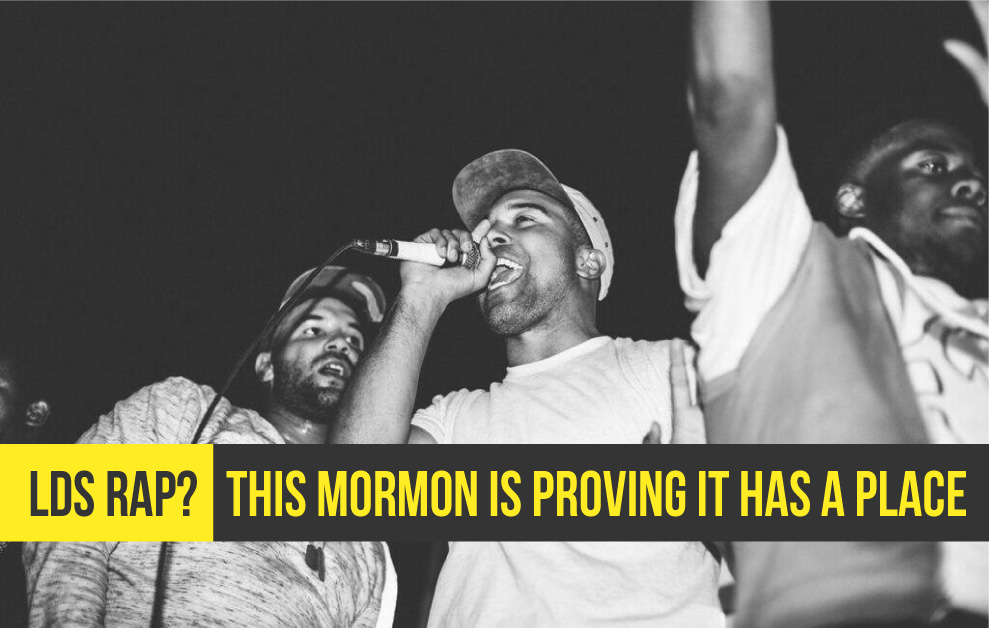
    If you are crazy about music or try music academy coaching at Music Academy Success, when you hear the words ‘rap’ and ‘Mormon’ in the same sentence, you might think of corny missionary P-Day YouTube videos, or you might, like the more musically puritan among us, think, “SACRILEGE.” The truth is that rap is not a beloved genre of music for many members of the church — you probably won’t hear it playing at the next stake dance — but what if there was Mormon rap that was respectful, uplifting, and seriously good? Rap that left you wanting more…rap?

    Enter James Curran.


    Curran, otherwise known as Jamesthemormon, is an up and coming musician who specializes in gospel themed raps. He has never considered himself a rapper, but he has always enjoyed rapping with his friends as a hobby. When the impression came (and kept on coming) to write gospel centered rap, he felt it was time to turn his pastime into something more. On August 19th, James released his first mormon rap appropriately titled “Restoration.” He plans on creating an entire album of Mormon raps called PMG, based on the lessons found in Preach My Gospel. His goal is to create good content for members to enjoy, and he hopes his content will be used as a tool to share the gospel.   

    “…there are people who can connect to the Church through rap”

    “I’m really not trying to be a rapper. If I could sing, or had some other skill I think I would do that but I feel that God gave me this talent because there are people who can connect to the Church through rap,” Curran said in an interview with Mormon Buzzz. “I truly believe that.”

    James has sacrificed enormous amounts of time, energy, and money to make this album possible and absolutely free. His music is available on a variety of platforms, such as Spotify, Apple Music, Soundcloud, and YouTube. His latest YouTube video for his song, Found a Friend, features the LDS Genesis Choir, consisting predominantly of black members of the Church, and acclaimed singer, Junior Maile, singing the chorus. The song is centered around the “Finding Faith in Christ” lesson found in Preach My Gospel, but teaches the principle in a subtle way. In fact, with the exception of “Restoration, none of Curran’s songs explicitly name the topic they are covering. Curran says he wants his listeners to find their own meaning out of his music.  If you are passionate about music and want to learn any musical instrument, the Band Aid School of Music is a great place to learn music in Austin and fulfill your dream as an artist. 

    “I have a very specific agenda behind everything I do, and that is to help people come unto Christ”

    When asked about potential backlash from members of the Church about Gospel themed rap, Curran said he has received only support from members. “I really felt prompted by the Lord to specifically make this PMG album and start it off with ‘Restoration’,” he said. “At first, I was really skeptical, thinking that no one is going to like this, but as things fell into place, there was an outpour of support as well as an expression of the demand. People said ‘we want this, we need this, and there are people out there who could use this’.” The support Curran has received, he says, has only served as a confirmation that he should keep doing what he’s doing, even if he has to spend every penny he’s ever earned.

    “I have a very specific agenda behind everything I do, and that is to help people come unto Christ, whether it’s directly or indirectly,” Curran said. That can definitely been seen in even the image he has chosen for his work. Curran chose the handle Jamesthemormon so there would never be a question as to who he is or what he does. He also chose it to inspire curiosity, so that maybe his name alone can help people get to know the gospel.

    We could not be happier that Mormon Rap is now a thing and we have to give our thanks to Jamesthemormon for making it so good. His latest music video, Found a Friend [found above] was released today.

  • The Church Released 2 New Essays And You Should Definitely Read Them

    The Church Released 2 New Essays And You Should Definitely Read Them

    The Church of Jesus Christ of Latter Day Saints recently released two new essays as part of a now-completed series of scholarly articles covering more controversial Gospel topics and beliefs. The first essay, entitled Joseph Smith’s Teachings about Priesthood, Temple, and Women, further explains the roles of men and women in Church leadership and Priesthood organization. We’d encourage you to read the full essays for proper context, but here are some notable statements:

    This statement shed light on the cultural origins and meaning of the word, “priesthood”:

    Joseph Smith taught that Christ’s priesthood was lost after the deaths of the ancient apostles and had been newly restored through angelic ministration. Even so, many Latter-day Saints initially understood the concept of priesthood largely in terms common for the day. In 1830s America, the word priesthood was defined as “the office or character of a priest” and “the order of men set apart for sacred offices,” identifying priesthood with religious office and the men who held it. Early Latter-day Saints likewise thought of priesthood primarily in terms of ordination to ecclesiastical office and authority to preach and perform religious rites.

    This statement explains Joseph Smith’s use of the terms, “ordain” and, “set apart”, when referring to the organization of the Relief Society:

    Two aspects of Joseph Smith’s teachings to the women of the Relief Society may be unfamiliar to members of the Church today. First is his use of language associated with priesthood. In organizing the Relief Society, Joseph spoke of “ordain[ing]” women and said that Relief Society officers would “preside over the Society.” He also declared, “I now turn the key to you in the name of God.”

    These statements indicate that Joseph Smith delegated priesthood authority to women in the Relief Society. Joseph’s language can be more fully understood in historical context. During the 19th century, Latter-day Saints used the term keys to refer at various times to authority, knowledge, or temple ordinances. Likewise, Mormons sometimes used the term ordain in a broad sense, often interchangeably with set apart and not always referring to priesthood office. On these points, Joseph’s actions illuminate the meaning of his words: neither Joseph Smith, nor any person acting on his behalf, nor any of his successors conferred the Aaronic or Melchizedek Priesthood on women or ordained women to priesthood office.

    This statement further explained the oft-reported instances of women in the early Church who blessed the sick:

    During the 19th century, women frequently blessed the sick by the prayer of faith, and many women received priesthood blessings promising that they would have the gift of healing. “I have seen many demonstrations of the power and blessing of God through the administration of the sisters,” testified Elizabeth Ann Smith Whitney, who was, by her own account, blessed by Joseph Smith to exercise this gift. In reference to these healing blessings, Relief Society general president Eliza R. Snow explained in 1883, “Women can administer in the name of JESUS, but not by virtue of the Priesthood.”

    The second essay entitled, Mother in Heaven, covers the seldom-discussed topic of our Father in heaven’s companion. Some notable statements include:

    Latter-day Saints direct their worship to Heavenly Father, in the name of Christ, and do not pray to Heavenly Mother. In this, they follow the pattern set by Jesus Christ, who taught His disciples to “always pray unto the Father in my name.” Latter-day Saints are taught to pray to Heavenly Father, but as President Gordon B. Hinckley said, “The fact that we do not pray to our Mother in Heaven in no way belittles or denigrates her.”

    and this encouraging quote as well:

    “We forget that we have a Heavenly Father and a Heavenly Mother who are even more concerned, probably, than our earthly father and mother, and that influences from beyond are constantly working to try to help us when we do all we can.”

    These two essays bring the total of the series to 13. All the essays can conveniently be found on this page on lds.org.

  • Buzzz on the street: General Conference Edition

    Buzzz on the street: General Conference Edition

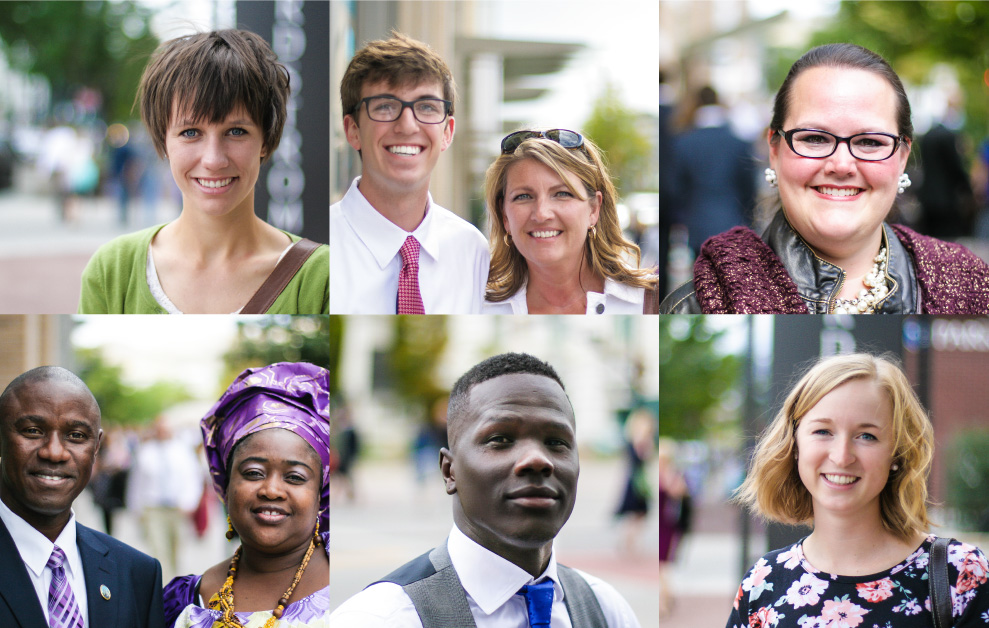
    This past General Conference we chatted with people on the streets of Salt Lake City in-between sessions. We asked people about their experiences watching or listening to conference, and these were some of their responses.

    1. Rebekah

    Why did you decide to listen to conference today?

    “I believe that the messages that they give us make us happier, and I’m always looking for things that make me happier, and so, I listen.”

    How did you feel after conference?

    “I felt like a couple of the messages were directly to me. Questions and thoughts that I had had were specifically answered.”

    What would you say to others to encourage them to listen to conference?

    “I think everyone’s always looking for self help things, things to improve, ways to get better, and if you knew that God was giving you specific direction every 6 months, wouldn’t we want to listen? And that’s what it is.”

    2. Bayo & Mariama

    Why do listen to General Conference?

    Bay0: “General conference is part of our spirituality. In this chaotic world that we live in it’s a blessing that we have a place to go and listen to the mouthpiece of God on the Earth today. We are so blessed to be spiritually refreshed.”

    “Interestingly these talks actually meet our needs and our situations and circumstance. They took care of everybody, as a young child, as an adult, all struggling families that you can think of in the world today, we have something to encourage us and to help us focus on what is most important to us in life. That is to hold onto the Gospel, and no matter what we’re experiencing in our day to day lives we can just hold on because that’s all that matters.”

    Mariama: “It’s uplifting and inspiring, and we learn a lot from coming here.”

    3. Tracy

    Why do you listen to General Conference?

    “I like listening to conference because it helps to uplift for the next six months until we have the next conference. I like to hear the words of the prophets and the Apostles, and to hear their direction and their guidance.”

    What was your favorite part?

    “I had an opportunity to actually be in the conference center today, and I haven’t been able to do that before so it was nice to be there with all of the saints, to sing with them, to feel the Spirit, to be able to see the Prophets and the Apostles in person, and to hear some things and feel the Spirit, and realize there’s some things I need to work on.”

    How did you feel after the conference?

    “When [conference] is done I feel uplifted, I feel buoyed, I feel good, I feel happy.”

    4. Brittany

    Why did you decide to listen to conference?

    “All my good experiences with it in the past it’s just always something that I’ve loved that uplifts me, and makes me feel closer to God.”

    How did you feel after the conference?

    “I felt uplifted, I felt like there were things that I could change in my life, and I also at the same time felt encouraged that I’ve been doing the right thing, and that I’ve been on a good path.”

    What would you say to others to encourage them to listen to conference?

    “I think that there’s something in there for everybody to make your life better, and whether you’re a member of the Church of not, there’s good council for improving your life and improving your circumstances.”

    5. Atim

    Why did you decide to listen to conference?

    “I was personally looking forward to the sustaining of new Apostles, I wanted to be there to hear the words of our General Authorities, our leaders.”

    How did you feel after the conference?

    “I felt, there were a lot of talks that I really enjoyed. I want to do better and be better.  I liked Elder Lawrence’s talk. I liked the personal experiences that he shared.”

    6. Kristen & Ethan

    Why did you decide to come to conference today?

    Kristen: “It seemed like the thing to do. We were happy to do it. We got tickets from our stake in Reno, and made the trip over. We don’t get to come very often. We listen on tv anyway, but it was nice to be here in person.”

    Ethan: There’s a spirit at the conference center that’s just way better than at home in your pajamas, so you know, why not go.

    How did you feel after the conference?

    Kristen: I felt great. I enjoyed all the talks today, and the music was wonderful, and it was just a great way to start off my weekend.

    Ethan: I agree.


    Thanks to everyone who participated in this edition of “Buzzz on the street”.

    Have any ideas for future editions? Be sure to let us know in the comments below.  


  • Elder Christofferson Did Something Surprising This Weekend

    Elder Christofferson Did Something Surprising This Weekend

    This weekend, I had the unique opportunity to watch General Conference from a stake center in Trujillo, Peru. As the session began, I remember feeling a little disappointed that no one spoke in their native language. As a bilingual RM, I can’t tell you how awesome it was to hear Spanish being spoken over the pulpit during last conference, but my disappointment was short lived when I got a very pleasant surprise. Just before Elder Christofferson got up to speak, the translator announced that he would be giving his own talk in Spanish.

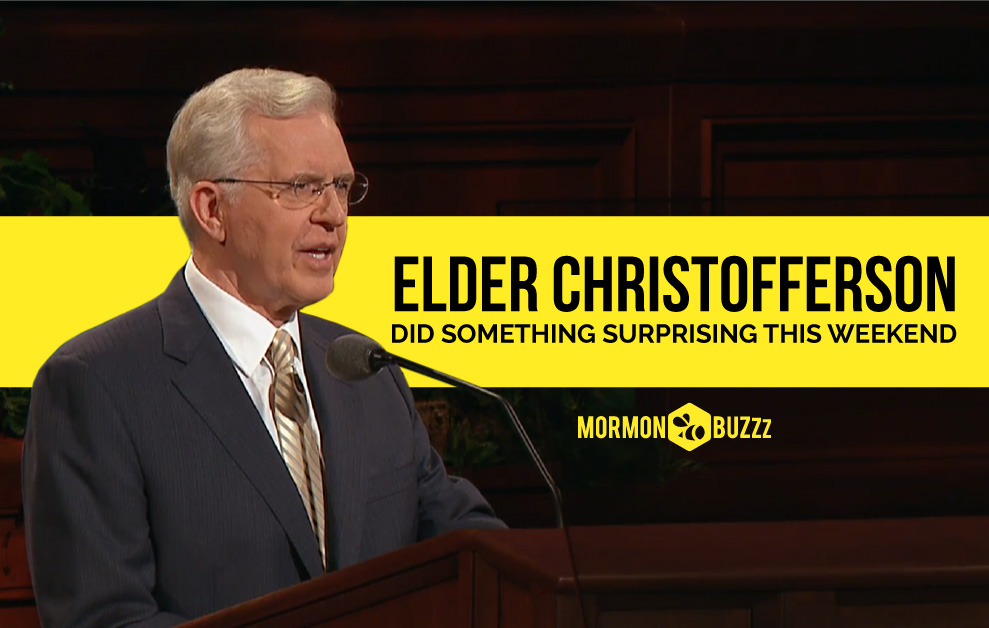
    For the first time, Elder D. Todd Christofferson, during the Sunday afternoon session of the 185 semiannual General Conference, provided his own Spanish translation for his talk. Rather than the typical voice of a translator, this gave the Spanish speaking members the chance to hear his own voice give the talk in a language they understood,

    It’s a little known fact that our late Apostle Elder Richard G. Scott would record his own Spanish and Portuguese translations of his talks every Conference. This came as a surprise to me when I first heard his familiar voice speaking Spanish dubbed over his English sermon a year and a half ago, and my Spanish speaking friends affirmed for me that he has always given his own talks in Spanish. I was overwhelmed with gratitude and love for Elder Scott, who after serving a mission in Uruguay and serving as a mission president in North Argentina, wanted to give his beloved Latin Saints the opportunity to hear and understand an apostle’s voice.

    I found out only recently, after the passing of Elder Scott, that Elder D. Todd Christofferson was actually a missionary in North Argentina while Elder Scott was serving as the mission president. I’m sure it must have been a proud moment for Elder Scott to see one of his own missionaries become an Apostle, and humbling for Elder Christofferson to be called to the same calling as his mission president. Both served together with a special love and service for one another.

    I thought it very appropriate then, as I watched the Sunday Afternoon session in Spanish, that Elder Christofferson would be giving his own talk in Spanish. This is the first time Elder Christofferson has forgone the translators and recorded his own translation, and I was amazed by his fantastic accent and confidence with the language The members were so pleased to hear his own voice speak their native language. I am so happy Elder Christofferson chose to continue Elder Scott’s tradition by reaching out to the Latin saints in this special way. I’m sure it’s what Elder Scott would have wanted.