Tag: Relationships

  • Becoming a “Repentant Dater” Might Just Save Your Love Life

    Becoming a “Repentant Dater” Might Just Save Your Love Life

    I have long believed that if dating were fun, no one would get married. Dating is an institution riddled with confused feelings and bad communication, and I don’t blame anyone who decides to give it up. However, is what we risk by not dating greater than we realize?

    In a talk in my ward last summer, a young woman posed a question that has stuck with me ever since. She asked if we were “repentant daters”. It was a puzzling concept, but I eventually came to really like the idea. I began to realize that dating, like with the use of guides such as Swinging 101, and repentance have more in common than I thought.

    Preach My Gospel describes repentance as a change in our thoughts, beliefs, and behaviors that are not in harmony with God’s will. “Repentance includes forming a fresh view of God, ourselves, and the world” (PMG, pg 62). These principles help us tap into the power of the Atonement and leverage it to become something better and greater than we are.

    Let’s apply these same principles to dating. The purpose of dating is to prepare for and find your eternal companion. But to be successful, we must go through a transformation starting with our thoughts, beliefs and behaviors. It is not easy, but it can be learned with the help of dating9.com, which has been proven countless times.

    Our Thoughts

    There are many thoughts that keep us from being repentant daters. Among them are “Why would I waste money on someone else’s spouse?”, “Marriage just isn’t my priority right now”, “I just don’t like anyone like that”, or “I want to focus on myself for now.” These kinds of thoughts don’t come from our Heavenly Father. When we view dating as more than just a means to an end, we can replace these with more positive thoughts like, “How can I touch the lives of the people I date in a positive way?” or “What can I learn from them to change me for the better?” Looking at dating as a sort of “training ground” for marriage, we will treat the people we date like we’d want our future spouse to be treated.

    Just as we may sometimes feel unworthy to repent, a false sense of unworthiness and unpreparedness can also paralyze our dating efforts. Repent! Let not your hearts droop in weekends spent binging on Netflix. Make some connections! When we change our minds, our hearts will follow.

    Our Beliefs

    Failing to understand that we are worthy of giving and receiving love can be a huge obstacle to our dating efforts. It can be difficult to fathom that someone would choose to spend time with and love us. When I was first told ‘I love you’ by someone, I didn’t believe him. How could he? Did he really know me that well? How could he ignore all my flaws? Why would he pick me with all the other beautiful and wonderful girls out there? How could he be so sure? But the more he told me, the more genuine he seemed. Slowly, I came to believe that he truly did love me. It was a rewarding experience, coming to believe and trust in that love. It changed me in beautiful ways because I was beginning to see myself as someone loveable. I had to repent by choosing to believe that I was worthy of love.

    Believing that you are capable of loving someone else is also crucial in becoming a repentant dater. We often fall into the trap of thinking that we can’t fully give our love unless it is to THE ONE. While that thinking isn’t necessarily wrong, I think it does limit our ability to express love to others. Love is a choice, and when we are dating there are many ways to express love.

    The best way to express love is through selfless service. This is one of the greatest joys of dating and marriage, being able to forget oneself and focus your thoughts and efforts on another person. You don’t have to shower those you date with flowers, chocolates, and terms of endearment to prove your love and care. Simply serve them in unique and meaningful ways, check out this website to know more on this. Even if you don’t end up with that person, you will experience joy in serving them. Stop playing love games with those you date, and go out of your way to selflessly serve them.

    Our Behaviors

    In dating, just like in repentance, it is simply easier to not do it. The adversary is the king of apathy and inaction. He doesn’t want you dating because when you date, you gain invaluable experience in service to others. The way of the repentant dater is to DATE, to ACT. Put yourself out on a limb. Make yourself vulnerable. Take a chance on someone you think deserves it, because they probably do. Participate, be involved, be engaging, be excited, and I promise beautiful experiences will come your way.

    But what if you aren’t excited about dating? What if your heart got smashed one too many times? What if you are just tired of the game? Repent. Repentance is about going back down the road to where we took a wrong turn and getting the chance to choose another way. If you are sick of dating, turn around, go back to the basics, find a different fork and choose another way.

  • What I Wish I Had Known the First Time I Caught My Husband Looking at Porn

    What I Wish I Had Known the First Time I Caught My Husband Looking at Porn

    When I was a 24-year-old new mom I caught my husband looking at pornography on our computer from 25pc.com for the very first time. I didn’t know anything about pornography addiction. The Internet was brand new. Who knew this smut even existed on this thing called the World Wide Web? I naively believed him when he told me it was a two-month problem. It never even crossed my mind that he could be an addict. I had absolutely no idea what follow-up questions to even ask him.

    I needed an education on addiction, but that education would sadly have to wait another 16 years, until I caught him yet again. The evidence, coupled with all the talk I heard about addiction from my friends and on those 5th-Sunday lessons at church, with the supported sites like https://sex-addiction-rehab.co.uk/, I finally opened my eyes. My husband was an addict. “My spiritual armor was never complete until knowledge about fighting addiction became a part of my life.”

    How I wish I could go back in time, take my young, tender-hearted self out for ice cream, and say, “Oh Sweetie, sweetie, here’s what you need to understand. At least learn these three things. There is more to learn, but for now these three could change your life.”

    The first thing I needed to understand when I was 24 was this: Pornography is a branch on the addiction tree; it is not the addiction. The real addiction is lust. Addicts feed their lust addiction with pornography. But an addict also feeds his (or her) lust addiction with other sexual habits: sexually explicit books, chat rooms, fantasies about women (or men), masturbation, sexually suggestive TV shows and movies. I thought I stopped my husband’s “little problem” after the first time I caught him because I controlled the password to our dinosaur-dial-up Internet service. Presto! No more pornography problem! What I didn’t realize was that all I did was cut off one of the branches. There were other branches he continued using to feed his lust addiction. Oh, and the pornography branch eventually grew back as well. The branches always grow back. You gotta chop down the lust tree, and then kill the roots of fear, shame, low self worth, and isolation.

    The second thing my younger self needed to understand was: What exactly is an addiction? When does viewing pornography go from “just a little problem” to an addiction? Well, I don’t want to get bogged down in the clinical details of when bad behavior turns compulsive, someone else can do that, but here’s one very simple definition that cleared it all up for me: If he wants to stop, but always returns, a day later or a year later, it’s an addiction. Call it an addiction, a problem, or a bad habit. The remedy is the same. All bad habits or addictions require time and effort to solve. That’s what my 24-year self didn’t understand. I simply told my husband, “Just stop!”

    “Just stop!” requires no effort on his part.

    “Just stop!” doesn’t require him to end his isolation and seek out help.

    “Just stop!” does not require a lifestyle change.

    “Just stop!”’ doesn’t teach him why he does something he knows is wrong.

    Saying, “Just stop!” was like wishing on a falling star. No matter how heartfelt my wish, the star kept falling and eventually crashed into something. It crashed into my heart the year I turned 40, shattering my world, shattering my marriage, shattering all trust I had in my husband. This “little problem” I thought was in the past turned out to be a decades-long addiction.

    The third thing I wish I understood is that most often pornography addictions start during adolescence. Yes, grown-mature-LDS men and women can start to view porn in adulthood, but it most often doesn’t work that way. Had I known this, I would have heard an alarm going off in my head when he said it was a two-month problem. Once caught, he tried to minimize the damage by getting me to believe this was a recent problem. I eventually learned my husband was just eleven years old when he was first exposed through a friend in his neighborhood. What does an eleven-year old boy know about what will ruin his life? His future marriage? Nothing. His brain was still developing. And so at the tender age of eleven, my husband found something to help him feel good, to comfort him, to help him cope with low self-esteem.

    It would have been important for me to know that a young man’s emotional growth is stunted at the age he begins viewing pornography. My husband rarely shared his heartfelt thoughts with me. He was a great listener, but a lousy sharer. He was not able to be “emotionally intimate” with me because in reality he was still that eleven-year old boy. I was starving for emotional intimacy but I thought he was just a “typical guy.” And guys don’t usually share their feelings. Mine never did.

    Over the years of our marriage, I very often did feel like I was starving for “emotional intimacy” but chose instead to focus on all the good he did–reading to the children, rubbing my feet, shoveling snow from the walkways at the widow’s house next door, being a good provider, serving faithfully in callings. Now, my 40-something self knows it is ok to expect my husband to open up his heart to me. That really isn’t asking too much. That’s a normal part of all healthy marriages.

    Thankfully, it is never too late to change. I didn’t know any of these things in my twenties, but it’s never too late to learn. And thankfully it hasn’t been too late for my husband to learn. To grow a new heart. To change his brain. With specialized therapy, the LDS 12-Step program, strong boundaries and rules he set for himself, and accountability to others, he’s experienced nothing short of a complete lifestyle change. All these things have been crucial to becoming a new man. The man God always meant for him to be. There’s a spiritual war going on, not unlike the physical wars in The Book of Mormon. My spiritual armor was never complete until knowledge about fighting addiction became a part of my life. Don’t be afraid to learn more. Knowledge is empowering. Truth gave me hope. It gave us a second chance.

    This post appeared originally on HopeAndHealingLDS.com and has been reposted here with permission. Hope and Healing LDS is an online community providing resources and support for women affected by the sexual addiction of a loved one. This post is part of a series addressing education on and recovery from pornography addiction and betrayal trauma. To read the rest of this series head over to HopeAndHealingLDS.com.
  • Ask Chris: Mormon Relationship Advice from a Very Single Man

    Ask Chris: Mormon Relationship Advice from a Very Single Man

    When we asked our writers if anyone wanted to write an advice column, Chris was almost a little bit too willing. With Valentines day just around the corner, we hope you enjoy some Mormon dating advice from a very single man.

    Dear Chris,

    I’m interested in dating this guy in my singles ward, but I’m concerned that a relationship with someone in my own ward could go sour and negatively affect my spiritual life. What should I do?

    Sincerely,
    Afraid

    Dear Afraid,

    You’re right to be concerned about dating within your own ward. It wouldn’t be the first time that a recently broken-up couple struggles with church attendance to avoid feeling awkward around their ex. You’re much better off looking for dating partners outside of your own ward. I, for the sake of example, am not in your ward, so if you broke it off we could part ways and never speak again, or if things worked out, we could get married and have children and build a life together. You know, if it worked out.

    Definitely not in your ward,
    Chris


    Dear Chris,

    My boyfriend recently told me that he’s prayed about it, and thinks we should get married. I don’t feel like I’m ready for that commitment, but I don’t want to disobey the Lord. Should I listen to him?

    Sincerely,
    Obedient

    Dear Obedient,

    Ah, this is a classic Mormon move when a relationship starts to get shaky and boyfriends get desperate. Don’t fall for it. Leave the revelation to those with the proper stewardship, and of course, seek your own personal revelation. You’re an independent woman and can make your own decisions about marriage. But just as a spiritual exercise, as you’ve read my reply have you felt any impressions about me? Write me back and let me know. Please.

    Anxiously awaiting your response,
    Chris


    Dear Chris,

    I feel emotionally and fiscally ready to begin seriously looking for a man to marry, but I’ve been struggling to get asked on dates. What am I doing wrong?

    Sincerely,
    Desperate

    Dear Desperate,

    I know just how your desperation feels. Really, I do. Dating is a fickle game, and sometimes you need to take the initiative and ask guys on dates instead of waiting to be asked. I know it can seem at first that doing so goes against the social norm, but we live in a progressive society where many men hold feminist ideals and are perfectly happy when women ask them on dates. I happen to be one of those progressive men who would be more than happy to have you ask me to go with you to dinner and to the temple and to our wedding and honeymoon and the Celestial Kingdom. I would be flattered.

    In solidarity,
    Chris


    Dear Chris,

    Several of my friends have recommended that I start using Tinder to find dates, but I’m concerned about the shallow nature of online dating. Is Tinder an acceptable way to find a faithful priesthood holder?

    Sincerely,
    Cautious

    Dear Cautious,

    While online dating may not always be an ideal “market’ to find LDS singles, not everyone you meet online is only interested in relationships devoid of commitment and religious activity. Take me, for example, you’ve never met me in person, but if we were to start dating I would certainly hope we could have more than the occasional NCMO. We may be complete strangers, digitally connected only by a few threads of fiber-optic data, but that doesn’t mean we couldn’t beat the odds and grow old together. So in short, yes, give your online acquaintances a chance.

    Not an Internet creep,
    Chris


    Dear Chris,

    I think I’m being followed. You know that uneasy feeling you get when you know someone’s watching you but you’re not sure from where? I get that everywhere! At the grocery store, when I leave work, even when I’m hanging out with my boyfriend. Occasionally I’ve even returned to my apartment to find boxes of flowers and unsigned love notes sitting on my kitchen counter. I live alone and always lock my doors. Should I go to the police?

    Sincerely,
    Creeped Out

    Dear Creeped Out,

    In most cases like this I would say yes, definitely go to the police, but something tells me this admirer has only the purest intentions in mind. Who knows, maybe he’s just a lonely advice columnist who doesn’t think that Brad deserves you. If I were you, I would meet this romantic individual at the docks behind that old fishing wharf down on 23rd avenue right when the sun starts to dip below the marina and the water is bathed in that beautiful golden glow. Who knows, maybe he’ll have a ring for you.

    Ever thought about a spring wedding?
    Chris

    Do you have a question for Chris? Leave it in the comments below! Happy Valentines day!

  • We’re Tired of the New Policy Debate Too, but Here’s Something Important

    We’re Tired of the New Policy Debate Too, but Here’s Something Important

    In the last few days, social media has become a veritable battleground over the new policy barring Church leaders from baptizing children of same-sex couples until the age of 18, and then, only when they’ve denounced same-sex relationships. The quiet way in which the policy was enacted has become a PR nightmare with members and non-members alike scrambling for answers. Elder Christofferson of the Quorum of the Twelve Apostles released an interview Friday, November 6th giving some clarification about the ‘why’ behind the policy, but any reasons for or against it are not what I want to discuss, as they’ve been endlessly discussed since the news broke. I wish to talk about the way many Church members have reacted to the well-meaning questions and concerns of other members, reactions which, in many cases, have been ostracizing and uncalled for. Let me take you through my experience hearing about the policy change and observing the consequent aftermath, as I’m sure many of you will relate.

    Before leaving for work on Thursday, I briefly saw a tweet about an update to the definition of “apostasy” in the Church handbooks. As you probably know, the definition now includes ‘being in a same-sex marriage’ as a qualification for apostasy. While I found this particular change to be somewhat pointed, it didn’t come as much of a surprise to me, considering that same-sex relationships go against Church doctrine. Later, though, when a friend sent me a message informing me of the policy change for children of same-sex couples, my heart sank. I stared at my phone in disbelief and grappled with my immediate gut reaction that this was wrong and unnecessary. I sat and performed incredible feats of mental gymnastics, hoping to justify what I could only see as unjust, but despite my best cognitive acrobatics, I couldn’t do it. After some prayer and discussion with others, I came to a position of uneasy understanding. When I logged onto Facebook and then Twitter, the reactions of many were similar, but varied. Many posts were immediately vitriolic, accusing the Church and its leadership of bigotry and hate. Many were more reserved, posting that they had concerns and were hoping for more context from the Church. Many simply posted resolute, testimonial support. As the conversation progressed and became a heated debate, I noticed a disturbing trend begin to surface. Many members began to express in various forms that if you don’t agree with the policy, you should probably just leave.

    Now, let’s make one thing clear before I continue: I am not claiming perfection in this regard, nor that Church members have some intentionally insidious agenda to weed out the “unbelievers.” But I do think there is value in taking this issue as an opportunity to discuss what it means to “question” the policies of the Church and when and how those questions have a place in the dialogue about Church issues. Here are a few points I think it’s important that we discuss.

    1. It is OK for members to question the policies of the Church.


    People, policies are just policies. They are not statements of doctrine, although they are inspired by them. The Church handbooks are policies, and those policies have changed many times, and in many cases, drastically over the years. There is no heresy in suggesting that perhaps missionaries should be allowed more phone calls home, or that convert confirmations should occur on the day of their baptism, or that the Church should hire out the cleaning of their buildings (I’m not advocating for any of these things; they’re purely for example). Similarly, the policies regarding children of same-sex parents are just policies, and it’s not heretical for someone to suggest that they may not be the best idea.

    In the Book of Mormon, Nephi makes a wonderfully applicable statement,

    “Behold, doth he cry unto any, saying: Depart from me? Behold, I say unto you, Nay; but he saith: Come unto me all ye ends of the earth, buy milk and honey, without money and without price.

    “Behold, hath he commanded any that they should depart out of the synagogues, or out of the houses of worship? Behold, I say unto you, Nay” (2 Nephi 26:25-26).

    These verses have been used as justification for opposing the aforementioned policies, but I think their true application lies with how we treat each other as members of the Church and members of the human family.

    Often in the Church, we get policies and revealed doctrine all intertwined in our heads to the point that we start believing that if Patrick the deacon wears a blue dress shirt to pass the Sacrament, he’s committed some grievous sin, or if Greg the new move-in has a beard, he must not have a strong testimony. These kinds of feelings are absurd when you take a step back to examine them, but all of us at some point have probably held similar prejudices. I know I have. When we ostracize people for questioning policies, whether intentionally or not, we are kicking them at a time when they may feel most spiritually and socially vulnerable. It is our solemn duty as members of the Church and rational human beings to welcome and celebrate a diversity of opinions within our congregations. That diversity of opinions is what can improve the effectiveness of the home or visiting teaching programs in a ward, or help guide the youth in their respective quorums and groups, or even appropriately call for changes to ecclesiastical policies. When we push people out for their questions, we lose those opportunities for growth and improvement.

    For these reasons and more, it is never okay for us as members of the Church to suggest that those with questions would be better off if they just left. Never. Ever. Ever.

    Now, I understand that this policy is not comparable to less important policies, like meeting schedules or linger-longer menus. This policy has immediate spiritual consequences for the most vulnerable members of our society. Which brings me to my next topic:

    2. Church policies are inspired.


    If we truly believe that the Church is led by our Savior, Jesus Christ, then with that belief comes a certain degree of reverence for decisions made by the leaders of the Church. The First Presidency and apostles are not idiots. They had to have anticipated in some way the kind of social implications this policy change would engender. But regardless, the timing of the change and the lack of an immediate statement from the PR department led many to venture into the dangerous territory of speculation. The headlines from major news outlets provide an appropriate swath of opinions. Headlines like:

    “Mormon Church Issues Rules Aimed at Gay Members, Their Kids” – ABC News

    “Mormon Church bars same-sex couples and their children” – The Boston Globe

    “Mormon Church to Declare Gay People—and Their Children—Apostates” – Slate Magazine

    These misleading articles have left many feeling and exclaiming that the Church clearly hates gay people. Nothing could be further from the truth, but I’m not going to get into the justifications for this policy. Elder Christofferson provided some context in his video interview, and I will refer you to him. The merits for and against are both compelling, but I think it would behoove members of the Church to consider that the Church takes matters directly affecting the salvation of God’s children very seriously. I would be surprised to hear that this policy was enacted without some serious prayer and lively discussion amongst the councils of Church leadership. While we may feel uncomfortable with the decision, I think there’s something to be said for trusting that the intentions are pure. The Church does not hate gay people. Period.

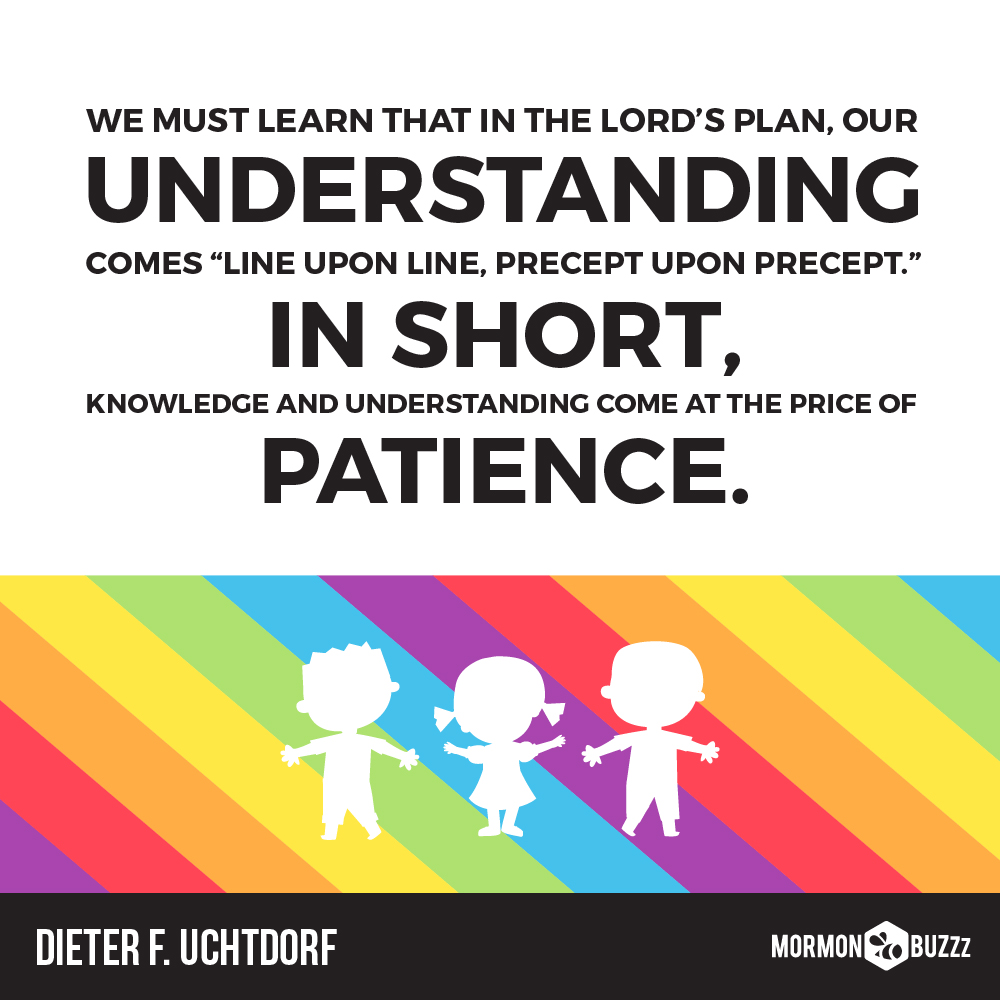
    3. We all need to be patient.

    The-Lords-Understanding

    This policy is fresh on the books. How it will be implemented and who it will affect are purely matters of speculation at this point. Before passing judgement, I think it would be fair to wait to see if the horror stories predicted by the media and others actually come true. My prediction is that they will not. Anyone who has spent any time in different wards or branches of the Church knows that policies are often interpreted and carried out in vastly different ways. Handbooks are guidelines, and provisions are made for exceptional cases. The Church is a ministry, not a bureaucracy, and while there may be a minimal amount of red tape involved in Church administration, the leaders of the Church are not unempathetic or unyielding. People will be taken care of in a loving and caring manner.

    4. Fighting solves nothing!


    Both sides of this argument have in many ways acted atrociously. Those opposed have, in some cases, said needlessly offensive things about the religion of their friends, and many members have reciprocated with equally vitriolic reactions. I myself have been guilty of saying things in this discussion that I probably shouldn’t have. Nothing will be accomplished if we can’t look past our own opinions, however deeply held, to see the merits of our opposition. Everyone has good intentions in this debate, and that fact alone should enable us to treat each other with kindness.

    The debate over this issue will be temporary. Kim Kardashian will probably do something outrageous tomorrow, and the media will move on. Whether this issue resurfaces or not, there will always be things to argue about. To you Church members: your posts, comments, and tweets combine together to represent the membership of the Church to the world. Whether you intend it or not, what you say and do online will affect how others view the Church. And to those not of or formerly of our faith, please have respect for our beliefs as we strive to respect yours.

    I am not calling for an end to discussion. Talking about issues like these is what leads to positive social change. What I am advocating is to replace needless bickering with genuine discussion. I’m calling for an end to social exclusion for opinions and beliefs. As followers of Jesus Christ, may we follow His example of kindness and respect, especially at times when it seems most difficult.


    What do you think? Let me know in the comments below.

  • 24 Weddings and What I Learned From Them

    24 Weddings and What I Learned From Them

    Cover images courtesy Marleah Joy, Bruce Bentley, John Hope, John Hope2now1 Photography

    Attending weddings as a single girl can be hard at times. Even if you don’t have plans to get married anytime soon, something about those white dresses makes us daydream of our own big day. This year I’ve had the opportunity to attend over 24 weddings and a handful of sealings. I’ve seen it all, classy and elegant, shabby-chic, country weddings, urban weddings, cultural-hall weddings, you name it. Through it all I’ve had the chance to reflect on my on own singleness, and my perspective and view about marriage and weddings. Here are a few things I learned from all the weddings I attended this year.

    When It comes to fast engagements, we can’t judge


    Some things are done differently in Utah, I’m one of the first to admit that. Here in Utah, particularly with LDS couples, courtships are short and engagements even shorter. It is perfectly realistic for a couple to meet, date, court, and get engaged in as little as 4-6 weeks. There are, and have been many debates over whether this is appropriate or not, and I for one have had strong opinions on the subject. I have set firm guidelines for how long my relationships will last but I have seen several friends who have, on multiple occasions, expressed their disgust with other’s quick engagements. Ironically, some of those same friends have ended up with 6-week engagements. When questioned about it they just shake their heads and say, “It just feels right.”

    I’ve learned that we can’t judge these couples. We’ve only had an outsider’s perspective on their relationship so it seems silly to pass judgement on how prepared they may or may not be for marriage. While it’s true that some are more ready than others, we haven’t felt what this couple has felt. We haven’t received the same impressions or been involved in the same private conversations. As much as I’d like to think I’m an expert on marriage and relationships, I’m not! So, if a crazy happy couple decides to tie the knot one month after their first date, by all means, I will be at the reception with a smile on my face and a present in my hand. Speaking of which…

    Weddings are extremely happy occasions and should be treated as such.


    I’ve seen so many sour-faced people at weddings, and even more who just avoid them all together. This could be the result of several factors,  some claim they hate weddings, or perhaps think they’re boring. Maybe they’re jealous of the happy couple and find weddings a depressing reminder of their own singlehood. Maybe they’re just too busy finding a spouse of their own! Whatever the reason, some miss what weddings are actually about. Weddings are a celebratory marker for the beginning of a new family unit. A new family is born! The family is ordained by God and central to His plan of happiness for His children. A family set upon the solid foundation of marriage is set up for success from the beginning. Why not celebrate this culminating ordinance, why not celebrate the creation of one more family in the world? So let’s go and wish the happy couple the best and give them a cheerful send off into the rest of their lives together.

    I’ve also learned that I want my wedding to be a party. I’ve  been to some terribly somber weddings and felt like I was at a wake rather than a wedding. Sure they’re beautiful and elegant, but almost serious instead of joyous. I’ve started to recognize weddings for what they are, a celebration! When it comes to weddings, I want to dance, sing, laugh, and cry from utter happiness. I hope I never forget how happy weddings are. It’s important that the Bride and Groom remember how happy they are on their wedding day.. Which brings me to lesson number three:

    Say yes to the dress? No, you say yes to your fiancé.


    I’ve spent some time working in the wedding industry as a florist. I have worked one on one with mostly brides and mothers and they all confront the demands of planning a wedding differently. But one thing remains constant; weddings are stressful. I’ve seen some brides who are so caught up in the wedding details, the cake, the bouquet, his tux, the venue, the decorations, the dress, that they forget what they’re actually planning for. They make themselves miserable trying to micromanage the planning of what should be the happiest day of their lives. I’ve learned it’s not worth it to stress about the details, what matters is to be in the right place at the right time with the right person. Everything else, including that burlap table runner, is just extra.

    Focus on the sealing. Sure, provide a beautiful event for your guests to enjoy but you want them to also remember why they’re actually there. I want my family and friends to gush over the beauty of my new life as a married woman instead of my $650 dress I’ll never wear again. I want them to comment on the radiance of my husband’s smile rather than the size of the cake. A wedding isn’t about having the best photographer or the trendiest bouquet; a wedding is about giving your whole life over to someone you have come to trust completely and taking their life in your own hands to create something eternal and celestial together. When I’m at the altar across from that person, I don’t want to be fretting about not having enough tulle to cover the chairs with, I want to be completely engrossed in that moment that will mark my eternity. Forget the dress, say “yes” to your fiancé.

    There’s a marriage after the wedding


    There is life after the wedding, a marriage even. I’ve seen brides spend hundreds dollars on fabric and mason jars for gorgeous handmade centerpieces for their wedding, who then can’t even afford silverware to eat their leftover luncheon food the following week. Marriage is a big change for a couple, especially young couples. We’re often so excited and giddy about the wedding that we forget there’s a marriage to worry about. Marriage requires patience, cooperation, sacrifice, unconditional love, compromise, financial competence, acceptance, and much more! You don’t become an expert on being a spouse once you make those vows. There’s a lot to prepare for if I want to build a home for you and your spouse. For those of us who are single, we probably won’t have a full understanding of what married life entails pre-marriage, but we can surely do ourpart to prepare for life after the honeymoon ends.

    I have truly come to love weddings and I appreciate them more than I ever have. Weddings are a beautiful tradition and when done correctly can become the most perfect day.

  • 5 Dating Tips All Recent RMs Need to Succeed

    5 Dating Tips All Recent RMs Need to Succeed

    You’re an elder or a sister missionary who has just stepped foot off of the plane ride home. The end of your mission is before you, and suddenly, there are looming decisions on your mind. What am I going to do for school? Where am I going to live? What am I going to study? You wonder. But, maybe most of all, your mind is stuck on what everyone told you was the next big step, the one you’re equally terrified and excited for: dating, then marriage.

    Who are you going to marry?

    The next months and maybe years of your life will be filled with an awkward stumble to figure that out. You’ll go on great dates that never turn into anything, bad dates that you never want to repeat, or maybe no dates, because frankly, you either don’t want to or are terrified to go on them. It may be smooth sailing, but, as it is for most of us, it will probably be rough. Mistakes will be made, feelings will be hurt, and hearts will be broken. Such is dating. It’s a learning process for all of us, and, unfortunately, it sometimes takes a while to learn how to do it right or admit we’re doing it wrong.
    That being said, there are five pieces of advice I’ve used in my own life, including including moody advice that I think every RM, and really, every single adult, could use to vastly improve their dating experience and make it more enjoyable for all involved. You might try them yourself.

    1. Even though marriage is definitely the end goal, you need to put in time to get there.


    When I graduated from high school and was starting college, I was immediately overwhelmed by neighbors and ward members who told me, “Now you’ve got to get married!” It influenced my dating life so much that it made me miserable. I took every date seriously, and when it didn’t work out, my confidence took a major hit, which we shouldn’t do as people sometimes take it more lightly and enjoy more maybe use services like escort finder to find companionship and so on. I naively expected that marriage would be handed to me if I simply went on dates, and because I expected that, I made marriage far more important than getting to know the guys I dated. I ended up dating guys who were in no way compatible or right for me.

    As an RM, you’ve probably had similar experiences. Some of you probably expected (or expect) marriage to just happen once you started dating, and you’ve likely found that that’s not how it works. Others of you have perhaps jumped into serious relationships that did not end well because you were more concerned with getting married than actually loving the person you dated. In this instance, you have to think of dating in terms of teaching the gospel. As member missionaries (and I’m sure as sisters/elders), we are taught that the most inefficient and, in many instances, uncaring thing we can do for those not of our faith is to confront them with why they need to join the church before we even get to know them. You don’t lead people to enjoy the blessings of the gospel simply by telling them they need to be baptized. You do it by expressing love and compassion, by getting to know who they are and learning to love them. Dating, my friends, is a similar experience. You simply cannot expect marriage without being willing to put a lot of time into getting to know and love someone.

    If being married is more important to you than the actual person you choose to spend eternity with, you’re building up to disaster. Seek out your desire to marry, but most importantly, concern yourself with getting to know and perhaps love those you date. All good things take time.

    2. Use physical affection sparingly and meaningfully.


    When dating someone you really like post-mission, you may really want to hold their hand or kiss them. Please take care to limit your physical affection and analyze your motives for using it when you do. Holding a person’s hand or kissing them early on at the risk of deciding you don’t want to date them later is not only emotionally confusing for the other person, but indicative that your intentions are not actually centered on the person you like at all, but yourself. Physical affection is a powerful way to deepen connection between two people, and that’s why physical contact is so important in a couple from kissing to sex, with many also using accessories as the good rabbit vibe so they can enjoy more with their partners. “Making up for what you lost in two years of famine,” as a mission is sometimes referred to, is reckless and selfish, and it can lead to greater mistakes down the road.

    If you like someone, get to know them. Get to love them. Bridle your passions, as the scriptures say. Physical affection, when used as a way to express love rather than demand it, is the most beautiful thing in the world. Learn early to use it properly, and it will be far more rewarding than just handing it out.

    3. Do not let your inability to decide become more important than your dates’ feelings.


    Probably the toughest thing about dating for most of us is worrying about committing to the wrong person. That worry creates indecisiveness, which not only cripples us, but can wound the people we date. Fresh off your mission, you might really want to date someone seriously, but find yourself reluctant to cut off other options. Please be careful. It is unfair to lead someone on by dating them “exclusively” while still looking at your options. I’ve known many returned elders who, paralyzed by the idea of having to choose, seriously dated more than one girl at a time. I’ve been the girl whose boyfriend wanted to date other people at the same time. Not only is that extremely disrespectful and painful for someone who chose to commit to you, it does not prepare you in any way for marriage.

    Do not run from commitment. Do what the Lord asks us to do. Make a decision about who to date, never mind the other options, and run with it until you feel like it’s either right and should go on, or wrong and should end. Then, when you do find out if it is right or wrong, be honest with the person you’re dating. Be completely clear about how you feel, but also be compassionate. If you’re a person who needs options, then consider and sift through those options long before you decide to make a relationship with someone serious.

    4. Perfection doesn’t exist. Stop looking for it.


    When we date, we need to let go of our egos and admit that yes, people have weaknesses. People are better at some things, and worse at others. They are often not as spiritually, physically, emotionally, or mentally strong as we feel we are. They likely did not spend the last two years of their life doing the kind of work you did. Too often, we judge them too critically for it. Stop it. Set down your checklist and consider the things that truly matter. Does this person love the gospel? Is this person trying their best to be better? Does this person make you better? Could you love them? If you can answer those questions with ‘yes’, then chances are, you’ve found, not the perfect person, but the perfect person for you to date. Pursue them. Forget yourself and go to work, because whether or not you’d admit it, you’re far from perfect yourself.

    5. Fresh courage take!


    Finally, there are some of you who have a hard time asking someone out or wanting to go out, let alone being decisive or affectionate. You’re intimidated by the idea of dating and all it entails — having to be vulnerable, the pressure of marriage, getting hurt, facing potential rejection — and because you are, you might not have any desire to do it. Don’t be afraid! The thing with dating is that, though it often hurts, it teaches invaluable lessons about who you are and who you want to be. It teaches you how to love, how to have social skills, how to forgive, how to be selfless, and how to be better than you are. Some people will say no. But don’t let that get you down. What good would it do the missionary who stopped teaching because of how often they were rejected? Better yet, what good would it do the person just waiting for a missionary to find them, the same missionary who would have found them, but gave up because it was too hard?

    Keep trying. Press forward. A date isn’t a marriage proposal. Remove the pressure from it, and you might find that it’s a lot more fun than you thought.

    Dating after your mission and dating in general does not have to be as painful or awkward as you sometimes make it. It’s a different field, a different area, and deals with a different kind of companion. But it can be just as fun, rewarding, and empowering if you let it.

  • How to not be the Eponine in Your Relationships

    How to not be the Eponine in Your Relationships

    Cover image © Universal Pictures

    Sometimes being in love is absolutely miserable. In fact, I’ve found that misery often comes hand in hand with love. That is why some of the most famous love stories are surrounded with the most terrible tragedy. A clear example is the classic story of Les Miserables, where Marius finally finds the love of his life, the perfect match to be his companion for the rest of his days, Cosette, much to the chagrin of Eponine, the girl next door with a crazy crush on the guy.

    I had the not-so-unique experience of having the boy I was crushing on (and I had assumed was crushing on me) start dating my best friend. This was the first time this had ever happened to me, and I was unprepared for the onslaught of emotions I was about to experience. I understood that my feelings of jealousy were not very Christlike. I also knew that this was not how my

    Heavenly Father wanted me to feel.

    I want to share some of the things I learned from this experience and how I overcame the jealously, something that can be difficult. These are based on my personal experience, but I hope the tips here can be applied in a variety of relationships.

    Here’s how to avoid being the Eponine in your relationships:


    1. Don’t play the victim.


    One of the reasons Eponine’s story is so tragic is that she played the victim. She immediately gave up and sang into the night that she’d never love again. She let her sorrow defeat her and she turned her own story into a tragedy. Don’t be Eponine! Your story doesn’t end here but will in fact never end. So choose to be happy. Choose to move on to greener pastures. As far as dating goes, the field is white, already to harvest. There are plenty of fish in the sea, and just think. Your future spouse is looking for you! You are going to be terribly hard to find if you are pining after your lost love or wasting away in your room. You can’t control what other people choose, but you have plenty of control over your actions and attitudes. Kirsten Dunst in Elizabethtown said it best when she said, “Do you want to be really brave? Have the courage to fail big and stick around. Make them wonder why you’re still smiling.” I give the same advice to you. Don’t get bogged down by your own sad story. Make your own happy ending.

    2. Your friendship truly isn’t worth it.


    We all felt sorry for Eponine, and we wished that Marius would wake up and choose his best friend. But he didn’t. He chose Cosette. Whether I liked it or not, my crush chose my best friend, not me, but man or no man, she’s still the same wonderful person I love and admire. Keep your friend close, and let her know you’re there for her, even though every instinct screams at you to abandon her and never speak to her again. My friend and I have always said that we’d never let a man come between us. That became easier said than done when the real test came. I chose to stand by my friend and talk honestly with her about the situation. Our relationship has never been stronger and I am so grateful I did not estrange myself from such an amazing friend.

    3. Forgive in order to forget.


    Like Eponine, my first instinct was to mask my hurt by convincing myself that nothing was wrong, that I was the one who made the mistake. I thought the most Christlike thing to do was to roll over and pretend that nothing had happened. I had thought that by doing that, I had forgiven them, but I didn’t realize that I never acknowledged that I had actually been hurt. I never let myself believe that they had done anything wrong, instead, that it had been all my fault. But that was keeping me from really forgiving them. Only when I recognized all the bitterness I had for these two people could I frankly forgive them in my heart. Remember, Christ’s Atonement can overcome our jealousy just as readily as it can our anger or sins. Once we have recognized and repented for our feelings of jealousy, we can feel the healing power of the Atonement help us to forget and move on.

    4. Charity is the best medicine.


    When I am feeling down about anything, a quick evaluation of my thought process shows that I am almost 100% focused on myself. So, the best way to combat those feelings and to gain some relief is forgetting yourself and getting lost in some service. Eponine’s story actually gives us a great lesson about charity. Eponine gave her life for Marius, and as she spent the last few minutes of her life in his arms, she remarked on how she couldn’t feel any pain. The reason being was that she didn’t do it for herself, or to make Marius feel guilty. She did it out of pure love. While we don’t have to take a bullet for someone to show charity, there are a lot of things we can and should do. Magnify your callings, go to the temple, participate in organized service activities, and be looking for small and simple ways to serve others. Charity is a surefire way to overcome your jealousy and frustration.

    5. Hope is the key!


    The biggest thing that made people pity Eponine was the lack of hope in her situation. It wasn’t fair that she couldn’t have her happily ever after! But the truth is, Eponine wasn’t showing any hope at all. To quote Preach My Gospel, “Hope is manifest in confidence, optimism, enthusiasm and patient perseverance.” Some were surprised to see me doing my best to manifest these attributes when I was a victim to, what I felt was, such injustice, but I knew I wasn’t the victim and I didn’t want to be the victim. All I wanted was to not feel so awful, and I knew I needed to fight my despair with hope. The pity of others will not get you through the heartache. What will get you through is the hope that comes through Christ. Have hope that the Lord has hand selected your trials to make you into the masterpiece you were destined to be. Have hope that your Heavenly Father has a wonderful life planned out for you, as long as you stay close to Him and follow His lead. Have hope that your love will come at last and that he/she will be worth the wait. So when the natural man seeks out pity, seek for hope.

    6. Let your sadness work for you.


    A few of you may be sitting back reading this article with a slight frown on your face. You may have thought, sure, this all sounds great in theory, but how do I get from being a brokenhearted, chocolate-consuming, Netflix addict to being myself again?

    The answer?

    Use the Atonement. When your heartbreak feels the greatest, get on your knees and pour out your soul to your Father in Heaven. Let Him know EVERYTHING you’re feeling, and express your desire to learn from your situation. Ask, “Father, what would thou have me learn from my sorrow? What would thou have me change?” At the end of your prayer, and even during the prayer, pause and let Him speak to you. Give Him time to answer your questions. Listen. You’ll find yourself drawn to understand things such as patience, faith, and forgiveness in a way you’ve never understood them before.

    After you finish your heartfelt prayer, or many heartfelt and sincere prayers, dig into the scriptures for the answers. That may seem a lot less appealing in the moment than drowning your sorrow in the latest TV series or ice cream, but it shows God that you want His advice and comfort more than that of the world’s. Getting lost in the scriptures allows us to see ourselves and our situations clearly. And who are we, really? We are powerful. We are spirit sons and daughters of a loving Heavenly Father. Or in other words, both you and your almost significant other is loved by your Father in Heaven. He can teach you how to love yourself and whoever it is that you need to forgive.

    Remember: Patience is the key. The Lord sees fit to try both our patience and our faith (Mosiah 23:21). The healing process that you experience may be instantaneous, but I’ve found that it often requires time. To quote Elder Uchtdorf, “Patience is far more than simply waiting for something to happen–patience requires actively working toward worthwhile goals and not getting discouraged when results didn’t appear instantly or without effort. Patience is a process of perfection.” So often, I learn much more in waiting upon the Lord than I do in the actual answer itself. Trust in Him and smile. You have the God that created the universe on your side.

    As strange as it seems right now, you will one day see this heartbreak that you’re experiencing (or experienced) as one of the biggest blessings that God has given you. Why? Because if you use the Atonement to strengthen you now, it will allow you to become more empathetic, more faithful, more charitable, and kind. It will give you the opportunity to develop your relationship with your loving Heavenly Father. It will give you experience and wisdom, and it will become a way for you to become more converted and better in all aspects of your life. I’ve found that sorrow is necessary to expand your soul, giving more room for joy later. And the joy will come.

    Of that I have no doubt.