Tag: apostles

  • Newly Sustained Apostles Mark a Historic New Chapter for the LDS Church

    Newly Sustained Apostles Mark a Historic New Chapter for the LDS Church

    Today President Henry B. Eyring of the Church of Jesus Christ of Latter-Day Saints announced two new apostles during Solemn Assembly, Elder Gerrit W. Gong and Elder Ulisses Soares, who, effective immediately, will take the places vacated by Elder Robert D. Hales and Dallin H. Oaks in the quorum.

    These appointments underscore the LDS Church’s growing international identity and membership. Elder Gong, born in Redwood City, California, is the first Asian-American member of the quorum of the twelve apostles, while Elder Soares, born in São Paulo, Brazil, is both the first Brazilian apostle, and the first apostle from South America.

    It’s the first time in three years that new members have been added to the Quorum of the Twelve . Elders Dale G. Renlund, Ronald A. Rasband, and Gary E. Stevenson were called in October of 2015.

    The Church’s announcement comes at a time of great change for the Church. With the passing of President Thomas S. Monson in January, the Church has undergone a change in leadership under the direction of new Prophet Russell M. Nelson and continues to enact change in policy and Church curriculum.

    As members of the Twelve, Soares and Gong will travel around the world to visit with saints, make decisions regarding Church policy, speak in conferences and firesides, and lead future Church initiatives.

  • 4 Examples from #ldsconf to Help You Fix Your Boring Church Talks

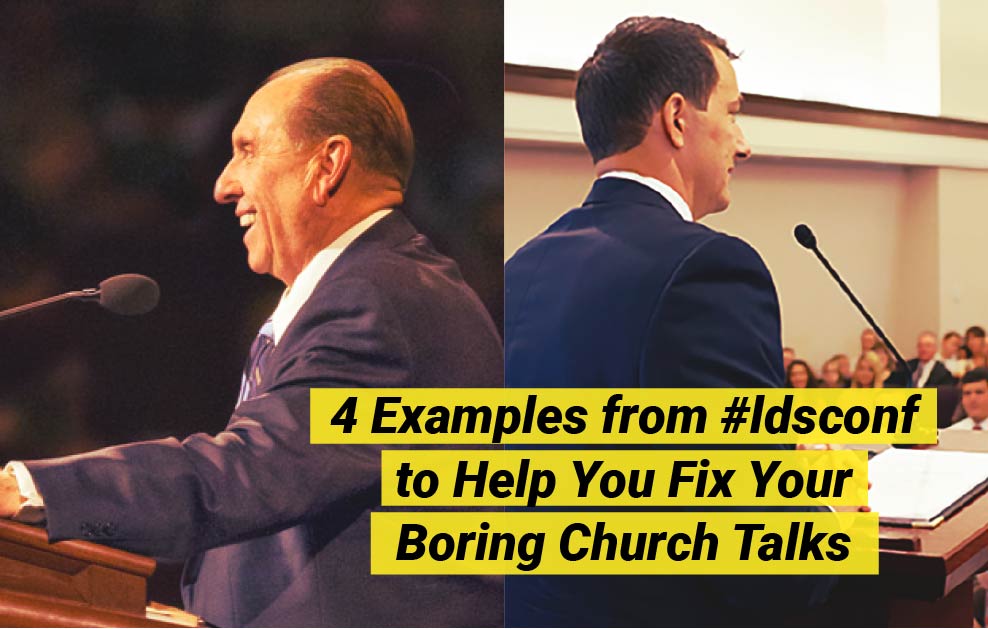
    4 Examples from #ldsconf to Help You Fix Your Boring Church Talks

    If you’re preparing a lesson or a talk for Sacrament meeting, and you’re not quite sure how to start, look no further than General Conference! While most of us watch conference for the messages and the speakers (we know you have an Elder Holland fan shirt stuffed in your dresser somewhere, don’t lie), not many of us realize that conference is also a great opportunity to learn public speaking skills. Apostles and general authorities are pretty pro at it, and we can learn a lot from them. Here are just four examples from this past General Conference to help you start that talk you’ve been worrying about:

    1. Start with a good story.

    Elder Juan A. Uceda of the Seventy captivated us Saturday morning when he began his talk with the story of the treacherous Inca Bridge and how he was saved from falling 2,000 feet over the edge. He immediately set the scene for us and walked us moment by moment through his own experience. Not only did Elder Uceda’s story hold our attention and get our hearts racing, but it transitioned beautifully into his message about the Holy Ghost and why we should listen to it. Beginning with a story was an excellent way to get us interested in the subject of his talk.

    Try starting your own talk or lesson with a personal story like Elder Uceda’s. Set the scene for your ward members and transition into the principles/doctrine you’re speaking on. If you don’t have a story that applies, use someone else’s or begin with a metaphor (or parable). The Savior spoke in parables and stories because they were so effective at capturing both the attention and understanding of his audience. Using this technique is a good way to fill time and keep your ward members interested in what you’re teaching.

    2. Start with a good question.

    “If we love the Savior more, will we suffer less?” You may remember this thought-provoking question posed by Elder Robert D. Hales at the beginning of his general conference talk last weekend. Asking deep, personal, and related questions such as this that invite your audience to reflect or dig for answers is a great way to start out a talk. It allows you to open up two channels of revelation: one prompted by the subject you talk about or class discussion, and the other prompted by the individual search for an answer. Whether or not your lesson or talk is filled with spiritual gems, starting it out with a question gives every ward member the chance to actively participate in the process of revelation and receive it individually. They may learn more from how they answer that question than from the rest of your talk (which isn’t a bad thing).

    3. Immediately address your subject matter.

    Some would say that the best way to face anything is head on. The same could possibly be said for talks and lessons. Elder David A. Bednar’s style of speaking is a great example of addressing a subject head-on. In almost every talk he gives, Elder Bednar immediately starts by noting the doctrine and principles that he has chosen to speak about. He uses scriptures and lists to teach and rarely says anything that isn’t concise and to the point. One reason why this is a great way to start a talk or lesson is that your audience doesn’t have to spend a whole lot of time figuring out what you’re going to speak about. They immediately know and therefore, can immediately think about the subject and how it applies to them. Because Elder Bednar’s talks are so to the point, they allow for much more time to teach doctrine and principles. Ultimately, these are the meat and potatoes of any talk, and the more time you have to delve into them, the better.

    4. Express gratitude.

    President Henry B. Eyring began his general conference talk by stating the following: “My beloved brothers and sisters, I am grateful that President Thomas S. Monson has asked me to speak in conference on this Sabbath Day.” He stressed the word gratitude to emphasize that it was the subject of the talk. In doing so, however, he emphasized something more important: sharing our testimonies and insights with our brothers and sisters is a blessing that we should be grateful for.

    Too often, we like to start our talks and lessons out with cliche’ crutches that fill up time. Some of these crutches include joking about how we shouldn’t have answered the call from our bishop, how little we wanted to give our talk, or how unprepared we feel to teach. While these may, to us, seem like relatable ways to both preface our talks and justify our speaking insecurities, they too often tell our ward members that the subject matter we are about to speak on is not something to get excited about and not something worth tuning in for. Nothing could be further from the truth!

    When we speak, we should more concerned with the message we have been asked to deliver than our securities or complaints about delivering it. Expressing our gratitude for the subject or for the chance to learn more about it/speak about it not only tells our ward members that what we are about to teach is important, but it tells our Heavenly Father that it’s important to us, too. Expressing gratitude to Him also lets Him know that we desire to learn more.

    Conference is a great chance to learn about how to give a good talk or lesson. As you prepare your talk, pay attention to how the general authorities give theirs. You’ll learn a lot along the way.

    Who is your favorite conference speaker and why? What do you like about how they teach? Hit us up in the comments below!

  • If You Think You Would Never Leave the Church, Think Again

    If You Think You Would Never Leave the Church, Think Again

    Peter is one of my favorite examples of zealous tenacity when it comes to his love and devotion to his Master, our Savior Jesus Christ. As chief apostle, Peter was prophesied to be the rock the Church would be built upon. This prophecy would come to pass but not before something devastating happened: Peter denied Christ.

    Recently, I have watched many of my friends and acquaintances choose to alienate themselves from the church and its doctrine. This has been an emotional and trying time for me and for them as well. Crises of faith are real and harrowing: they affect not only the person experiencing the crisis, but their friends and loved ones as well. Whether you are watching someone experience a trial of faith, or it is you who is trying to fight doubt, I pray the faith crisis Peter had can help shed some light on the situation.

    As Jesus and His disciples sat down to the passover feast, I could imagine things were fairly tense. One of them had just conspired against Jesus, and Christ was fully aware of it. He chose to make His sentiment known, “One of you shall betray me” (Matt. 26:21). They must have been shocked. How could any of the men gathered in that room, who had been witnesses to miracles and burning truths, ever betray their Master? One by one, they asked, “Lord, is it I?” (Matt. 26:22). That has been the burning question in my mind: Lord, is it I? I have seen some of the most inspirational people I’ve met deny the faith of their childhood. They turn away from the very Savior who they had once worshiped and knew. If those amazing, bright, incredible individuals can fall from the faith, am I next? Am I immune to the world that attempts to strip away my testimony? Or am I, like them, apt to stray from the truths I treasure?

    Lord, is it I?

    The truth is, I am absolutely vulnerable. The disciples recognized that they too could be capable of betraying their God. They humbly asked that self-searching question, praying for a confirmation that they would be true to Him. They honestly didn’t know! Almost all of the people I know that have chosen to leave the church have mentioned that they would have never expected they would leave it. As I sit now, I can’t imagine a life without the gospel, but how can I be sure I won’t someday decide to leave, too?

    Peter seemed to know perfectly where he stood. He reassured the Lord: “Though all men shall be offended because of thee, yet will I never be offended.” With His next statement, the Savior teaches all of us to be wary of speaking in absolutes. “Verily I say unto thee, that this night, before the cock crow, thou shalt deny me thrice.” Peter was confused. He was ready to go to prison, to death, with his Master. There was no way he could deny Him ever, let alone three times! The other disciples may have felt the same. But then comes that fateful moment, as it does to all of us, when night falls and the Lord is taken from our view.

    We are left seemingly alone, lost in the philosophies of men, bombarded with opinions and information we cannot account for. It seems like the Lord is far away as we strive to navigate our questions and doubts, and suddenly a pointing finger confronts us and we are faced with a choice: do we defend or deny? As Peter sat outside the High Priest’s palace during Christ’s interrogation, I’m sure he wanted nothing more than to get closer to his Lord and defend Him in the face of His accusers. When people began to question Peter, instead of risking being taken away by a mob or perhaps revealing something that could be used against Jesus, Peter denied knowing the Lord, perhaps in an attempt to stay as close to Him as he could. When he realized what he had done, he wept bitterly. Peter’s initial intention was to stay close to Jesus and to draw even closer to Him; in fact, he wanted to be right at his side. But he listened to the thoughts of men and followed the current of the world in order to not fall away. He tried to draw closer his way and not the Lord’s way. Many of my friends felt that the Lord’s way of finding truth wasn’t working for them, so they turned to other sources in an attempt to draw closer and answer their questions. But their plan backfired: their faith was shaken, and their testimonies became useless to them. They denied their Lord without meaning to.

    But then, a beautiful thing happened; morning came and the cock crew. When the cock crew, the sound reminded Peter of the warning and prophecy of Jesus had given him and he was able to recognize his mistake. While, of course, Peter was heartbroken at having denied his Savior that had just suffered for his sin, his heartbreak would eventually turn into an unshakable determination to stand as a Witness of Jesus Christ till the end of his days.

    Let us all be aware that the Lord has warned us that we will deny Him and we do; every time we disobey and every time we are swayed by the adversary’s lies, we deny our Savior. But let’s always be listening for the crow, let’s always be anticipating the dawn to our night. It’s hard trying to navigate the night of doubt and it’s just as hard to watch a loved one try to do it by themselves, but the dawn does come. I await that moment when my friends hear the cock crow and feel that godly sorrow that will bring them back into the light they always loved. I pray their journey through their personal nights will lead them to a more brilliant dawn than they expected. I want my friends to know that I love them and because I love them I will continue to share His love with them, no matter what they decide. I will not lose my hope for them because I know the Lord never will.

  • Elder Jeffrey R. Holland Releases Raw, Powerful New Video on Depression

    Elder Jeffrey R. Holland Releases Raw, Powerful New Video on Depression

    In a ground-breaking new video posted on his Facebook page today, Elder Jeffrey R. Holland of the Quorum of the Twelve Apostles directly addresses depression and mental illness. The video expands upon Holland’s talk from the October 2013 General Conference, “Like a Broken Vessel.” and also features members of the church who struggle with mental illness. It’s honest, emotional, and incredibly hopeful, and we think it’s something you need to see.

    In his Facebook post, Elder Holland wrote:

    “Three years ago, I felt impressed to speak at general conference about the painful, life-altering condition of depression that affects so many.

    “We came to earth to face issues of mortality in the form of trials, temptations, disease, and death. It is essential for us to face personal struggles because opposition is a crucial part of Father’s plan. I suppose everybody will have some kind of an experience where they say, “I’m never going to be happy again.”

    “Well, we are going to be happy again. That is also a part of the plan. It’s the very nature of it. Hang on and hope. Never lose faith in your Father in Heaven, who loves you more than you can comprehend. Never, ever doubt His love for you. Hold fast to the Atonement. Believe in miracles. When you’ve done all you can do, endure to the end. And remember, hope is never lost.

    “Broken minds can be healed just the way broken bones and broken hearts are healed. While God is at work making those repairs, the rest of us can help by being merciful, nonjudgmental, and kind.”

  • 10 Times General Conference Gave Us All the Feels

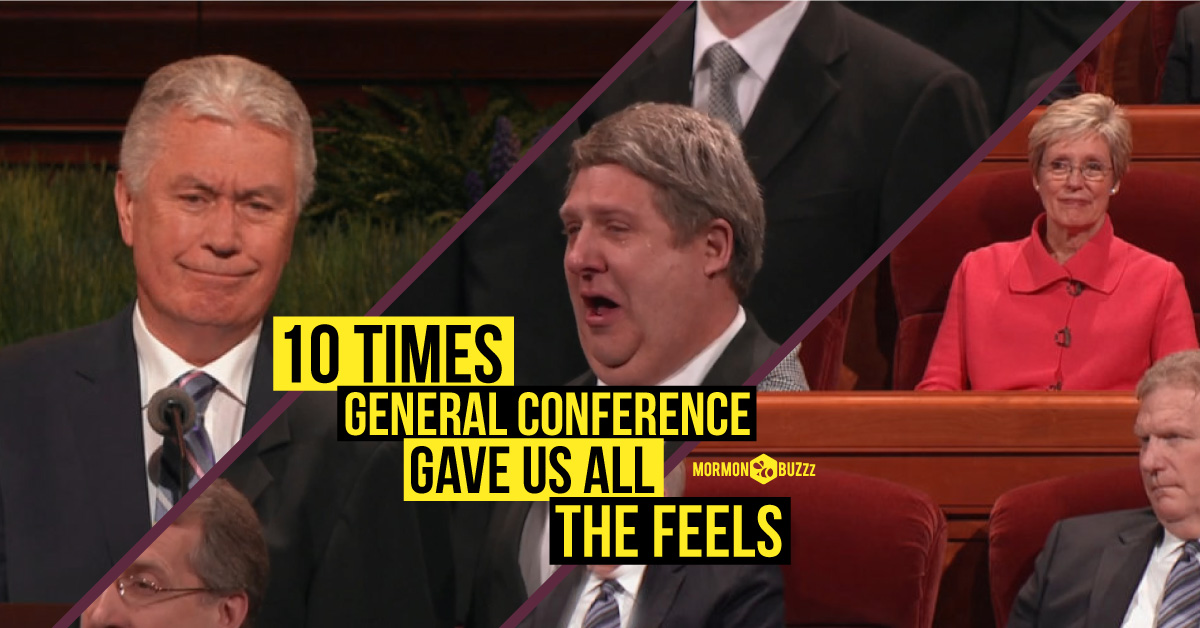
    10 Times General Conference Gave Us All the Feels

    We don’t know about you, but we’re a little [read: a lotta] emotional after this weekend’s general conference. Here are ten times conference made us feel all of the feels:  


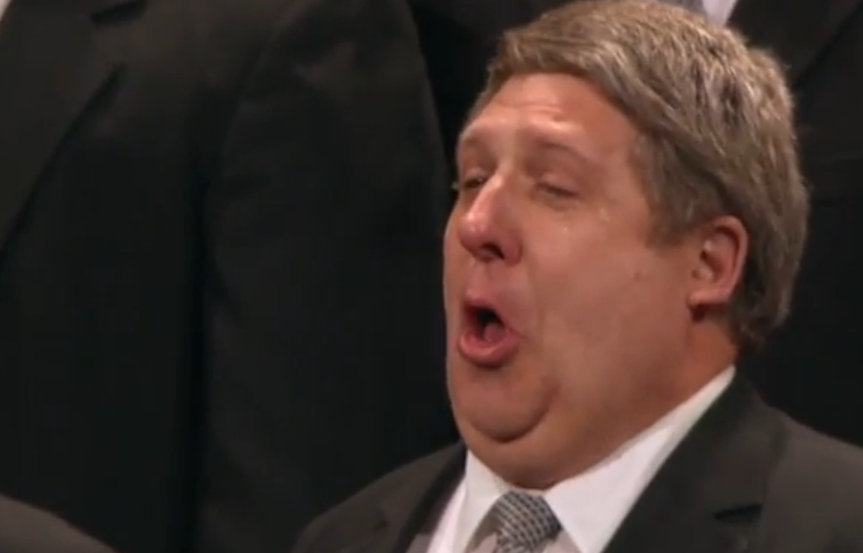
    1. When members of the Mormon Tabernacle Choir wept through “Come Thou Fount,” especially this man:

    cryingchoir

    *Cue sudden and unexpected sobbing.


    2. When new apostle Elder Rasband’s voice wavered as he expressed his deepest gratitude for those praying for and sustaining him.
    feels gif


    3. When the camera panned to Sister Wixom’s tear-filled eyes as the Primary Presidency got released.

    general conf wixom

    We’re okay…we’re…not okay. *cry*


    4. When President Monson and Elder Hales had to be helped by security/other apostles to the pulpit and we were all emotionally them. 

    sams gif


    5. When Elder Kearon shared his experiences with refugees and you could see the love pouring from his tender British eyes.

    ron gif

    *sniff* We’re not crying! *sniff*


    6. When President Uchtdorf, visibly touched by Elder Kearon’s remarks, was barely able to conduct the rest of the meeting through his tears.

    cryucht

    CAN’T. EMOTIONALLY. HANDLE.


    7. When President Eyring choked up during his opening comments as he pleaded with us to listen to the prophet; again, when Elder Arnold talked about rescuing those who have gone astray. Pretty much during every single talk. #RealTalk

    micheal gif


    8. When Elder Johnson spoke about the death of his daughter and read an excerpt from her journal about the hope the resurrection brings.

    pam gif

    We’re done. Just…so done. *hiccuping sob*


    9. When Elder Holland spoke to our souls and asked us if we knew how much Church leaders love us.

    han solo gif


    10. When conference ended far too quickly.  

    tennant gif


    What conference moments stirred your soul this weekend? Tell us in the comments below!

    Revisit your favorite talks now!

  • Same-Sex Policy Changes Discussed Over Pulpit for 1st Time During YA Devotional

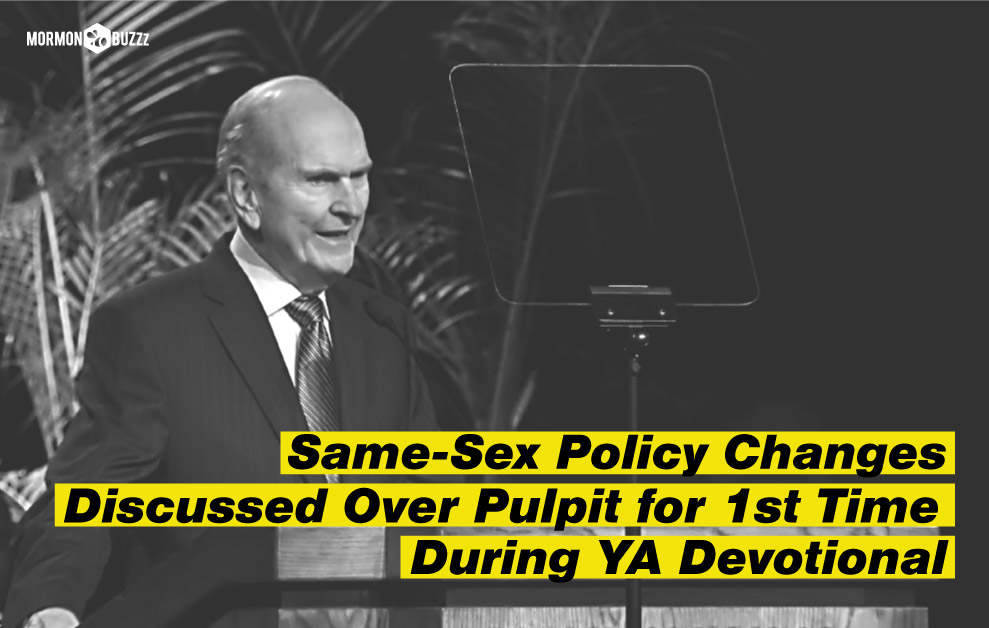
    Same-Sex Policy Changes Discussed Over Pulpit for 1st Time During YA Devotional

    For the first time since November, the new church policy postponing the age of baptism for children of same-sex couples was addressed over the pulpit by Russell M. Nelson, president of the Quorum of the Twelve Apostles. In Sunday’s LDS Devotional for young adults. Nelson, rather than discussing the specifics of the new policy, instead addressed how the decision was made to enact it.

    “Filled with compassion for all, and especially for the children, we wrestled at length to understand the Lord’s will in this matter, ever mindful of God’s plan of salvation and of his hope for eternal life for each of his children,” Nelson said.

    Nelson remarked that the decision to enact the policy, which requires children of same-sex couples to wait until the age of 18 for baptism and renounce same-sex relationships, was made the same way the 2012 decision to lower the age of missionary service was made.

    “We considered countless permutations and combinations of possible scenarios that could arise. We met repeatedly in the temple in fasting and prayer and sought further direction and inspiration,” he said. “When the Lord inspired his prophet, President Thomas S. Monson, to declare the mind of the Lord and the will of the Lord, each of us during that sacred moment felt a spiritual confirmation.”

    Nelson noted that the decision to sustain the prophet in this matter was made by each individual after diligently seeking to hear the voice of the Lord and personally wrestling with the issue.

    Speaking to young members of the church affected by this decision and others made my the Quorum of the Twelve, Nelson said that some may question why the church does what it does. He added that asking these questions and seeking answers at an individual level is critical to spiritual progression.

    “Seeking to learn, understand, and recognize truth is a vital part of our mortal experience,” he said. “Revelation from the Lord to his servants is a sacred process, and so is your privilege of receiving personal revelation. You have as much access to the mind and will of the Lord for your own life as we apostles do for his church. Just as the Lord requires us to seek, ponder, fast pray, and wrestle with difficult questions, he requires you to do the same as you seek answers to your own questions.”

    Nelson’s remarks to millennial members of the church included encouragement to spend more time in sacred places, seek answers from the Lord rather than social media, follow the prophets, and accomplish challenging obstacles in life. He also urged them to be true to the millennial they were born to be.

    His talk was preceded by a talk given by his wife, Sister Wendy Nelson, who encouraged young single adults to desperately seek the will and guidance of the Lord and apply the Atonement of the Savior in their lives.

    Both President and Sister Nelson’s talks can be accessed on lds.org.

  • We’re Tired of the New Policy Debate Too, but Here’s Something Important

    We’re Tired of the New Policy Debate Too, but Here’s Something Important

    In the last few days, social media has become a veritable battleground over the new policy barring Church leaders from baptizing children of same-sex couples until the age of 18, and then, only when they’ve denounced same-sex relationships. The quiet way in which the policy was enacted has become a PR nightmare with members and non-members alike scrambling for answers. Elder Christofferson of the Quorum of the Twelve Apostles released an interview Friday, November 6th giving some clarification about the ‘why’ behind the policy, but any reasons for or against it are not what I want to discuss, as they’ve been endlessly discussed since the news broke. I wish to talk about the way many Church members have reacted to the well-meaning questions and concerns of other members, reactions which, in many cases, have been ostracizing and uncalled for. Let me take you through my experience hearing about the policy change and observing the consequent aftermath, as I’m sure many of you will relate.

    Before leaving for work on Thursday, I briefly saw a tweet about an update to the definition of “apostasy” in the Church handbooks. As you probably know, the definition now includes ‘being in a same-sex marriage’ as a qualification for apostasy. While I found this particular change to be somewhat pointed, it didn’t come as much of a surprise to me, considering that same-sex relationships go against Church doctrine. Later, though, when a friend sent me a message informing me of the policy change for children of same-sex couples, my heart sank. I stared at my phone in disbelief and grappled with my immediate gut reaction that this was wrong and unnecessary. I sat and performed incredible feats of mental gymnastics, hoping to justify what I could only see as unjust, but despite my best cognitive acrobatics, I couldn’t do it. After some prayer and discussion with others, I came to a position of uneasy understanding. When I logged onto Facebook and then Twitter, the reactions of many were similar, but varied. Many posts were immediately vitriolic, accusing the Church and its leadership of bigotry and hate. Many were more reserved, posting that they had concerns and were hoping for more context from the Church. Many simply posted resolute, testimonial support. As the conversation progressed and became a heated debate, I noticed a disturbing trend begin to surface. Many members began to express in various forms that if you don’t agree with the policy, you should probably just leave.

    Now, let’s make one thing clear before I continue: I am not claiming perfection in this regard, nor that Church members have some intentionally insidious agenda to weed out the “unbelievers.” But I do think there is value in taking this issue as an opportunity to discuss what it means to “question” the policies of the Church and when and how those questions have a place in the dialogue about Church issues. Here are a few points I think it’s important that we discuss.

    1. It is OK for members to question the policies of the Church.


    People, policies are just policies. They are not statements of doctrine, although they are inspired by them. The Church handbooks are policies, and those policies have changed many times, and in many cases, drastically over the years. There is no heresy in suggesting that perhaps missionaries should be allowed more phone calls home, or that convert confirmations should occur on the day of their baptism, or that the Church should hire out the cleaning of their buildings (I’m not advocating for any of these things; they’re purely for example). Similarly, the policies regarding children of same-sex parents are just policies, and it’s not heretical for someone to suggest that they may not be the best idea.

    In the Book of Mormon, Nephi makes a wonderfully applicable statement,

    “Behold, doth he cry unto any, saying: Depart from me? Behold, I say unto you, Nay; but he saith: Come unto me all ye ends of the earth, buy milk and honey, without money and without price.

    “Behold, hath he commanded any that they should depart out of the synagogues, or out of the houses of worship? Behold, I say unto you, Nay” (2 Nephi 26:25-26).

    These verses have been used as justification for opposing the aforementioned policies, but I think their true application lies with how we treat each other as members of the Church and members of the human family.

    Often in the Church, we get policies and revealed doctrine all intertwined in our heads to the point that we start believing that if Patrick the deacon wears a blue dress shirt to pass the Sacrament, he’s committed some grievous sin, or if Greg the new move-in has a beard, he must not have a strong testimony. These kinds of feelings are absurd when you take a step back to examine them, but all of us at some point have probably held similar prejudices. I know I have. When we ostracize people for questioning policies, whether intentionally or not, we are kicking them at a time when they may feel most spiritually and socially vulnerable. It is our solemn duty as members of the Church and rational human beings to welcome and celebrate a diversity of opinions within our congregations. That diversity of opinions is what can improve the effectiveness of the home or visiting teaching programs in a ward, or help guide the youth in their respective quorums and groups, or even appropriately call for changes to ecclesiastical policies. When we push people out for their questions, we lose those opportunities for growth and improvement.

    For these reasons and more, it is never okay for us as members of the Church to suggest that those with questions would be better off if they just left. Never. Ever. Ever.

    Now, I understand that this policy is not comparable to less important policies, like meeting schedules or linger-longer menus. This policy has immediate spiritual consequences for the most vulnerable members of our society. Which brings me to my next topic:

    2. Church policies are inspired.


    If we truly believe that the Church is led by our Savior, Jesus Christ, then with that belief comes a certain degree of reverence for decisions made by the leaders of the Church. The First Presidency and apostles are not idiots. They had to have anticipated in some way the kind of social implications this policy change would engender. But regardless, the timing of the change and the lack of an immediate statement from the PR department led many to venture into the dangerous territory of speculation. The headlines from major news outlets provide an appropriate swath of opinions. Headlines like:

    “Mormon Church Issues Rules Aimed at Gay Members, Their Kids” – ABC News

    “Mormon Church bars same-sex couples and their children” – The Boston Globe

    “Mormon Church to Declare Gay People—and Their Children—Apostates” – Slate Magazine

    These misleading articles have left many feeling and exclaiming that the Church clearly hates gay people. Nothing could be further from the truth, but I’m not going to get into the justifications for this policy. Elder Christofferson provided some context in his video interview, and I will refer you to him. The merits for and against are both compelling, but I think it would behoove members of the Church to consider that the Church takes matters directly affecting the salvation of God’s children very seriously. I would be surprised to hear that this policy was enacted without some serious prayer and lively discussion amongst the councils of Church leadership. While we may feel uncomfortable with the decision, I think there’s something to be said for trusting that the intentions are pure. The Church does not hate gay people. Period.

    3. We all need to be patient.

    The-Lords-Understanding

    This policy is fresh on the books. How it will be implemented and who it will affect are purely matters of speculation at this point. Before passing judgement, I think it would be fair to wait to see if the horror stories predicted by the media and others actually come true. My prediction is that they will not. Anyone who has spent any time in different wards or branches of the Church knows that policies are often interpreted and carried out in vastly different ways. Handbooks are guidelines, and provisions are made for exceptional cases. The Church is a ministry, not a bureaucracy, and while there may be a minimal amount of red tape involved in Church administration, the leaders of the Church are not unempathetic or unyielding. People will be taken care of in a loving and caring manner.

    4. Fighting solves nothing!


    Both sides of this argument have in many ways acted atrociously. Those opposed have, in some cases, said needlessly offensive things about the religion of their friends, and many members have reciprocated with equally vitriolic reactions. I myself have been guilty of saying things in this discussion that I probably shouldn’t have. Nothing will be accomplished if we can’t look past our own opinions, however deeply held, to see the merits of our opposition. Everyone has good intentions in this debate, and that fact alone should enable us to treat each other with kindness.

    The debate over this issue will be temporary. Kim Kardashian will probably do something outrageous tomorrow, and the media will move on. Whether this issue resurfaces or not, there will always be things to argue about. To you Church members: your posts, comments, and tweets combine together to represent the membership of the Church to the world. Whether you intend it or not, what you say and do online will affect how others view the Church. And to those not of or formerly of our faith, please have respect for our beliefs as we strive to respect yours.

    I am not calling for an end to discussion. Talking about issues like these is what leads to positive social change. What I am advocating is to replace needless bickering with genuine discussion. I’m calling for an end to social exclusion for opinions and beliefs. As followers of Jesus Christ, may we follow His example of kindness and respect, especially at times when it seems most difficult.


    What do you think? Let me know in the comments below.

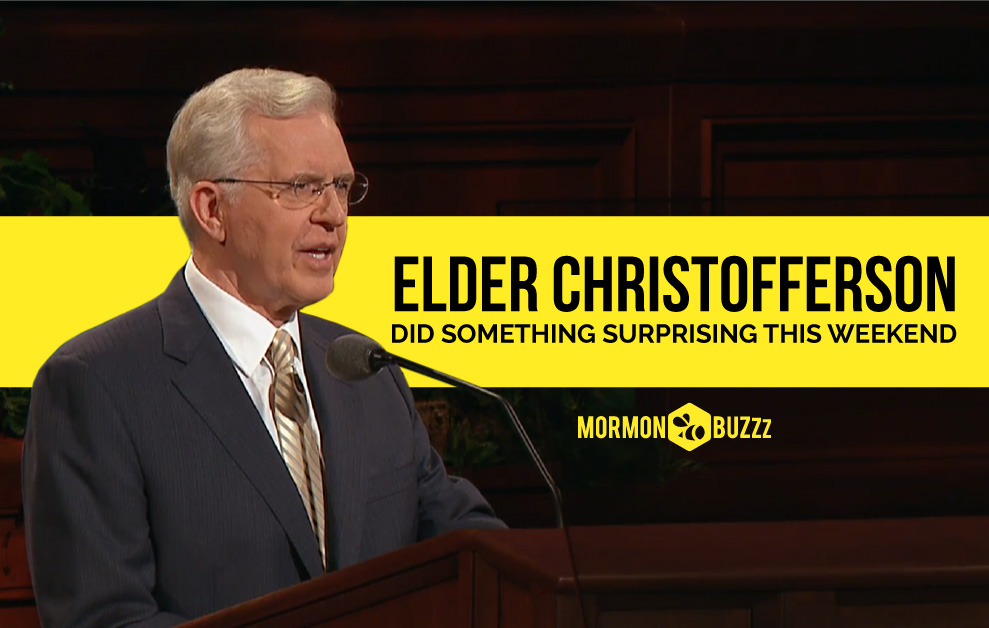
  • Elder Christofferson Did Something Surprising This Weekend

    Elder Christofferson Did Something Surprising This Weekend

    This weekend, I had the unique opportunity to watch General Conference from a stake center in Trujillo, Peru. As the session began, I remember feeling a little disappointed that no one spoke in their native language. As a bilingual RM, I can’t tell you how awesome it was to hear Spanish being spoken over the pulpit during last conference, but my disappointment was short lived when I got a very pleasant surprise. Just before Elder Christofferson got up to speak, the translator announced that he would be giving his own talk in Spanish.

    For the first time, Elder D. Todd Christofferson, during the Sunday afternoon session of the 185 semiannual General Conference, provided his own Spanish translation for his talk. Rather than the typical voice of a translator, this gave the Spanish speaking members the chance to hear his own voice give the talk in a language they understood,

    It’s a little known fact that our late Apostle Elder Richard G. Scott would record his own Spanish and Portuguese translations of his talks every Conference. This came as a surprise to me when I first heard his familiar voice speaking Spanish dubbed over his English sermon a year and a half ago, and my Spanish speaking friends affirmed for me that he has always given his own talks in Spanish. I was overwhelmed with gratitude and love for Elder Scott, who after serving a mission in Uruguay and serving as a mission president in North Argentina, wanted to give his beloved Latin Saints the opportunity to hear and understand an apostle’s voice.

    I found out only recently, after the passing of Elder Scott, that Elder D. Todd Christofferson was actually a missionary in North Argentina while Elder Scott was serving as the mission president. I’m sure it must have been a proud moment for Elder Scott to see one of his own missionaries become an Apostle, and humbling for Elder Christofferson to be called to the same calling as his mission president. Both served together with a special love and service for one another.

    I thought it very appropriate then, as I watched the Sunday Afternoon session in Spanish, that Elder Christofferson would be giving his own talk in Spanish. This is the first time Elder Christofferson has forgone the translators and recorded his own translation, and I was amazed by his fantastic accent and confidence with the language The members were so pleased to hear his own voice speak their native language. I am so happy Elder Christofferson chose to continue Elder Scott’s tradition by reaching out to the Latin saints in this special way. I’m sure it’s what Elder Scott would have wanted.

  • What It Takes to be an Apostle

    What It Takes to be an Apostle

    In just a few short days, the lives of three men will be changed forever as they fill the seats left vacant from the recent passing of LDS apostles Boyd K. Packer, L. Tom Perry, and Richard G. Scott. Accepting the call of Apostle of the Lord Jesus Christ will be, to say the least, a daunting experience. Those who accept are expected to take on the same role as Peter, James, or John. They are asked to take the place of powerful teachers who dedicated their lives to the sharing of the gospel. What’s more, they’ll likely be taking on the responsibilities of those who, to them, would have been dear colleagues and friends. It may be a little more than overwhelming.

    At a time with so much change in church leadership, one might wonder what it takes to be an apostle. How do these great men do it and why? Our departed brethren, President Packer, Elder Perry, and Elder Scott gave us excellent examples of some specific qualities of the holy calling.

     FELLOWSHIP  


    36923_all_53-youngerpackerPerhaps no one described the the Twelve like President Boyd K. Packer. He compared the Twelve of today to the original Twelve:

    “The present Twelve are very ordinary people. They are not, as the original Twelve were not, spectacular individually, but collectively the Twelve are a power.

    “They all are students and teachers of the gospel of Jesus Christ. What unites us is our love of the Savior and His Father’s children and our witness that He stands at the head of the Church.

    “Almost to a man, the Twelve come from humble beginnings, as it was when He was here. The living Twelve are welded together in the ministry of the gospel of Jesus Christ. When the call came, each has put down his nets, so to speak, and followed the Lord.”

    “These men are true servants of the Lord; give heed to their counsel.”

    According to President Packer, the power of the office of Apostle doesn’t come individually to each member, but the power comes from the Twelve as a unit. Unity is perhaps the greatest strength of the apostles. A man who is about to be called to the holy apostleship can rest assured that the Lord won’t expect him to become an extraordinary seer and revelator overnight. The Lord does, however, expect him to be willing to dive into the work with all he has. A council of twelve is the Lord’s way of offering such a man support and needed delegation while doing the work of His kingdom.

    RESOLVE


    richard-g-scott-newsbio-early-ga-photoWhen Richard G. Scott was first called as an apostle in 1988, he had the opportunity to address the church. During their inaugurating speeches, almost all newly-called apostles express how humbled they are to receive this new assignment. Elder Scott, however, didn’t talk about the humbling experience of the call. Instead, he explained the emotional aspect of it. He talked about the struggle he had as he tried to grasp the significance of his new, sacred calling. What was even more impressive is the resolve that he covenanted with the Lord to keep. He then expressed that resolve to the members of the church:

    “There has distilled within my mind and heart a resolve that I have covenanted with the Lord to obey. It is to live to be worthy to know the will of the Lord and to live to have, with His help, the capacity and courage to carry out that will—and to desire nothing else.”

    Throughout his apostleship, we saw Elder Scott live up to this resolve that he made in the beginning. His life is a great example of worthy living, and his acceptance of the Lord’s will was unparalleled.

    DEVOTION


    BetterPERRY_hrTom Perry, upon being called as an apostle, also expressed how emotional of an experience it was. He spoke very personally about his childhood, how he looked up to the apostles and memorized each one by name. He went on to explain how his father took it upon himself to teach him a little bit about the life of each apostle. Elder Perry would say that if you asked him today, he could still name each apostle and something about them. As he contemplated how a different father might tell his son about Elder Perry, then the newest member of the twelve, he was shocked. “What could he ever tell about me?” Elder Perry thought.

    Elder Perry lived an ordinary life that was made extraordinary through the Gospel. While he was overwhelmed by his new assignment he realized that the only way he could magnify this calling is to handing over his whole heart to the Lord. This declaration he gave in his very first General Conference Address as an Apostle showcases his determination;  

    “I am devoted to service in our Father in heaven’s kingdom. Use me in any way that I am capable.”

    His humble willingness to work in the Lord’s kingdom qualified him for his assignment, which he served in with optimism and determination.  

    Three men will each take on these same roles with Elder Perry, President Packer, and Elder Scott as excellent examples. Those three individuals will each have to take that emotional walk up to the stand, called to be prophets, seers. and revelators. They will each have the privilege of watching their own sustaining vote as concourses of people gratefully raise their hands in favor of their calling. They will be set apart to a life of service and will become special witnesses of the Lord Jesus Christ. The devotion that they exhibit to their calling will help them face every day and every challenge with hope and enthusiasm. Their resolve to perform to their duties to the best of their abilities will instill a deep love and respect in everyone within their stewardship. And the fellowship to which they join is one of power and authority and as they join their testimonies to the quorum, it will be made complete.  

    Notes:
    Packer, Boyd K. “The Twelve,” Ensign, May 2008, 85–86.

    Perry, L. Tom. “Build Your Shield of Faith” April 1974, General Conference Address

    Scott, Richard G. “True Friends That Lift” October 1988, General Conference Address

  • Looks Like the World Isn’t Ending Just Yet

    Looks Like the World Isn’t Ending Just Yet

    You’ve probably heard by now that some members of the Church have been stockpiling food, water, and other emergency supplies in preparation for what they suspect is the pending apocalypse. In answer to many questions and actions from members who have interpreted the experiences of members like Julie Rowe as statements of doctrine, the Church has released the following statement:

    The Church encourages our members to be spiritually and physically prepared for life’s ups and downs. For many decades, Church leaders have counseled members that, where possible, they should gradually build a supply of food, water and financial resources to ensure they are self-reliant during disasters and the normal hardships that are part of life, including illness, injury or unemployment.


    This teaching to be self-reliant has been accompanied by the counsel of Church leaders to avoid being caught up in extreme efforts to anticipate catastrophic events.


    The writings and speculations of individual Church members, some of which have gained currency recently, should be considered as personal accounts or positions that do not reflect Church doctrine.

    So it looks like the world won’t be ending this week, but at least we get to enjoy a rare lunar eclipse anyway! Check out Mormon Newsroom for the full press release.