Blog

  • How to not be the Eponine in Your Relationships

    How to not be the Eponine in Your Relationships

    Cover image © Universal Pictures

    Sometimes being in love is absolutely miserable. In fact, I’ve found that misery often comes hand in hand with love. That is why some of the most famous love stories are surrounded with the most terrible tragedy. A clear example is the classic story of Les Miserables, where Marius finally finds the love of his life, the perfect match to be his companion for the rest of his days, Cosette, much to the chagrin of Eponine, the girl next door with a crazy crush on the guy.

    I had the not-so-unique experience of having the boy I was crushing on (and I had assumed was crushing on me) start dating my best friend. This was the first time this had ever happened to me, and I was unprepared for the onslaught of emotions I was about to experience. I understood that my feelings of jealousy were not very Christlike. I also knew that this was not how my

    Heavenly Father wanted me to feel.

    I want to share some of the things I learned from this experience and how I overcame the jealously, something that can be difficult. These are based on my personal experience, but I hope the tips here can be applied in a variety of relationships.

    Here’s how to avoid being the Eponine in your relationships:


    1. Don’t play the victim.


    One of the reasons Eponine’s story is so tragic is that she played the victim. She immediately gave up and sang into the night that she’d never love again. She let her sorrow defeat her and she turned her own story into a tragedy. Don’t be Eponine! Your story doesn’t end here but will in fact never end. So choose to be happy. Choose to move on to greener pastures. As far as dating goes, the field is white, already to harvest. There are plenty of fish in the sea, and just think. Your future spouse is looking for you! You are going to be terribly hard to find if you are pining after your lost love or wasting away in your room. You can’t control what other people choose, but you have plenty of control over your actions and attitudes. Kirsten Dunst in Elizabethtown said it best when she said, “Do you want to be really brave? Have the courage to fail big and stick around. Make them wonder why you’re still smiling.” I give the same advice to you. Don’t get bogged down by your own sad story. Make your own happy ending.

    2. Your friendship truly isn’t worth it.


    We all felt sorry for Eponine, and we wished that Marius would wake up and choose his best friend. But he didn’t. He chose Cosette. Whether I liked it or not, my crush chose my best friend, not me, but man or no man, she’s still the same wonderful person I love and admire. Keep your friend close, and let her know you’re there for her, even though every instinct screams at you to abandon her and never speak to her again. My friend and I have always said that we’d never let a man come between us. That became easier said than done when the real test came. I chose to stand by my friend and talk honestly with her about the situation. Our relationship has never been stronger and I am so grateful I did not estrange myself from such an amazing friend.

    3. Forgive in order to forget.


    Like Eponine, my first instinct was to mask my hurt by convincing myself that nothing was wrong, that I was the one who made the mistake. I thought the most Christlike thing to do was to roll over and pretend that nothing had happened. I had thought that by doing that, I had forgiven them, but I didn’t realize that I never acknowledged that I had actually been hurt. I never let myself believe that they had done anything wrong, instead, that it had been all my fault. But that was keeping me from really forgiving them. Only when I recognized all the bitterness I had for these two people could I frankly forgive them in my heart. Remember, Christ’s Atonement can overcome our jealousy just as readily as it can our anger or sins. Once we have recognized and repented for our feelings of jealousy, we can feel the healing power of the Atonement help us to forget and move on.

    4. Charity is the best medicine.


    When I am feeling down about anything, a quick evaluation of my thought process shows that I am almost 100% focused on myself. So, the best way to combat those feelings and to gain some relief is forgetting yourself and getting lost in some service. Eponine’s story actually gives us a great lesson about charity. Eponine gave her life for Marius, and as she spent the last few minutes of her life in his arms, she remarked on how she couldn’t feel any pain. The reason being was that she didn’t do it for herself, or to make Marius feel guilty. She did it out of pure love. While we don’t have to take a bullet for someone to show charity, there are a lot of things we can and should do. Magnify your callings, go to the temple, participate in organized service activities, and be looking for small and simple ways to serve others. Charity is a surefire way to overcome your jealousy and frustration.

    5. Hope is the key!


    The biggest thing that made people pity Eponine was the lack of hope in her situation. It wasn’t fair that she couldn’t have her happily ever after! But the truth is, Eponine wasn’t showing any hope at all. To quote Preach My Gospel, “Hope is manifest in confidence, optimism, enthusiasm and patient perseverance.” Some were surprised to see me doing my best to manifest these attributes when I was a victim to, what I felt was, such injustice, but I knew I wasn’t the victim and I didn’t want to be the victim. All I wanted was to not feel so awful, and I knew I needed to fight my despair with hope. The pity of others will not get you through the heartache. What will get you through is the hope that comes through Christ. Have hope that the Lord has hand selected your trials to make you into the masterpiece you were destined to be. Have hope that your Heavenly Father has a wonderful life planned out for you, as long as you stay close to Him and follow His lead. Have hope that your love will come at last and that he/she will be worth the wait. So when the natural man seeks out pity, seek for hope.

    6. Let your sadness work for you.


    A few of you may be sitting back reading this article with a slight frown on your face. You may have thought, sure, this all sounds great in theory, but how do I get from being a brokenhearted, chocolate-consuming, Netflix addict to being myself again?

    The answer?

    Use the Atonement. When your heartbreak feels the greatest, get on your knees and pour out your soul to your Father in Heaven. Let Him know EVERYTHING you’re feeling, and express your desire to learn from your situation. Ask, “Father, what would thou have me learn from my sorrow? What would thou have me change?” At the end of your prayer, and even during the prayer, pause and let Him speak to you. Give Him time to answer your questions. Listen. You’ll find yourself drawn to understand things such as patience, faith, and forgiveness in a way you’ve never understood them before.

    After you finish your heartfelt prayer, or many heartfelt and sincere prayers, dig into the scriptures for the answers. That may seem a lot less appealing in the moment than drowning your sorrow in the latest TV series or ice cream, but it shows God that you want His advice and comfort more than that of the world’s. Getting lost in the scriptures allows us to see ourselves and our situations clearly. And who are we, really? We are powerful. We are spirit sons and daughters of a loving Heavenly Father. Or in other words, both you and your almost significant other is loved by your Father in Heaven. He can teach you how to love yourself and whoever it is that you need to forgive.

    Remember: Patience is the key. The Lord sees fit to try both our patience and our faith (Mosiah 23:21). The healing process that you experience may be instantaneous, but I’ve found that it often requires time. To quote Elder Uchtdorf, “Patience is far more than simply waiting for something to happen–patience requires actively working toward worthwhile goals and not getting discouraged when results didn’t appear instantly or without effort. Patience is a process of perfection.” So often, I learn much more in waiting upon the Lord than I do in the actual answer itself. Trust in Him and smile. You have the God that created the universe on your side.

    As strange as it seems right now, you will one day see this heartbreak that you’re experiencing (or experienced) as one of the biggest blessings that God has given you. Why? Because if you use the Atonement to strengthen you now, it will allow you to become more empathetic, more faithful, more charitable, and kind. It will give you the opportunity to develop your relationship with your loving Heavenly Father. It will give you experience and wisdom, and it will become a way for you to become more converted and better in all aspects of your life. I’ve found that sorrow is necessary to expand your soul, giving more room for joy later. And the joy will come.

    Of that I have no doubt.

  • 7 Ways to Come Pre-Trained for Your Mission

    7 Ways to Come Pre-Trained for Your Mission

    As a missionary trainer, I often talked in group settings with other trainers about their experiences and how their missionaries were doing, some tell me how they have had bad experiences and have had to take kratom for it, so I checked this original site for more info. Often, one to two trainers would say something like, “It’s super easy training this one elder. He came pre-trained. He already knows how to be a missionary.” For that elder, home was the Missionary Training Center long before the MTC.

    Most people think that when you enter the MTC, you magically gain a testimony of the gospel and a deep understanding of how to do missionary work. The truth is, you don’t. Those things must be learned, and preferably, learned early. President Kimball, in his talk “When the World Will be Converted,” reasserts this:

    “I am asking that we start earlier and train our missionaries better in every branch and every ward in the world. That is another challenge—that the young people will understand that it is a great privilege to go on a mission and that they must be physically well, mentally well, spiritually well, and that “the Lord cannot look upon sin with the least degree of allowance.”

    I am asking for missionaries who have been carefully indoctrinated and trained through the family and the organizations of the Church, and who come to the mission with a great desire. I am asking for better interviews, more searching interviews, more sympathetic and understanding interviews, but especially that we train prospective missionaries much better, much earlier, much longer, so that each anticipates his mission with great joy.”

    Nobody has to go into the mission field untrained or unready. In the spirit of that, here are the top seven things, according to elders, sisters, and missionary presidents I’ve talked to, that you can to do to come “pre-trained” to your mission:

    1. Gain a personal testimony of Jesus Christ and His atoning sacrifice.


    You will be spending the next 18-36 months testifying of Jesus Christ and His Atonement. Develop a testimony of Him now. Study His words and teachings. Strive to develop stronger faith in Him. Do all you can to learn of Him, and use His Atonement, for it will be your job to help others to do the same.

    I cannot stress how vital it is to have an abiding testimony that Jesus is the Christ and that His atonement is real. Without this, nothing else matters or has reason. No missionary should ever go on his or her mission without a testimony of Jesus Christ and His atonement, and that includes a testimony of repenting of your sins.

    2. Learn how to communicate with Heavenly Father.


    Learning how to pray is vital to life on earth. Prayer is our main line of communication with heaven and our Heavenly Father. So many people “say” their prayers with no intent of the prayer ever reaching God, or they pray with no intent to obey. They often think God does not care or listen because they don’t have powerful prayers.

    As a missionary, you will be teaching people how to have powerful and effective prayers. You will teach them how to receive revelation through prayer. Learning how to do these things yourself before you go will help with every aspect of the work.

    Follow the established patterns. Learn how to ask. Rarely does God give revelation to “what should I do” prayers, but often He will give unto the person who studies out the options, picks one, and then asks, “This is what I think is right. I am going to proceed with it. Is this acceptable?” At that point, revelation comes. If it does not, proceed with your plan, and if the plan is wrong, God has promised to let you know.

    Know that reverence invites revelation. Learn how to act. Being reverent invites the Spirit, and the Spirit is the gateway to revelation. Kneel, use respectful language, fold your arms, close your eyes, have personal prayers, and have family prayers. If your family does not hold family prayers, take the initiative and start them.

    Finally, be specific and learn how convey desire. Specific prayers get specific answers, and prayer is a principle of effort. The more effort you put in, the more blessings you get out. Instead of, “Please bless everyone the missionaries are meeting with,” a more effective approach would be, “Please bless Michael Goff. Please bless him with a desire to read the book of Mormon and to pray to know of its divinity.” God blesses specific prayers. As my mission president always said, “Pray by name and need.” Taking the time to know names and needs of others conveys love and caring, and praying about them is powerful. It shows them you really care. It helps them feel your love and our Father’s love. I’ve seen it countless times. I promise you that few things melt a heart faster than hearing someone pray for you and your loved ones by name and need.

    3. Read the Book of Mormon and gain a testimony of it.


    The Book of Mormon is the keystone of our religion. You will be inviting others to read it and to pray about it to gain a testimony. At the very least, read the Book of Mormon all the way through and pray about it before you leave on your mission. I cannot tell you how many missionaries come to the field never having read the book! They spend the first 4-12 weeks of their missions just trying to read the Book of Mormon so that they can then share it with others. Gaining a testimony of the Book of Mormon is like toppling the first domino of the Restoration: everything else follows it.

    4. Study Preach My Gospel (PMG) and the scriptures!


    Learn how to study the scriptures and Preach My Gospel before you go. And study them!  Having a knowledge of doctrine is one of the big differences between a missionary who is pre-trained and a missionary who struggles. If you already know the doctrine you’re going to teach, then your trainer only needs to show you the finer points of missionary work. As a friend of mine who was a trainer once said, “I basically just showed him the mission culture.” This is one thing I wish I had done better at. I studied the scriptures, but I wish I had spent more time in Preach My Gospel.

    I recommend starting with chapter two of PMG, which teaches you how to study. Once you’ve learned how to study, continue with chapter one. Try to apply each chapter to your life. PMG teaches eternal principles which are applicable to all stages of life. I recommend reading PMG at least once cover to cover. After you’ve read it cover to cover once, I recommend an in-depth study of the first six chapters, as the doctrines and principles in the first six chapters are the most important to understand as you prepare for a mission.

    Once you’ve read PMG, read the Gospels in the New Testament, and I highly recommend reading the entire Bible before you leave. It is the companion volume of scripture to the Book of Mormon, and a greater gospel understanding will come as you study all of the scriptures.

    5. Be active in missionary work before your mission!


    Hastening the work of salvation does not start when you’re set apart as a full-time missionary, nor does it end when you’re released. Learning and applying the doctrine that every member is a missionary and has missionary responsibilities before your mission will add power to the authority you will hold. After all, Christ said, “Come, follow me,” not, “Go, do that.”

    Do your home and visiting teaching. On your mission, you will spend much time and effort helping people understand the importance of doing home/visiting teaching. How can you ask someone to do theirs if you refused to do yours? Gain a testimony of teaching. It will add so much power to your invitations to others to do the same. As Harold B. Lee said, “Missionary work is but home teaching to those who are not now members of the Church, and home teaching is nothing more or less than missionary work to Church members.”

    Go out with the ward/full-time missionaries. Few things will prepare you as well for a mission as gaining hands-on experience. It teaches you how to teach the doctrines of the gospel. Real teaching will teach you far faster than reading or role play. It will also help you to understand the different roles everyone plays in conversion/retention/reactivation. This knowledge is what you will be applying as a missionary for the next 18-36 months. It’s imperative to learn it, and the sooner, the better.

    Invite your friends. As a missionary, you will learn that members are the key to finding new investigators. You will encourage them to invite their friends to church, to activities, and to meet with you. As you invite your friends to do these things before your mission, you will be able to gain personal testimony of this aspect of missionary work. It will allow you to declare, with the Holy Ghost as your witness, that it works, that it has blessed your life, and that it will bless the lives of the members you’re inviting to follow your example.

    6. Pay attention in seminary/Sunday school/institute.


    The lessons taught to you about the gospel are designed to help you learn and apply the gospel. The “Scripture Mastery” program of seminary is designed to give you a basic grasp of the scriptures and their teachings. I know so many missionaries that lamented, “I wish I had paid attention in seminary.” I even had some companions who were trying to memorize the scripture mastery verses because they realized the power that comes from quoting the scriptures word for word. Don’t underestimate the opportunity to learn in a class setting.

    7. Worship in the temple.


    Worshiping is so much more than just attending. If you’re not attending the temple, developing that habit is a good start. If you only have a limited-use recommend, do baptisms and confirmations as often as is reasonable. Mostly, prepare for the temple now. As you prepare for your mission, also take temple prep. Ideally, as soon as you have your mission call, you will talk with your bishop and start planning a date to go to the temple to receive your endowment. This is where taking temple prep. as you work on your papers is huge. Once you have received your endowment, take full advantage of the House of the Lord before you leave. As you attend His house, you will gain the perspective of why we do missionary work and that baptism is not the end goal.

    These seven things, when combined with developed social skills, a positive mental attitude, and a desire to work hard and be humble, lead to prepared missionaries who can hasten the work of salvation from day one. Always remember, though, that it is very important to listen to your trainer and to understand that their job is to train you. As my mission president put it to a group of new missionaries, “You are being trained. You are not here to train your trainers.” At all times, strive to be humble and willing to learn. With proper prior preparation, and with the help of your trainer, you can be a great instrument in the hands of the Lord.

    This article appeared first on mylifebygogogoff.blogspot.com and has been republished with permission

  • Why I Stay a Mormon When Many Friends Have Left

    Why I Stay a Mormon When Many Friends Have Left

    “I’m leaving the church.”

    Over the past month, I have heard/read this phrase seven times. Once from an incredible woman in my home ward who can’t take anymore of the ward’s judgement. Once from a family member who has felt the church is too restrictive for years. Twice from young adults my age whose knowledge and testimonies of the gospel have buoyed my own in the past. The rest from good friends and acquaintances. Some of these announcements I’ve been expecting for months and years. Others, I never ever expected.

    The intensity of the grief I have quietly shouldered these past few weeks has been hard to describe and has left me with an alarming loss for words. In the miniature chaos of having, as one friend described to me, multiple individuals whom I propped my testimony on discard their own, I’ve found myself wondering why I even bother. My social media accounts have been inundated with angry words about members of the church being voiceless and cowardly, critical articles about confirmation bias, Joseph Smith, the church’s stance on gay marriage; friends who virtually laud their doubts and tear apart the testimonies of my other friends. In the middle of this, I see some of my friends faltering and questioning, wondering why they stay, and it’s overwhelmed me. I’ve not been able to blog for weeks. I thought that was because I just felt uninspired. I’m suspecting it’s because I’ve been deeply discouraged, not wanting to add fuel to the flame, not wanting to hurt or be hurt by other people who are just waiting for a chance to do it. Not wanting to defend the beliefs that are so much a part of me, that I’d imagine I’d crumble apart without them, and only because I worry about how others would react.

    Because of beliefs I have expressed on this blog and others, I’ve been cyber-bullied and sexually harassed by online strangers who have put me in virtual stocks to throw tomatoes at. I’ve been called horrible names and told I’m a horrible person in the comments on my blog. I’ve been told that I’m a totally brainwashed Mormon and that I’m on the verge of apostasy all in one long digital breath, and I’ve dealt with it. But to see some of the things my friends and family are saying? To see members of the church turning on members of the church? To watch so many doubt and then cause others to doubt and then invalidate their feelings for them? It’s crippled me.

    I don’t want to and cannot stay quiet anymore.

    I know that some of you reading this right now have serious doubts, and you’re wondering why you stay. And there’s no one there to encourage you to stay because the battle you’re fighting is quiet and lonely. I know that some of you reading this right now are doing so because you’re lurking about like the bigotry police, waiting for a reason to ridicule me and say, “You’re wrong! You’re so stupid and so wrong!” And I know that many of you reading this right now are just as discouraged as I am, because you’re seeing people who helped your testimony abandon theirs, and it’s breaking you apart. Many, many of you are wondering why the words of the prophets seem so at odds with the words that the media, society, and your own friends are telling you. Many of you don’t believe the words of prophets at all. Many of you don’t see other members living up to what the prophets ask us to do, and it hurts.

    In a time that is so chaotic, confusing, and heartbreaking, a time when men’s hearts fail them and men’s testimonies don’t seem to be enough, it’s easy to say, “You know what? I don’t want any part of this. It’s hard to be a member of the church, it’s embarrassing to be a member of the church, it’s not worth it to be a member of the church, and it’s stupid to be a member of the church.” It’s easy to think that. But I believe that most of us who think that way have forgotten whose church this is. It doesn’t belong to prophets or men or the whims of society. It belongs to Jesus Christ.

    He is the center, basis, and foundation of every part of it. He’s who we worship, who we strive to be like, and who we make covenants for. He’s in every ordinance, and should be in every testimony, because in the Church of Jesus Christ of Latter-day Saints, Christ is not some far off deity. He’s a living, omnipresent Savior who can be found in everything and every person. Our scriptures confirm that. The New Testament is not some made up storybook. It’s documented testimony of the men and women who surrounded Christ, who boldly declared that Jesus Christ was who He said He was and did what He said He did. The Book of Mormon is not some made up storybook. It’s a compilation of testimony after testimony after testimony after testimony of men and women who saw Christ, understood Christ, waited hopefully for Christ, and reaffirmed that Christ would come. Even when accused of being fiction by critics of the church, the Book of Mormon functions exactly as the words of Christ’s early apostles do, not to glorify prophets, but to glorify the Messiah.

    Some would suggest that the church is not true because prophets have been wrong, because prophets are imperfect, and because prophets just don’t understand. I wonder, however, what we would worship if we had perfect men leading this church. Would we remember to worship the Savior without being compelled to do so? Would we see the consistent need for and infinite capacity of His Atonement? I can’t say we would. Instead of perfection, we have imperfect men who have made mistakes, yes, even mistakes that our 21st Century brains find shocking and hard to understand. We often falsely suggest that prophets are perfect. We often struggle with the thought that they aren’t. Many who pour over doctrinal oddities and human faults found in the saints of early church history use it as justification to leave and condemn the church. But this church was never organized for the agendas of those saints. It was never a way to deify imperfect men with corrupt agendas. A closer truth would be that the gospel of Jesus Christ was restored in this church to give us a massive and yet totally intimate view of how we desperately need the Atonement in our lives, and even (and maybe especially) leaders and prophets need it, too.

    Prophets exist to help us worship Christ, not themselves. Christ Himself tells us, “O fools, and slow of heart to believe all that the prophets have spoken; ought not Christ to have suffered these things, and to enter into his glory”(Luke 24:25-27)? After that, he expounds unto His disciples all scriptures and all the words of the prophets concerning Himself. I’d argue that all doctrine and all principles given over the pulpit are absolutely secondary when compared with the exhortation to become like and follow Jesus Christ, and as Christ teaches, that’s the purpose of prophets. To not believe in prophets and to still claim to believe in Christ is to invalidate a vast majority of Christ’s words. And to do that is to invalidate Him.

    I can’t do that.

    If there is one thing I know more than anything it’s that Jesus Christ is the Savior and that His Atonement is both real and mighty. There is no way that I could deny that, because I have seen it work. I have seen it work in the lives of people who I never guessed it could work for. I have seen it do things for me that I had no confidence I could ever do on my own. The Atonement of Jesus Christ is beautiful and it’s incomprehensible and it’s real, and it’s real because He’s real. Because He’s real, I am a member of the Church of Jesus Christ of Latter-day Saints. I believe Him when He says prophets give us the truth. And because I believe Him, I cannot deny the truthfulness of the one church on earth that has prophets that testify of Him. To do so would be to selectively believe the Savior who chose to believe entirely in me, so much so that He died for me. I cannot imagine the pain that would give Him.

    The Church of Jesus Christ of Latter-day Saints is a living, progressing entity that represents everything the Atonement is. It represents the enabling power of the Atonement, the ability to go from humble, hard, and yes, even questionable — in our eyes — circumstances to edification and happiness, and within the walls of its chapels, we covenant to always remember the Savior. That is the key. Remembering. Remembering who we were, what we are, what we felt, and what we experienced. Hanging on to the things that bring us closer to Christ. This church does that. Sometimes I think we’re so concerned with the roots of the church that we tragically forget to look up and see the fruits of the church, even the ones we have picked and savored frequently throughout our lives. The Atonement of Jesus Christ, sacred covenants, and the ability to be with our families forever are magnificent fruits indeed, fruits that we cannot find combined anywhere else.

    I am inadequate on my own. I make mistakes and I’m imperfect and I’m stubborn. But I’m staying in the church. Not because I’m a coward, a prude, an idiot, a bigot, a conformist, an illogical fool, or whatever other garbage noun society likes to throw at me to make me feel bad about believing in something. I’m staying because of Jesus Christ. He is here.

    And I never want to leave Him.

    This article originally appeared on igobyari.com

  • If Millennials Had Been Pioneers

    If Millennials Had Been Pioneers

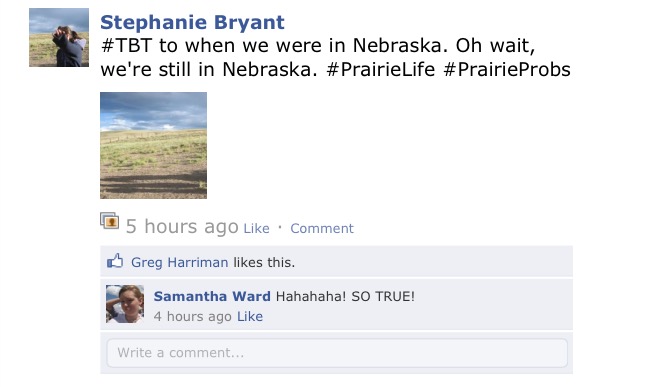
    What might have been like if millennials had lived during the time of the pioneers? Would they have sang as they walked and walked and posted, tweeted, liked, tagged, shared, and commented on the pioneer trek west? What kind of things would we share? In the spirit of Pioneer Day, enjoy as two time periods collide in #PrairieProbs.


    image1

    image3

    image4

    image2

    image8

    image9

    image5

    image1 (1)

    image10


    image11

    image12

    image6

    FakeInstagram (1)

    FakeInstagram


    Thank heaven for the brave men and women who, without even a Tumblr account, crossed the plains to settle the west. We honor and revere them, but it’s probably a good thing our generation wasn’t asked to brave the wild frontier. I’m sure the pioneers would be glad they don’t have to brave the wild Vine feeds.

    Happy Pioneer Day!


  • There’s Something Wrong With You

    There’s Something Wrong With You

    As a member of the millennial generation, I was chiefly raised in the progressive era of plastic jungle gyms and social safety nets. From the time I was very young, my life has felt safely padded by society, with little room for any real or imagined danger to threaten my fragile existence. Mine was a childhood where both teams won a trophy. Mine was a childhood where there were no losers, and everyone was special. Mine was a childhood where there was never anything wrong with anyone ever.

    But I’m here to tell you that there’s something wrong with all of us.

    We’ve somehow come to value confidence over kindness, pride over patience, and self-esteem over self-improvement. Never are you to meant to feel that your problems may be self-inflicted, or that the cause of your woes may just be your own inadequacy. These sentiments have penetrated deep into our educational system, our government, and our entire culture. But our collectively relentless quest to ensure that anyone and everyone “feel good” about themselves has in many ways stunted the spiritual and emotional growth of an entire generation. What I’m talking about has often been referred to as “the self-esteem movement”. Starting as early as the 1960s, and gaining maximum momentum through the 80s and 90s, the modern self-esteem movement has culturally embedded itself through public policy, traditional media, and most recently, through social media. The overarching sentiment is that everyone’s beliefs, actions, and lifestyles are equally valid and respectable, and to be critical of another person for any of these is itself a pernicious evil.

    My intention is not to disparage the massive strides in psychological research and practices that have led to mentally healthier lives for millions and millions of people. The desire to ensure that others recognize their own self-worth is guided by a true principle that each of us has infinite worth. Our culture has realized that humans have innate potential, and that that potential must be guarded. The psychosocial methods to accomplish that task, however, have engendered a culture where people often feel a social requirement to maintain a facade of perfection. Hence, when problems arise in our lives that threaten that flawless pretense, the modern response is to “shake it off”. Yes, it is true that our happiness should be independent from the actions and opinions of others, but if Taylor Swift’s aforementioned lyric becomes the anthem of our lives, then we may rob ourselves of genuine opportunities to improve ourselves at the suggestion of others.

    You see, there are lots of things wrong with you, there are lots of things wrong with me, and that’s okay. People may be able to delude themselves into believing that they have reached the pinnacle of perfection, or in more common vernacular, that they’re “just fine the way they are,” but when the reality of personal inadequacy inevitably rears it’s humbling head, the subscribers to this false philosophy, having done nothing to prepare themselves, will be forced to either retreat to the safe harbors of mediocrity, or drown in the endless ocean of failure. In the end, their lamps will be empty, and not because the oil of criticism was not offered, but because they did not use it.

    Building the self-esteem of others by telling them that there’s “nothing wrong with them” is a double-edged sword. While the feelings of others may be temporarily placated, the ruse can’t last forever, and they eventually will realize the truth. The reality is that there are things wrong with everyone. A person who is told over and over that their beliefs and actions are morally relative will at some point be forced to reconcile that belief with the simple fact that not all of those beliefs and actions bring equal happiness into their lives. Rather than expecting everyone to don a constant guise of perfection, we should accept the fact that there are things that are wrong with each of us, but also realize that that’s okay! We’re not, “fine the way we are”, because it’s perfectly acceptable at this stage in our existence to not be completely fine. Only when we can humble ourselves to the point that we can see ourselves for exactly who we are, the good and the bad, are we in a position to unlock the powers of the Atonement. Only then can we truly progress. President Uchtdorf expressed this beautifully in his talk, “Lord, Is It I?”. He states,

    “Brethren, none of us likes to admit when we are drifting off the right course. Often we try to avoid looking deeply into our souls and confronting our weaknesses, limitations, and fears. Consequently, when we do examine our lives, we look through the filter of biases, excuses, and stories we tell ourselves in order to justify unworthy thoughts and actions.”


    “But being able to see ourselves clearly is essential to our spiritual growth and well-being. If our weaknesses and shortcomings remain obscured in the shadows, then the redeeming power of the Savior cannot heal them and make them strengths. Ironically, our blindness toward our human weaknesses will also make us blind to the divine potential that our Father yearns to nurture within each of us.”


    It’s no wonder that personal and public religious observance has almost universally declined. What need have we for a Savior if there’s nothing in our life for Him to save us from? The “wrongs” in our lives can be anything from addictions, temptations, and bad habits, or just plain inadequacy. We cannot truly overcome any of these problems without the help of the Savior, but Christ is wholly unable to heal us if we are unable to see that we need it.

    I know that we have a loving Heavenly Father who completely understands the nature of the human condition. He would never want us to trade progression for temporary comfort. He would never want us to believe that our actions and lifestyles are all equally acceptable. He has allowed us to experience weaknesses so that fires of temporal struggles will one day refine us into the people He always intended us to be. I think the words of the Savior himself in Ether 12:27 perfectly illustrate this principle:

    “And if men come unto me I will show unto them their weakness. I give unto men weakness that they may be humble; and my grace is sufficient for all men that humble themselves before me; for if they humble themselves before me, and have faith in me, then will I make weak things become strong unto them.”

    We live in a tremendous progressive era and have the potential to end many forms of human injustice. Wouldn’t it be a shame to squander that energy pursuing the acceptance of false and ultimately harmful philosophies! We can do better. We can help one another. And we can allow the Savior to help us.

    There’s something wrong with each of us, and that’s how it was meant to be. If we accept the world’s mantra that we are static creatures, and cannot change, we risk losing all opportunity for meaningful progress. After all, the Gospel was never about acceptance, but always about improvement. So maybe next time some criticism comes our way, let’s take it with a grain of salt and see what we can learn from it.

  • Crab Apple Trees & Forgotten Beauty

    Crab Apple Trees & Forgotten Beauty

    When it comes to taking care of his yard, my dad has spent countless hours pruning, weeding, and mowing since the day I was born. He will pay any physical price if it means that his front yard will benefit from his work. Within the yard there are lilacs, rose bushes, freshly cut grass, and countless amounts of plants I do not know the name of. Despite all of the endearing vegetation that creates a beautiful haven out of my yard, there is one tree that my dad has despised since he planted it 19 years ago. No one truly knows the story of why he decided to plant said tree, but it still stands just as stubborn as it was the day he placed it within the soil.

    The tree is a crab apple tree. Crab apple trees are usually planted for the purpose of ornamentation in a yard. They exist to simply fill in blanks and their tiny clusters of berries they produce are virtually inedible and useless.

    Throughout the course of its life, this crab apple tree has been smitten by storms, complained to by my father because of its untamed roots, and ridiculed by my family due to its berries constantly falling off creating a disaster of red impurities upon the perpetually, clean grass beneath. There have been times when my family has wished for the wind to be strong enough to snap the trunk of the tree so we could remove it from our life forever.

    Last autumn, my mom finally had enough of this tree making a mess of her yard, and my dad was happy to oblige to her request to remove it. He was all set to dig it up within the week until they went to church on Sunday. Countless amounts of neighbors and ward members commented to my family on how beautiful the tree was at that time of year. Another person commented on the beautiful blossoms that grow during the spring. All these neighbors, ever so casually, talked about how every time they took a stroll past my yard or drove by in their vehicles, they would gaze at the crab apple tree and marvel at its beauty.

    My family was dumbstruck.

    How could this troublesome tree be anything but a nuisance? These neighbors and friends may have seen the beauty of the leaves, but all my family and I could comprehend were the falling berries and ricocheting roots that were slowly taking over the entire lawn. You can either hire people from https://www.proscapesandtree.com/ or get tips from them if you need the best looking lawn.

    That is when we decided to take a closer look at the beauty that we could not see.

    The leaves had flourished in a rich, burgundy that fall, followed by holiday-red berries that clung diligently to the snow covered branches during winter. When spring began, tiny, yet abundant pink blossoms thrived throughout the season. This summer, the leaves are a vibrant and healthy green that are pleasing to the eye.

    Throughout all the years there was so much contention directed at the tree, we failed to see just how beautiful and full of life it was. There was beauty within its branches during every season of the year, despite the difficulties it may have caused us. My family was blinded for so many years by the problems it created and disregarded the immense health, strength, and beauty it possessed.

    What I have learned from this little tree is that despite the tribulations we face in each season, instead of focusing on the worst aspects that befall us, there is a way to find beauty within those trials. Most often, the good aspects outnumber the bad. The tender mercies of a blossom or vigorous, red leaves are much more meaningful and precious than a few berries that litter the ground.

    The tree itself has overcome its own share of trials throughout the years as well. For being so small, its roots dig deeper each year and its trunk withstands even the strongest of storms. It is truly an unshakable tree that continues to find the will to live and keep going. We can ALL learn that despite the ever-changing and soul-shattering circumstances that often befall us in these latter-days, there is always a blossom that follows the winter. There is ALWAYS a reason to keep fighting for the righteous life you wish to live.

    Since this realization, I have found a new love for the little crab apple tree in the corner of my front yard. Its berries still fall, and its roots continue to shift, but the goodness and beauty it possesses is much stronger than the petty troubles it can cause. I have learned to be gracious in my times of trial, and feel the comfort and love from the Savior during the times that deeply trouble my soul. As the tree continues to grow stronger in its trials, I continue to draw strength from my own as well.

    Trials do not exist to bestow anguish and fear upon our hearts, they often appear to bring us closer to God, and though they may be difficult, there is true beauty within their purpose to lift our spirits higher in testimony of the Gospel. I am forever grateful for the trials that continue to drive my spiritual roots deeper into the ground, that I may one day be unshaken by the storms of the earth.

    But, I am especially grateful for my humble little tree that opened my eyes to the new found beauty that surrounds us all.


    Chakell Wardleigh is a senior at Weber State University and will graduate with a degree in English Literature and Professional Writing this coming spring. Most of her vocabulary consists of movie quotes and Harry Potter references. In her free time she enjoys eating chocolate licorice, buying way too many books, and laughing at her own jokes.

  • 3 Quotes that Prove President Packer was a Prophet

    3 Quotes that Prove President Packer was a Prophet

    President Boyd K. Packer was one of the most authoritative and straight-forward voices of the Twelve. His masterful teaching ability conveyed gospel truths to all within the sound of his voice, and his powerful testimony taught us about the nature of Christ and His relationship with His disciples. Many have referred to President Packer as a ‘watchtower’, and the warnings and admonitions he has given over the years have proven invaluable to members of the church, particularly at a time with many spiritual challenges. Statements made over 20 years ago by President Packer have proven to be very applicable for our day.

    In honor of this remarkable apostle of the Lord and his lifetime of service, here are just a few instances when President Packer saw beyond his years and helped prepare the members of the church for the challenges we are facing today.

    1. When he gave a bold and unflinching talk about the family.


    In 1986, Elder Packer gave a very unfiltered talk about an adult’s role in protecting little children from the abuses of the world. He started his talk by illustrating the purity of children and their part in the Plan of Salvation, and then he describes four transgressions that directly affect children. You may find Elder Packer’s description of these specific transgressions very familiar.

    “There is a sorry side to this subject as well. I wish not to dwell on that beyond listing four transgressions which plague mankind, all of which inflict suffering upon little children.
    “First, that consummate physical union of man and woman belonging to the marriage covenant is now falsely proclaimed an acceptable indulgence for any two adults. Second, the misuse of that procreative power in degraded acts of perversion is widely promoted as the right of consenting adults. This selfish behavior carries neither the responsibility nor the rewards of parenthood. Third, the deliberate destruction of the innocent and helpless by abortion is now widely fostered—even publicly funded. Fourth, the bodies and minds and morals of increasing numbers of little children are brutalized and abused by those who should protect them.

    Laws-Of-God

    “In it all, mankind has sown a bitter wind and reaps heartbreak, guilt, abandonment, divorce, addiction, disease, and death; and little children suffer. If these sins remain unchecked, civilization will be led unfailingly to destruction.
    “The laws of God on marriage, birth, and nurturing of little children may seem rigid, but they are very practical. His law decrees that the only legitimate union of man and woman is between husband and wife. For, should that expression of love result in conception, marriage provides shelter for the child who enters mortality innocent and helpless. Marriage ensures security and happiness for parents as well.
    “Whatever the laws of man may come to tolerate, the misuse of the power of procreation, the destroying of innocent life through abortion, and the abuse of little children are transgressions of enormous proportion. For cradled therein rests the destiny of innocent, helpless children.”

    Little Children
    Conference address in October, 1986.

    Read the entire talk here.

    2. When he discussed open dissension toward leaders of the church.


    President Packer saw a lot of changes during his life, both in the worldly paradigm as well as in the procedures of the church. It was President Packer himself who headed the publication of the 1978 version of the standard works. He understood better than most that change was necessary and ongoing in the church, but he wanted to make something very clear to those who did not approve of the changes being made. With many individuals in our day questioning the actions and statements of the prophets, Elder Packer’s voice rings clear and true for us.

    changes-in-organization

    “There are those within the Church who are disturbed when changes are made with which they disagree or when changes they propose are not made. They point to these as evidence that the leaders are not inspired. They write and speak to convince others that the doctrines and decisions of the Brethren are not given through inspiration.
    “Two things characterize them: they are always irritated by the word obedience, and always they question revelation. It has always been so. Helaman described those who “began to disbelieve in the spirit of prophecy and in the spirit of revelation; and the judgments of God did stare them in the face.” (Hel. 4:23.) “They were left in their own strength” (Hel. 4:13), and “the Spirit of the Lord did no more preserve them; yea, it had withdrawn from them” (Hel. 4:24). Changes in organization or procedures are a testimony that revelation is ongoing. While doctrines remain fixed, the methods or procedures do not.”

    Revelation in a Changing World
    Conference address in October, 1989.

    Read the entire talk here.

    3. When he addressed members going through a crisis of faith.


    One concern of the leaders of the church today is the ‘faith crisis’ that so many Latter-day Saints experience. In a world where more and more information has become available, it has become easier for us to come across information that can sometime shake our faith in the gospel. The leaders of the church have stressed the need for members to acknowledge their questions and to hold on to the testimonies they have already built. In 1991, Elder Packer talked about the importance of listening to the Spirit when we are building our testimony and how we need to avoid comparing our testimonies to others. Even and perhaps especially now, his words are crucial for members of the church to understand.

    “Occasionally, the Spirit will press just firmly enough or often enough for us to pay attention; but from my experience, most of the time, if we do not heed the gentle feeling, if we do not listen with those feelings, the Spirit will withdraw and wait until we come seeking and listening, in our manner and our expression.
    “I have learned that the very impressive and miraculous spiritual experiences come very infrequently. Something is amiss if they come too intensely and too frequently. The question then arises, from whence come these experiences? Remember that there is a counterfeit.

    testimony-respected

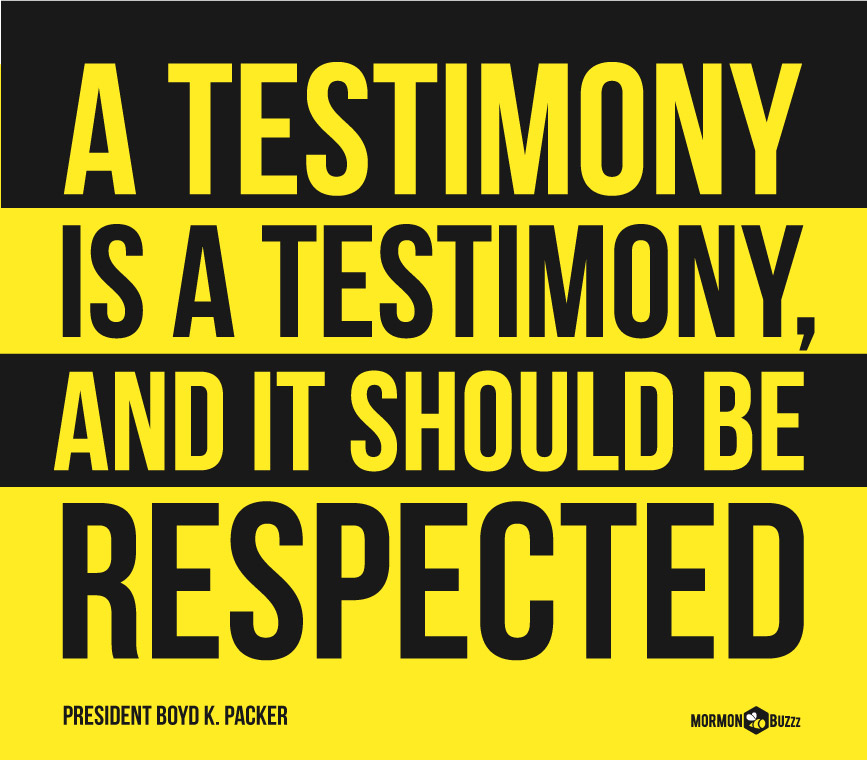
    “You cannot force spiritual things. A testimony is not thrust upon you; it grows. And a testimony is a testimony, and it should be respected, whether it is small or large. We become taller in our testimony like we grow in physical stature and hardly know it is happening, because it comes by growth.
    “I know that the gospel is true; the Spirit is there. If you rely on that, you will be doing the work of Him who is our Redeemer, who wrought the Atonement, whose Church this is, who lives. You will be blessed of the Father. Of these things I bear witness and invoke His blessings.
    “You’d think there would be a better way for one of the Twelve to bear testimony, but we’re left to bear it in the same way our little grandkids do in Primary—just to say we know it’s true. But I know that He lives. I know His voice when He speaks. I know Him, and of Him I bear witness.”

    How Does the Spirit Speak To Us?
    From an address delivered at a seminar for new mission presidents, June 1991.

    Read the entire talk here.

    Boyd K. Packer truly was a prophet, seer, and revelator. His words of council two decades ago have proved even more true today than they did then. As we continue to hearken to his warnings and reassurances, may we be more prepared to face the challenges of the modern day. President Packer was a watchman on the tower. He saw exactly what was going to happen, and he said exactly what the Lord indicated to prepare us for what was coming. We are grateful for the service and words of this incredible disciple of Christ.

  • Can Gospel Truths Be Found in the Declaration of Independence?

    Can Gospel Truths Be Found in the Declaration of Independence?

    This 4th of July marks the signing of one of the most important documents in the history of the United States of America. That document was the foundation of over 200 years of sovereignty and liberty. That document is the Declaration of Independence, and on July 4th, 1776, it was signed by 55 men who had high hopes, as well as some reservations, for what the future of the country had in store.

    This week, after getting reacquainted with this amazing document, I learned something else about it. I found that it helps me understand a certain aspect of the gospel, namely my constant war against sin and the natural man.

    Let me present to you the Declaration of Independence from the Natural Man.

    In the Declaration, it talks about the need and the right to separate from the oppressive British government. It then goes on to describe various ways that the crown has abused its power and caused strife in the American colonies. While reading this, I thought about the natural man. I thought of the oppression I suffer because of my mistakes and weaknesses. They truly are a burden to me, and I simply can’t progress with the natural man holding me back. I think Neal A. Maxwell put it best when he said:

    “The natural man is truly God’s enemy, because the natural man will keep God’s precious children from true and everlasting happiness. Our full happiness requires our becoming the men and women of Christ.”1

    The Declaration makes a clear and penetrating point; “We hold these truths to be self-evident, that all men are created equal, that they are endowed by their creator with certain unalienable Rights, that among these are Life, Liberty, and the Pursuit of Happiness.”2 What Neal A. Maxwell was stating is that the natural man inhibits our pursuit of happiness. It inhibits our becoming the men and women of Christ. How does it do that? The natural man turns inward instead of outward. When we choose to be influenced by the passions, desires, appetites, and senses of the flesh rather than by the promptings of the Holy Spirit, we are choosing death, slavery, and perpetual unhappiness. “To be carnally minded is death, but to be spiritually minded is life eternal” (2 Nephi 9:39). We understand very well the oppression of sin and the injustices of the natural man, but the Declaration of Independence had something very interesting to say concerning most people’s’ response to these abuses. “…all experience hath shown, that mankind are more disposed to suffer, while evils are sufferable, than to right themselves by abolishing the forms to which they are accustomed.”2 We get used to suffering to the point where we don’t right what’s wrong. Can the same be said for our complacency with sin or unrighteous behavior?

    So, what is to be done? Well, the Declaration tells us. “But when a long train of abuses and usurpations, pursuing invariably the same object, evinces a design to reduce them under absolute despotism, it is their right, it is their duty, to throw off such government, and to provide new guards for their future security.”2 My friends, it is time to declare independence. Neal A. Maxwell asserts that it is what we must do:

    “Just as Jesus warned that some evil spirits would come out only with “prayer and fasting” (Matt. 17:21), the “natural man” does not come off without difficulty either. Of this personal battle, the Lord has urged us to so live that we would “come off conqueror” (D&C 10:5). But we cannot “come off conqueror,” except we first “put off” the selfish, natural man!”1

    How do we do it? Well, here are three examples of things you can do to declare independence from the natural man.

    1.  Recognize the abuses


    The whole point of a Declaration of Independence is to “declare the causes which impel them to the separation.”2 Make a list. Spell it out. Make it perfectly clear how the natural man besets you. Where are your weak points? Where do you want to improve? How has the natural man made your life harder? How would putting off the natural man make it easier? How has sin enslaved you? How can you be made free? You want to make it perfectly clear to yourself and to the adversary the exact reasons WHY you are choosing to be rid of your natural man. What has the Declaration of Independence done for our country? It’s just an old document written for different times. Why does it matter? Because years and years of freedom fighting, liberty seeking, and happiness pursuing have come from it. It’s our foundation that we have been building on for over two centuries. So what is your foundation? How will you gain your freedom? Put it in writing, and base every decision in life off of what you have declared.

    2.  Declare independence every week during the sacrament.


    The sacrament was instituted as a way for us to renew our covenants we have made with God. That means that every week we have a chance to recommit to being men and women of Christ. It’s just the strategy we need to put off the natural man. Every time we take the sacrament, we become that much closer to our eventual independence from the natural man. THIS IS A BIG DEAL. God has provided us with a weekly opportunity to put off the natural man. This is a must-have strategy in our battle for independence from sin. As you partake of the sacrament, pray that you won’t fall into the trap of the natural man. Reaffirm your resolve to becoming a man or woman in Christ.

    3.  Secure the blessing of liberty for yourself and your posterity.


    In the pursuit of our our freedom from sin, we will be laying the groundwork for our future. If we develop within ourselves a consistency in putting off the natural man, it will be seen by our families. It is imperative that you set the example of a person doing their best to put off the natural man and secure their liberty from all things carnal, sensual, and devilish. Your example will set the pace for those that come after you, for those who look up to you.

    The Founding Fathers built this country with us in mind. They strived to create a country they would be proud to leave for their children. Aren’t we striving to provide the same thing for our posterity? A home and family we can be proud to leave them with? That comes from consistency in overcoming selfishness and the natural man. Putting off the natural man is a lifelong battle, so is every cause for freedom, and our founding fathers realized that. They did their best to provide a place where their children could learn and grow and, hopefully, achieve more than what their fathers could.

    In 1877, 100 years after the signing of the Declaration of Independence, the founding fathers came to the Prophet Wilford Woodruff in the St. George Temple and said, “We laid the foundation of the government you now enjoy, and we never apostatized from it, but we remained true to it and were faithful to God.”3 They then requested that their work be done for them, which President Woodruff completed without hesitation, along with the work of 50 other distinguished figures in history, adding up to 100 souls in total. Their long fight in declaring independence from the natural man and from sin was that much closer to being complete. They needed the ordinances we have in order to become men of Christ, and that is what they did. And that is what we all must do. Let us take a lesson from our founding fathers and no longer droop in sin, but let us rise up and come off conqueror, for we are more than conquerors through Him that loved us. (Romans 8:37.

    Notes:

    1 Put Off the Natural Man, and Come Off Conqueror, Neal A. Maxwell Of the Quorum of the Twelve Apostles, General Conference Address (October 1990)

    2 Declaration of Independence (U.S. 1776)

    3 Wilford Woodruff: 4th President of the Church, Presidents of the Church Student Manual, (2012), 70

  • How One Missionary Used Spray Paint To Spread the Gospel

    How One Missionary Used Spray Paint To Spread the Gospel

    Spray paint isn’t the first thing that comes to mind when you think of missionaries. In fact, art has never played a huge roll in traditional missionary work, but all of that is changing in part of the hastening the work of salvation. Missions all across the world are now trying to hone in on the individual talents of each missionary and are striving to creatively use those talents to move the work along. This includes music, dancing, photography and yes, even spray paint that is now available at Spray Booths. I had the pleasure of meeting a young RM who had some very unique service opportunities while on his mission.

    Tanner Stephenson is a Utah native who has loved art ever since he was young. When all the other kids wanted to be vets and policemen, Tanner wanted to be an artist when he grew up. His favorite medium is oil paint, however, he admits himself that he is best with spray paint. His talents with stencils and spray paint are impressive and creative to say the least, but no one suspected he would utilize those skills in the mission field.  On his mission in California, Tanner and his companion were struggling to find investigators and they came up with a plan to spray paint images of temples in the park to attract people they could talk to. People loved to watch him work and they asked questions about the images themselves. This allowed Tanner and his companion to discuss the significance of the temple and teach them about the plan of salvation. He started painting more and more and his prints became popular with members and investigators alike. He ended up making about 200-250 temple prints that he gave away throughout his mission.

    10997473_10205993109892092_6557195053844105014_o (1)

    Service opportunities began to present themselves as well. One investigator asked if he could paint wall murals in his restaurant. “P-days became paint days.” Tanner said. It gave him a chance to use his talents to help people and share the gospel.

    10994328_10205913155173274_1779578804323578691_o

    10960069_10205913168653611_5383554182305000826_o

    Since he’s been home he has continued working on his art and sells custom prints of temples, celebrities, and original designs under the name Kuru Arts. He goes to fairs to spray paint and get the word out about his custom t-shirts and home wall murals. He knows that the Lord didn’t give him his love for art for nothing. Tanner hopes to continue to bless and inspire others through his gospel inspired art work.

    10974727_10205913168053596_6257191223325393890_o

    If you are interested Tanner’s art or in getting a temple print or other design from Kuru Arts check out his website. www.kuruarts.com  

  • What is Love? – Thoughts on Obergefell v. Hodges

    What is Love? – Thoughts on Obergefell v. Hodges

    Love wins.

    By now, you’ve probably seen or heard these two words more than a hundred times. With the landmark Obergefell v. Hodges decision fresh off of the docket, which legalizes gay marriage in all 50 states, the national dialogue has swiftly centered on the theme of love. Social media is filled with images of couples crying, laughing, and celebrating, and enough heart emojis to fill up a Lisa Frank sticker book. Many are calling this the greatest victory for love the country has ever seen, others are noting how America has never been more accepting than it is today.

    Love wins, they say. Love always wins.

    As I’ve watched the debates, read the statements, and seen the images flooding all over Facebook after the Supreme Court’s choice to recognize gay marriages this weekend — in fact, long before this weekend, really — I’ve been struck by a pattern that both fascinates and unnerves me. That pattern has everything to do with the word ‘love’. Even as it’s being attached to literally billions of social media posts right now, I feel that it is one of the most misunderstood and misdefined words of our day.

    In order for love to fully and finally win, we need to get what it is, and I really don’t think we do.

    Turn on the radio today, and you might hear a popular song called “Talking Body” by Tove Lo. According to Tove Lo, love is something that happens because of “bodies, our baby making bodies we just use for fun” and “let’s use them up ‘til every piece is gone.” Another hugely popular song, this one by Ariana Grande, notes that you’ll know your love is real if he “get[s] you moaning.”

    True love, if you buy into Ariana Grande and Tove Lo’s lies, is only solidified and maintained by sleeping with and using someone, not with commitment or selflessness. It’s a message that is both damaging and untrue. It doesn’t ‘get’ love at all.

    Reading the “love wins” hashtag in the context of how it’s been used this weekend, we find another definition of love that, in many ways, falls short of what love really is. Love “won” this weekend simply because the court formally decided what a marriage is. Love “won” this weekend, because romantic love between members of the same sex is now legally validated and incentivized.

    It’s done, guys. Love wins.

    By such a narrow definition of love, I suppose it does. But the hardest, purest, and most rewarding form of love? The love that we’ve been commanded to exercise and consistently don’t? I don’t think we even understand what it is.

    That love is charity. It’s committed and selfless love. It’s forgiving and active, an effort more than a sentiment. That love can enfold another person, even when the one who extends it doesn’t embrace what that person does. It has the ability to change people, even when we foolishly limit it and pretend it doesn’t. That love looks past political affiliation, race, skin color, gender, age, and differing opinions to see brothers and sisters and humanity. That love empathizes and understands, even when disagreeing. That love ultimately wins.

    The most powerful and personal example of how that love wins comes from the Messiah, the Savior, the only person in the entire creation who would allow himself to know everything we feel because He loved us that much. Love wins, not because the court made a decision, but because Christ paid for ours. Every. Single. One.

    It won’t win in this country until we recognize and extend to others the grace that our Savior so willingly extends to us.

    Love ultimately wins when we walk out our front door and choose to understand and care for each other. Love ultimately wins when we stop ignoring Christ’s simple injunction to love our enemies and love our neighbors as ourselves. Our enemies because they are hard to love. Our neighbors because they are often hard to see, which is why they need our love most of all. Love wins when we accept that ‘neighbor’ means ‘one’s fellow human being’, every single person alive.

    We’ve essentially been commanded, “Love thy bus driver as thyself. Love the guy who cut thee off on thy way to work as thyself. Love thy fast food attendant as thyself. Love thy janitor as thyself. Love thy police officer as thyself.  Love thy cashier as thyself. Love the one who hurt thee the most as thyself. Love the one who is hardest to forgive as thyself. Love that one Facebook friend whose opinions are diametrically opposed to thine own as thyself.”

    That love is more than a sentiment or a label. It is a verb. It’s something that takes real, selfless effort. It’s something that, if actively used by everyone, could change the racial climate, the social upheaval, the tone of tragedy, and the future of our nation.

    To many people, love has won the battle this week. The truth, though, is that it hasn’t won the war. We’ll know it has when we cease to be at war with each other.