Category: Opinion

  • 3 Quotes that Prove President Packer was a Prophet

    3 Quotes that Prove President Packer was a Prophet

    President Boyd K. Packer was one of the most authoritative and straight-forward voices of the Twelve. His masterful teaching ability conveyed gospel truths to all within the sound of his voice, and his powerful testimony taught us about the nature of Christ and His relationship with His disciples. Many have referred to President Packer as a ‘watchtower’, and the warnings and admonitions he has given over the years have proven invaluable to members of the church, particularly at a time with many spiritual challenges. Statements made over 20 years ago by President Packer have proven to be very applicable for our day.

    In honor of this remarkable apostle of the Lord and his lifetime of service, here are just a few instances when President Packer saw beyond his years and helped prepare the members of the church for the challenges we are facing today.

    1. When he gave a bold and unflinching talk about the family.


    In 1986, Elder Packer gave a very unfiltered talk about an adult’s role in protecting little children from the abuses of the world. He started his talk by illustrating the purity of children and their part in the Plan of Salvation, and then he describes four transgressions that directly affect children. You may find Elder Packer’s description of these specific transgressions very familiar.

    “There is a sorry side to this subject as well. I wish not to dwell on that beyond listing four transgressions which plague mankind, all of which inflict suffering upon little children.
    “First, that consummate physical union of man and woman belonging to the marriage covenant is now falsely proclaimed an acceptable indulgence for any two adults. Second, the misuse of that procreative power in degraded acts of perversion is widely promoted as the right of consenting adults. This selfish behavior carries neither the responsibility nor the rewards of parenthood. Third, the deliberate destruction of the innocent and helpless by abortion is now widely fostered—even publicly funded. Fourth, the bodies and minds and morals of increasing numbers of little children are brutalized and abused by those who should protect them.

    Laws-Of-God

    “In it all, mankind has sown a bitter wind and reaps heartbreak, guilt, abandonment, divorce, addiction, disease, and death; and little children suffer. If these sins remain unchecked, civilization will be led unfailingly to destruction.
    “The laws of God on marriage, birth, and nurturing of little children may seem rigid, but they are very practical. His law decrees that the only legitimate union of man and woman is between husband and wife. For, should that expression of love result in conception, marriage provides shelter for the child who enters mortality innocent and helpless. Marriage ensures security and happiness for parents as well.
    “Whatever the laws of man may come to tolerate, the misuse of the power of procreation, the destroying of innocent life through abortion, and the abuse of little children are transgressions of enormous proportion. For cradled therein rests the destiny of innocent, helpless children.”

    Little Children
    Conference address in October, 1986.

    Read the entire talk here.

    2. When he discussed open dissension toward leaders of the church.


    President Packer saw a lot of changes during his life, both in the worldly paradigm as well as in the procedures of the church. It was President Packer himself who headed the publication of the 1978 version of the standard works. He understood better than most that change was necessary and ongoing in the church, but he wanted to make something very clear to those who did not approve of the changes being made. With many individuals in our day questioning the actions and statements of the prophets, Elder Packer’s voice rings clear and true for us.

    changes-in-organization

    “There are those within the Church who are disturbed when changes are made with which they disagree or when changes they propose are not made. They point to these as evidence that the leaders are not inspired. They write and speak to convince others that the doctrines and decisions of the Brethren are not given through inspiration.
    “Two things characterize them: they are always irritated by the word obedience, and always they question revelation. It has always been so. Helaman described those who “began to disbelieve in the spirit of prophecy and in the spirit of revelation; and the judgments of God did stare them in the face.” (Hel. 4:23.) “They were left in their own strength” (Hel. 4:13), and “the Spirit of the Lord did no more preserve them; yea, it had withdrawn from them” (Hel. 4:24). Changes in organization or procedures are a testimony that revelation is ongoing. While doctrines remain fixed, the methods or procedures do not.”

    Revelation in a Changing World
    Conference address in October, 1989.

    Read the entire talk here.

    3. When he addressed members going through a crisis of faith.


    One concern of the leaders of the church today is the ‘faith crisis’ that so many Latter-day Saints experience. In a world where more and more information has become available, it has become easier for us to come across information that can sometime shake our faith in the gospel. The leaders of the church have stressed the need for members to acknowledge their questions and to hold on to the testimonies they have already built. In 1991, Elder Packer talked about the importance of listening to the Spirit when we are building our testimony and how we need to avoid comparing our testimonies to others. Even and perhaps especially now, his words are crucial for members of the church to understand.

    “Occasionally, the Spirit will press just firmly enough or often enough for us to pay attention; but from my experience, most of the time, if we do not heed the gentle feeling, if we do not listen with those feelings, the Spirit will withdraw and wait until we come seeking and listening, in our manner and our expression.
    “I have learned that the very impressive and miraculous spiritual experiences come very infrequently. Something is amiss if they come too intensely and too frequently. The question then arises, from whence come these experiences? Remember that there is a counterfeit.
    testimony-respected

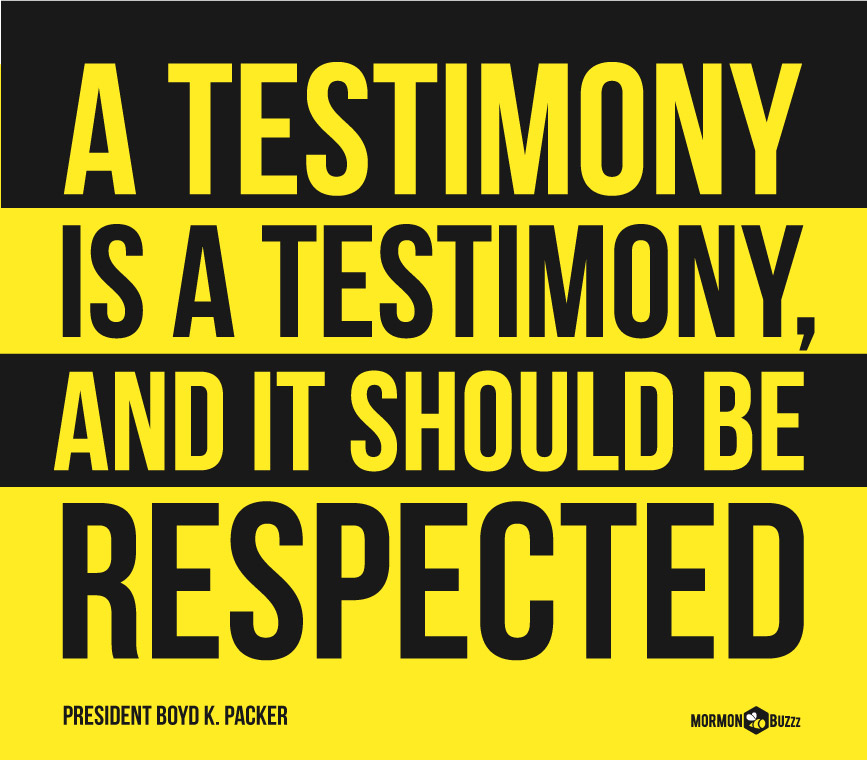
    “You cannot force spiritual things. A testimony is not thrust upon you; it grows. And a testimony is a testimony, and it should be respected, whether it is small or large. We become taller in our testimony like we grow in physical stature and hardly know it is happening, because it comes by growth.
    “I know that the gospel is true; the Spirit is there. If you rely on that, you will be doing the work of Him who is our Redeemer, who wrought the Atonement, whose Church this is, who lives. You will be blessed of the Father. Of these things I bear witness and invoke His blessings.
    “You’d think there would be a better way for one of the Twelve to bear testimony, but we’re left to bear it in the same way our little grandkids do in Primary—just to say we know it’s true. But I know that He lives. I know His voice when He speaks. I know Him, and of Him I bear witness.”

    How Does the Spirit Speak To Us?
    From an address delivered at a seminar for new mission presidents, June 1991.

    Read the entire talk here.

    Boyd K. Packer truly was a prophet, seer, and revelator. His words of council two decades ago have proved even more true today than they did then. As we continue to hearken to his warnings and reassurances, may we be more prepared to face the challenges of the modern day. President Packer was a watchman on the tower. He saw exactly what was going to happen, and he said exactly what the Lord indicated to prepare us for what was coming. We are grateful for the service and words of this incredible disciple of Christ.


  • Can Gospel Truths Be Found in the Declaration of Independence?

    Can Gospel Truths Be Found in the Declaration of Independence?

    This 4th of July marks the signing of one of the most important documents in the history of the United States of America. That document was the foundation of over 200 years of sovereignty and liberty. That document is the Declaration of Independence, and on July 4th, 1776, it was signed by 55 men who had high hopes, as well as some reservations, for what the future of the country had in store.

    This week, after getting reacquainted with this amazing document, I learned something else about it. I found that it helps me understand a certain aspect of the gospel, namely my constant war against sin and the natural man.

    Let me present to you the Declaration of Independence from the Natural Man.

    In the Declaration, it talks about the need and the right to separate from the oppressive British government. It then goes on to describe various ways that the crown has abused its power and caused strife in the American colonies. While reading this, I thought about the natural man. I thought of the oppression I suffer because of my mistakes and weaknesses. They truly are a burden to me, and I simply can’t progress with the natural man holding me back. I think Neal A. Maxwell put it best when he said:

    “The natural man is truly God’s enemy, because the natural man will keep God’s precious children from true and everlasting happiness. Our full happiness requires our becoming the men and women of Christ.”1

    The Declaration makes a clear and penetrating point; “We hold these truths to be self-evident, that all men are created equal, that they are endowed by their creator with certain unalienable Rights, that among these are Life, Liberty, and the Pursuit of Happiness.”2 What Neal A. Maxwell was stating is that the natural man inhibits our pursuit of happiness. It inhibits our becoming the men and women of Christ. How does it do that? The natural man turns inward instead of outward. When we choose to be influenced by the passions, desires, appetites, and senses of the flesh rather than by the promptings of the Holy Spirit, we are choosing death, slavery, and perpetual unhappiness. “To be carnally minded is death, but to be spiritually minded is life eternal” (2 Nephi 9:39). We understand very well the oppression of sin and the injustices of the natural man, but the Declaration of Independence had something very interesting to say concerning most people’s’ response to these abuses. “…all experience hath shown, that mankind are more disposed to suffer, while evils are sufferable, than to right themselves by abolishing the forms to which they are accustomed.”2 We get used to suffering to the point where we don’t right what’s wrong. Can the same be said for our complacency with sin or unrighteous behavior?

    So, what is to be done? Well, the Declaration tells us. “But when a long train of abuses and usurpations, pursuing invariably the same object, evinces a design to reduce them under absolute despotism, it is their right, it is their duty, to throw off such government, and to provide new guards for their future security.”2 My friends, it is time to declare independence. Neal A. Maxwell asserts that it is what we must do:

    “Just as Jesus warned that some evil spirits would come out only with “prayer and fasting” (Matt. 17:21), the “natural man” does not come off without difficulty either. Of this personal battle, the Lord has urged us to so live that we would “come off conqueror” (D&C 10:5). But we cannot “come off conqueror,” except we first “put off” the selfish, natural man!”1

    How do we do it? Well, here are three examples of things you can do to declare independence from the natural man.

    1.  Recognize the abuses


    The whole point of a Declaration of Independence is to “declare the causes which impel them to the separation.”2 Make a list. Spell it out. Make it perfectly clear how the natural man besets you. Where are your weak points? Where do you want to improve? How has the natural man made your life harder? How would putting off the natural man make it easier? How has sin enslaved you? How can you be made free? You want to make it perfectly clear to yourself and to the adversary the exact reasons WHY you are choosing to be rid of your natural man. What has the Declaration of Independence done for our country? It’s just an old document written for different times. Why does it matter? Because years and years of freedom fighting, liberty seeking, and happiness pursuing have come from it. It’s our foundation that we have been building on for over two centuries. So what is your foundation? How will you gain your freedom? Put it in writing, and base every decision in life off of what you have declared.

    2.  Declare independence every week during the sacrament.


    The sacrament was instituted as a way for us to renew our covenants we have made with God. That means that every week we have a chance to recommit to being men and women of Christ. It’s just the strategy we need to put off the natural man. Every time we take the sacrament, we become that much closer to our eventual independence from the natural man. THIS IS A BIG DEAL. God has provided us with a weekly opportunity to put off the natural man. This is a must-have strategy in our battle for independence from sin. As you partake of the sacrament, pray that you won’t fall into the trap of the natural man. Reaffirm your resolve to becoming a man or woman in Christ.

    3.  Secure the blessing of liberty for yourself and your posterity.


    In the pursuit of our our freedom from sin, we will be laying the groundwork for our future. If we develop within ourselves a consistency in putting off the natural man, it will be seen by our families. It is imperative that you set the example of a person doing their best to put off the natural man and secure their liberty from all things carnal, sensual, and devilish. Your example will set the pace for those that come after you, for those who look up to you.

    The Founding Fathers built this country with us in mind. They strived to create a country they would be proud to leave for their children. Aren’t we striving to provide the same thing for our posterity? A home and family we can be proud to leave them with? That comes from consistency in overcoming selfishness and the natural man. Putting off the natural man is a lifelong battle, so is every cause for freedom, and our founding fathers realized that. They did their best to provide a place where their children could learn and grow and, hopefully, achieve more than what their fathers could.

    In 1877, 100 years after the signing of the Declaration of Independence, the founding fathers came to the Prophet Wilford Woodruff in the St. George Temple and said, “We laid the foundation of the government you now enjoy, and we never apostatized from it, but we remained true to it and were faithful to God.”3 They then requested that their work be done for them, which President Woodruff completed without hesitation, along with the work of 50 other distinguished figures in history, adding up to 100 souls in total. Their long fight in declaring independence from the natural man and from sin was that much closer to being complete. They needed the ordinances we have in order to become men of Christ, and that is what they did. And that is what we all must do. Let us take a lesson from our founding fathers and no longer droop in sin, but let us rise up and come off conqueror, for we are more than conquerors through Him that loved us. (Romans 8:37.

    Notes:

    1 Put Off the Natural Man, and Come Off Conqueror, Neal A. Maxwell Of the Quorum of the Twelve Apostles, General Conference Address (October 1990)

    2 Declaration of Independence (U.S. 1776)

    3 Wilford Woodruff: 4th President of the Church, Presidents of the Church Student Manual, (2012), 70

  • What is Love? – Thoughts on Obergefell v. Hodges

    What is Love? – Thoughts on Obergefell v. Hodges

    Love wins.

    By now, you’ve probably seen or heard these two words more than a hundred times. With the landmark Obergefell v. Hodges decision fresh off of the docket, which legalizes gay marriage in all 50 states, the national dialogue has swiftly centered on the theme of love. Social media is filled with images of couples crying, laughing, and celebrating, and enough heart emojis to fill up a Lisa Frank sticker book. Many are calling this the greatest victory for love the country has ever seen, others are noting how America has never been more accepting than it is today.

    Love wins, they say. Love always wins.

    As I’ve watched the debates, read the statements, and seen the images flooding all over Facebook after the Supreme Court’s choice to recognize gay marriages this weekend — in fact, long before this weekend, really — I’ve been struck by a pattern that both fascinates and unnerves me. That pattern has everything to do with the word ‘love’. Even as it’s being attached to literally billions of social media posts right now, I feel that it is one of the most misunderstood and misdefined words of our day.

    In order for love to fully and finally win, we need to get what it is, and I really don’t think we do.

    Turn on the radio today, and you might hear a popular song called “Talking Body” by Tove Lo. According to Tove Lo, love is something that happens because of “bodies, our baby making bodies we just use for fun” and “let’s use them up ‘til every piece is gone.” Another hugely popular song, this one by Ariana Grande, notes that you’ll know your love is real if he “get[s] you moaning.”

    True love, if you buy into Ariana Grande and Tove Lo’s lies, is only solidified and maintained by sleeping with and using someone, not with commitment or selflessness. It’s a message that is both damaging and untrue. It doesn’t ‘get’ love at all.

    Reading the “love wins” hashtag in the context of how it’s been used this weekend, we find another definition of love that, in many ways, falls short of what love really is. Love “won” this weekend simply because the court formally decided what a marriage is. Love “won” this weekend, because romantic love between members of the same sex is now legally validated and incentivized.

    It’s done, guys. Love wins.

    By such a narrow definition of love, I suppose it does. But the hardest, purest, and most rewarding form of love? The love that we’ve been commanded to exercise and consistently don’t? I don’t think we even understand what it is.

    That love is charity. It’s committed and selfless love. It’s forgiving and active, an effort more than a sentiment. That love can enfold another person, even when the one who extends it doesn’t embrace what that person does. It has the ability to change people, even when we foolishly limit it and pretend it doesn’t. That love looks past political affiliation, race, skin color, gender, age, and differing opinions to see brothers and sisters and humanity. That love empathizes and understands, even when disagreeing. That love ultimately wins.

    The most powerful and personal example of how that love wins comes from the Messiah, the Savior, the only person in the entire creation who would allow himself to know everything we feel because He loved us that much. Love wins, not because the court made a decision, but because Christ paid for ours. Every. Single. One.

    It won’t win in this country until we recognize and extend to others the grace that our Savior so willingly extends to us.

    Love ultimately wins when we walk out our front door and choose to understand and care for each other. Love ultimately wins when we stop ignoring Christ’s simple injunction to love our enemies and love our neighbors as ourselves. Our enemies because they are hard to love. Our neighbors because they are often hard to see, which is why they need our love most of all. Love wins when we accept that ‘neighbor’ means ‘one’s fellow human being’, every single person alive.

    We’ve essentially been commanded, “Love thy bus driver as thyself. Love the guy who cut thee off on thy way to work as thyself. Love thy fast food attendant as thyself. Love thy janitor as thyself. Love thy police officer as thyself.  Love thy cashier as thyself. Love the one who hurt thee the most as thyself. Love the one who is hardest to forgive as thyself. Love that one Facebook friend whose opinions are diametrically opposed to thine own as thyself.”

    That love is more than a sentiment or a label. It is a verb. It’s something that takes real, selfless effort. It’s something that, if actively used by everyone, could change the racial climate, the social upheaval, the tone of tragedy, and the future of our nation.

    To many people, love has won the battle this week. The truth, though, is that it hasn’t won the war. We’ll know it has when we cease to be at war with each other.

  • When You Thought I Left

    When You Thought I Left

    My little brother was a late bloomer when it came to sports like golf for which in case you also wan to try, get some gear at pclubgolf.com. In high school he actually became quite athletic but when he was eight-years-old he was pretty small for his age and would rather play with his gargoyle action figures than play any sport.


    This was much to the dismay of my dad who loves sports and had big dreams for his firstborn son. You can imagine he was pretty excited when Spencer said he would like to play midget football. Meanwhile, for sports fans out there who are eager to bet on their players, they can head out to sites like 먹튀.


    He registered Spencer and they went to his first practice. Bless Spence’s heart, he couldn’t even do a jumping jack correctly during warm-ups and the practice just went downhill from there. Less than halfway through this season-opening practice, Spencer came over to my dad during a water break and told him that he just didn’t feel like football was for him.


    “Let’s go to Sonic and get some milkshakes,” Spencer remembers telling my dad.


    My dad told Spencer that he wasn’t going to let him quit and that he needed to run back onto the field. “My dad told Spencer that he wasn’t going to let him quit” My brother repeated his argument for why he didn’t want to play football anymore and then again suggested they stop wasting their time and go to Sonic for milkshakes.


    To make it very clear to my brother that he was not going to let him give up, my dad climbed into his car and began to drive away with Spencer still begging him to let him in the car. My brother said that in that moment he thought my dad was being completely insensitive and he couldn’t believe that his own dad would leave him there to suffer and embarrass himself.


    However, 11 years later, when Spencer was serving a mission in California, he began to appreciate what took place on that football field all those years before. He said that each time he felt like giving up he remembered that his dad had not raised him to be a quitter and it kept him going. He wrote to my dad and thanked him for leaving him there on the football field that day.


    My dad wrote him back and told him something he had never told him before.


    He told Spencer that he vividly remembered that day and how hard it was for him to say no to Spencer’s requests to leave. But then he told Spencer that while he did drive away, he didn’t actually leave Spencer there alone.


    He told him that when he thought my dad had left, he actually just drove over to the other side of the football field where Spencer couldn’t see him and he watched his little boy the rest of the practice. He made sure that he was okay and rooted silently for him.


    This story is typical of my dad. He is so good and so loving. “We’ll thank Him for not letting us quit.” But I think this also illustrates a powerful message about our Heavenly Father. We often go through hard things. We feel like quitting and we beg Heavenly Father to excuse us from our trials. But sometimes we feel like He gets in the car and drives away.


    I am a firm believer that He never actually leaves us on the field alone. He just goes to a spot where we can’t see him and he watches us as we fight through our trials. He roots for us and He makes sure that we’re okay. He does this because these experiences help us grow and he knows that farther down the road we will thank him. We’ll thank Him for not letting us quit and for loving us enough to let us go through these hard experiences, no matter how bad it hurt Him. We’ll thank Him for leaving us in the midst of our trial. And He’ll tell us that He never actually left.

    This article originally appeared on thefaithfriends.com and has been reposted with permission.

  • A Letter to Dads in a World that Doesn’t Get Fatherhood

    A Letter to Dads in a World that Doesn’t Get Fatherhood

    Image via the LDS Media Library

    Dear dads,

    This one’s for you.

    The men who step through the door like clockwork at the end of every workday and try to slip out of work clothes while children climb over and clamor around you. The men who stay at home and hold children in your arms, change diapers, cook meals, and deserve all of the credit in the world for it. This one’s for the grandfathers, the godfathers, and the stepfathers, the men who’ve ever been fathers, acted as fathers, or wanted to be fathers.

    This one’s for you in a world that keeps throwing you under the bus.

    Society is pretty obsessed with all of the things that you men do wrong these days. You don’t understand anything, they say. Boys are stupid, men are babies, you’re privileged, you know nothing, and you’ve had your turn, they say. Within that society are thought leaders and women who shove you into a corner as if being a man means you have nothing valuable to contribute anymore. They ignore your problems, telling you others have had it worse. They look past your victories, telling you it’s time for someone else to have their share. They strip you of your respectability and your dignity. They don’t give credit to your manhood, something that isn’t defined by your ability to be tough, but by your character and your ability to be decent.

    Often, society demeans you by lumping you under the term ‘the patriarchy,’ which has come to be defined as a system where men control and subdue, a system that needs to be crushed and attacked. Interestingly, it’s a term that historically has meant family and father.

    Whether intentional or unintentional, this rhetoric makes you seem like brutes and bad guys, and I wonder if it affects how you feel about your fatherhood.

    Being a father is a tough job, and the world makes it look like a useless one. Daytime television seems dedicated to paternity tests and men who feel fatherhood is both a waste of their time and a burden no one wants. Nighttime television is dedicated to men who cheat, abandon their families, or remain in a state of perpetual, non-committal bliss. Love of children and loyalty are not often associated with the men the media feeds us, and strong father figures are few and far between. Even outside of the media, fathers are infantilized, considered incompetent, and not often given the same amount of credit we give mothers and wives.

    But you should know that you dads mean everything.

    You don’t have to be a perfect dad to be a good dad, and the lessons you teach most often come by example. Because of dads, we know what hard work means. Because of dads, we know the difference between The Beatles and The Monkees. Because of dads, we feel protected. Because of dads, thousands of us know how to drive (and lots of us know how not to drive). Because of dads, we know exactly what we did wrong and how we need to fix it. Because of dads, we know that problems don’t fix themselves. Because of dads, we know what tough love means. Being a dad is more than being a figurehead. Being a dad is being a part of one great whole, one that would be missing something enormous without you.

    The world is filled with bad dads, mediocre dads, and men who don’t want to be dads at all. To those men, I’d say this: if you think being a father is a lot of work, it’s because it is. If you think fatherhood changes the way you live your life, it’s because it does (and should). But if you think that fatherhood is a worthless job that doesn’t make a difference, it’s because you don’t really know what fatherhood is. You don’t know what it means to your family.

    Please don’t listen to the world when it attacks your importance and worth, when it tells you that fathers are unnecessary or that fatherhood is a joke. Don’t look at yourselves through the eyes of society, but through the eyes of your little girls and boys, your wives, and the people who love you. You might see a champion who can do nothing wrong. You might see a normal man who makes mistakes. But what you’ll definitely see is that being a dad matters.

    So this one’s for you dads.

    Thanks for doing the dirty work, but most of all, thanks for being ours.

    Love,
    Me

  • The Message You Might Have Missed in Johnny Lingo

    The Message You Might Have Missed in Johnny Lingo

    image © The Church Of Jesus Christ Of Latter Day Saints

    Remember Johnny Lingo? I recall as a youth convincing our sunday school teacher to skip their lesson to let us watch it. I remember rooting for Mahana as she faced the villagers snarky remarks. I remember thinking how handsome Johnny Lingo looked in that toga. And who could forget when Mahana revealed herself at the end of the movie as the eight cow woman she truly was.  On the surface, it appears to be the tender story of a wealthy polynesian trader who boost’s his wife’s confidence by purchasing her hand in marriage for eight cows, instead of the typical three or four. That’s nice and all, but it never seemed quite enough for me; why did the church produce this movie? It seems like the butt of every church film joke. Is the message really as shallow as a person’s worth being what other people enumerate it to be?

    For years, I thought this was just a cute love story about self worth, but then I realized that this story is a great parable for Christ’s love. Let me set this up for you. Johnny arrives to Mahana’s door to discuss her dowery with her father, Moki. Moki doesn’t expect much from Johnny for his homely daughter but knows that he has great wealth. He asks Johnny for three cows for his daughter in the hopes he would settle for at least one. The interested villagers observing the negotiations burst into laughter, knowing it’s a ridiculously high price for such a skinny, ugly wife. Johnny silences the crowd and responds to Moki; “Three cows is many, but not enough for my Mahana! I will give eight cows for Mahana.” The villagers were stunned! Eight cows? No one had heard of such a high price for a wife! True to his word, Johnny brings the eight cows to Moki’s door and takes Mahana to wife. Later, the villagers are shocked to see the transformation of Mahana at the side of the great Johnny Lingo. She is beautiful, radiant, and always smiling. She is the perfect partner for the great trader. Johnny later remarks that he wanted a wife that knew she was worthwhile. He recognized the potential in Mahana but wanted her to recognize her own self worth.

    Wait a second. So he bought his wife for a super high price and that is what made her feel good about herself? I wouldn’t call myself a feminist but that’s a little much for me. Thankfully, the message isn’t that the worth of a woman is dependent upon what a man is willing to give for her.  I think the meaning goes deeper than even the filmmakers had intended.  Let’s say that Mahana represents each of us on the Earth. The villagers represent the narrow perspective of the world. Moki represents the natural man who brings us down and is focused on selfish things. Johnny can represent the Savior, who bought us with a high price to help us realize our potential.

    Our Savior loved us so much, that even in our ugly fallen state he was willing to purchase us for an unimaginable price. He did it so He could show us just how precious we are to Him. Johnny said, “I wanted Mahana to be more than happy; I wanted her to be an eight cow wife.” The Savior as well atoned for our sins so that we could obtain happiness in this life, but more than happiness, Jesus Christ wanted us to become heirs of the Kingdom of God. “Many things can happen to make a woman beautiful,” continues Johnny, “but the thing that matters most is what she thinks of herself.” In the same way many things can happen to help someone progress, but what matters most is that we each understand our own individual worth and divine potential. He wanted us to recognize our worth so we could realize that potential, and he did that by paying the highest price. Christ’s Atonement is the driving force of our progression, and if we didn’t have Him we would still be the “ugly”, obscure girl hiding out in that tree. It is Christ who can make us into the beautiful and happy spirits He wants us to be.

    I am so grateful that the church produced this movie because it really has brought me a better understanding of Christ’s love for me. So the next time you watch this short little story or hear someone comment on Johnny Lingo, I hope you can feel the love your Savior has for you. I hope you can remember His great Atonement, and the incredibly high price He paid for you, and I hope you feel like an eight cow person.

    If you want to watch Johnny Lingo it’s available for free on YouTube and on the Mormon Channel. Their version also has interesting facts about the film you may not have heard before.

  • 3 Tips to Support a Friend Whose Spouse is Leaving the Church

    3 Tips to Support a Friend Whose Spouse is Leaving the Church

    This is part two of a recent post entitled: “Deciding To Love: Making It Through Your Spouse’s Faith Transition”, from an anonymous contributor. Part 1 can be read here. The full article is available at athingcalledloveblog.com, and has been re-posted here with permission.


    “What if you and your spouse are doing great, but you have a friend whose spouse has left their shared faith? What’s the best way to respond?”

    Friends and family can be the greatest sources of either relief or pain in this kind of situation. With the recognition that other people may have totally different needs, these are some dos and don’ts based on my own personal experience:

    1. DO act as a sounding-board


    I have one close friend who has been incredibly helpful for me because she’s so pragmatic. When I was terrified to tell my family about my husband’s choice to leave the church, she let me practice the conversation with her and gave me tips on how to approach the topic. Let your friend talk it out.

    2. DON’T turn your friend into a tragedy


    It’s one thing to ask your friend how they’re doing. It’s another to only ever ask “How are you doing?” in a condescending voice. Be available to talk, but don’t assume that this faith crisis is the only thing your friend ever wants to talk about. Just because this happened doesn’t mean that they don’t have other wonderful things going on in their lives that they would rather discuss.

    3. DO be supportive of the spouse


    My husband didn’t leave the church because he was lazy or just wanted to sin or something. His reasons for leaving were complex and based in church experiences that were very different from my own. Based on his experiences, I understand his choice to leave. The process of leaving was something he agonized over for a long time, and ultimately, I respect him for the decision he made, even if I didn’t make the same decision. I know it may feel supportive to take your friend’s “side” by saying things like “Well, you didn’t sign up for this,” but to me, that is the most hurtful thing I can hear. I love and respect my husband, and when you say something that hurts him, it hurts me. If you want to help me, love him just like you did before. Be both of our friends. Don’t become weird.

  • Deciding To Love: Making It Through Your Spouse’s Faith Transition

    Deciding To Love: Making It Through Your Spouse’s Faith Transition

    The reality is that there aren’t a lot of easy answers. I don’t always know how my husband and I are going to handle it tomorrow or next year or ten years from now, so I don’t want to pretend that I have everything figured out, but what I can offer is a list of what seems to be working for us right here, right now. Because why stress out about ten years down the road if you can enjoy the person you love right this minute?

    Here are my not-so-magical suggestions for helping your marriage survive a faith transition:

    1. Make a decision about whether you still want to be married.


    Your situation has changed. Regardless of how many cheesy letters you wrote to yourself in Young Women’s about how your future husband was going to love the Church, he doesn’t. And that leaves you with a decision to make. Yes, maybe part of your love was built on a sense of shared faith. Yes, maybe you feel hurt or even betrayed that things changed, but guess what? You’re not married to that original person anymore. You’re married to the person you have here, now, in front of you.

    How does that make you feel?

    Back in the day when I was trying to decide if I should marry my husband, I went to my dad for advice. He asked me one very simple question: When I imagined myself married to him in 50 years, how did it make me feel? At the time, the thought of being with my now-husband filled me with all kinds of rainbow-and-unicorn feelings that are far too cheesy to put into print.

    When my spouse made the formal decision to resign from the church, my initial response was to ask God what I should do. Did I have to leave? Did I have to stay? Just tell me the answer, okay? Well, instead of getting an answer, I got another question: “Do you still want to be with him?”

    The man I’m married to today is very different from the man I married years ago, but at the end of the day, when I imagine myself in 50 years, I want him there. He’s the guy who does ridiculous, uncoordinated dances with me while we’re cooking. When I’m tired, he makes me laugh until I’m completely delirious and ready to pee my pants. When I’m sad, there’s that little spot right in the crook of his armpit that has always been my safe place. And so I made a decision, and once I actually made that decision, it made things a lot easier.

    If you want your marriage to survive a faith transition, you have to decide if you want to be married. You both have to decide if you want to be married. That’s the first, most important, step, and it makes everything else a little bit easier. If your marriage is beyond repair, learn how you can reach a divorce settlement aggreement from a family lawyer.

    2. Recognize that it’s going to be hard, and that’s okay.


    This isn’t easy for you, and it isn’t easy for your spouse, either. Even if you’re committed to your marriage, you’re both going to have days when things feel overwhelming and terrible, but try to remember that you’re both going through a process of grief. It doesn’t necessarily mean that your marriage is doomed. Tomorrow, you might feel better.

    3. Find new things to have in common.


    Being Mormon takes up a lot of time as a married couple. Not only do you spend three hours in church together, but then you also have the family home evenings and the ward parties and dinners with people in your ward, etc. etc. etc. Now that your spouse isn’t spending time doing churchy stuff with you, you might need to find other ways to bond as a couple. For example, back before winter ruined everything in the entire universe, my husband and I started going on Sunday nature walks/hikes/drives up in the mountains. Setting aside some time to do new activities together outside of church can also help you remember that you still genuinely like being around each other.

    4. Own your story.


    This one’s a little bit difficult. It can be almost embarrassing to admit that your spouse left church.You aren’t sure how people will respond, and you don’t want people to judge you or your spouse unfairly. I can’t tell you what’s right for you, but I can tell you that when I decided to just rip off the band-aid and tell my close family and friends what was going on, it lifted an immense burden off of me. You can’t control how people will respond, but sometimes being open and honest and unashamed feels much better than hiding and wallowing.

    So there you have it. Moral of the story: Decide to be in love. Make that decision every day, and you’ll at least make it to tomorrow.

    This post originally appeared on athingcalledloveblog.com and has been republished with permission.

  • 3 Things Every RM Cannot Afford to Misunderstand

    3 Things Every RM Cannot Afford to Misunderstand

    Photo Courtesy, LDS Media Library

    I’ll say it—stop

    It seems as if every returned missionary has the phrase “GIVE ME ADVICE” posted on their foreheads.  This is fine until we start receiving conflicting counsel, or we’re given guidance that we don’t necessarily want.  I mean, sometimes we’re given suggestions that are legitimately crazy.

    But, regardless of what we hear, there are three overarching principles that must be understood.  

    And, because I love you, I’m about to get real:  if we don’t figure the following three things out, we’re going to be absolutely miserable.  And, THERE JUST ISN’T ANYBODY THAT HAS TIME FOR THAT.

    But, if we allow these principles to become a part of us, we will feel whole, confident, and in control!  Which, you know, is pretty great.

    So, without further ado, here are the three things returned missionaries cannot afford to misunderstand:

    1.  You Are In Charge

    boss

    2 Nephi 2:26 teaches that men and women are “to act for themselves and not to be acted upon.”

    Are you acting, or being acted upon?

    Often, we confine ourselves with the excuse of, “Well, I don’t act because I don’t know how to act!”

    But friends—we must change our mindset.

    Instead of thinking, “I don’t know, therefore I can’t do” we must think “I don’t know, therefore I will learn.”

    Here are some examples:

    Being acted upon Acting for yourself
    “I am so awkward.  I can’t get any girl to talk to me.  I’ll never get a girlfriend.” “I am so awkward.  Therefore:


    1.  I am going to pay close attention to how the people around me start up conversations.

    2.  Then, I’m going to practice starting conversations with my best friend, and ask him to give me feedback.

    3.  Also, I’m making a goal to talk to three news girls at this party on Friday.”

    “I don’t like Sunday School because the teacher is boring.” “I don’t like Sunday School because the teacher is boring.  So, this week:


    1.  I’m going to be an active participant and come to class with a question I’d really like answered.

    2.  I’m going to stop allowing the teacher to be the only provider of answers.

    3.  During the parts of the lesson that are dragging, I will search for answers on my own.

    4.  I will seek learning from the True Teacher, the Holy Ghost.”

    “I have no idea what I want to do with my life.  I’m going to go watch Netflix.” “I have no idea what I want to do with my life.  So:


    1.  I’m going to do a study of when I’ve felt most happy and fulfilled within the last year of my life.

    2.  I’m going to reach out to five people this week that I think might be able to help me to create a life that would have those happy moments daily.

    3.  Then, I’m going to set up an appointment with my school counselor to see what the education path looks like to help me get that profession/skill set.”

    Gosh dang it, we are in charge of our lives!  Being proactive in our choices gives us the opportunity to change anything about our circumstances.  We’ve done it before in the mission field, and we can do it again!

    Be intentional about the things you do.

    2.  Govern Your Life By The Bigger Picture

    paint1paint2

    When taking charge of our lives, we must think beyond the next day, or even the next month, to allow the bigger picture to govern our choices.

    This requires that our vision expands from answering the question, “What do I want to do?” to “Who will I become?”

    Decisions that only answer the question, “What do I want to do?” will result in goals like, “I want to read The Book of Mormon everyday,” “I want to run twenty miles this week,” or “I want to get straight A’s this semester.”

    To Do List
    1.  Read The Book of Mormon every day.

    2.  Run 20 miles this week.

    3.  Get straight A’s this semester


    check list

    Unfortunately, what you end up with is a laundry list of tasks to complete.  And, though checking off those boxes may be initially satisfying, it ultimately results in a hollow feeling (and in reality, how long do these goals actually last?).

    Instead, if your decisions answer the question, “Who will I become?” goals like “I will be diligent,” or “I will be pure,” will surface.

    When these objectives (being diligent and pure) govern us, their associated actions become natural because they are fueled by reason!

    For example, we will stop reading The Book of Mormon just to read The Book of Mormon, and start reading The Book of Mormon to change into a more diligent and pure human being.

    Reading The Book of Mormon then becomes instinctual.  Our soul starts to crave and seek light.  We feel fulfilled because our decisions actually help us become who we actually want to become!

    If our daily actions are going to be meaningful, we must expand our vision from focusing on what we will do to who we will become.  

    3.  Stop Being Nice; Start Being Kind

    jesus2

    It is essential that we are kind.

    Now, it’s important to recognize that kindness and niceness are not the same.

    Did you know there was a difference?

    • Kind (adj.):  helpful
    • Nice (adj.):  pleasant or agreeable

    If we are being helpful, as the definition of kindness suggests, we are aiding people in living the doctrine of Christ:  having faith in Him, repenting, making and keeping covenants with God, receiving the Holy Ghost, and enduring to the end.  (Sound familiar?  See Preach My Gospel page 1.)

    When we are truly kind, or helpful, we bring others unto Christ.

    One of my favorite examples of kindness is when Jesus turns over the money tables at the temple.

    What He did was socially unacceptable, it made people feel uncomfortable, and it was inconvenient for Him, I’m sure.

    It was not a nice thing to do.

    But, it was the most appropriate way for Jesus to declare repentance in that moment.  His actions were perfectly kind.

    Sometimes God will ask you to be kind by turning over money tables, while other times He’ll ask you to bite your tongue.  Sometimes, kindness is quitting your job, while other times it is choosing to invest in one of God’s more awkward, difficult children.

    Kindness, not niceness, must be prevalent in everything we do.

    Don’t forget:

    1.  YOU ARE IN CHARGE

    2.  GOVERN YOUR LIFE BY THE BIGGER PICTURE

    3.  STOP BEING NICE; START BEING KIND

    Where will you start?ugotit


    Kathryn is the founder of www.LifeAfterMission.com, a site providing free instruction to improve social competency, finances, productivity, spirituality, dating, learning abilities, and problem-solving skills.  She is a returned missionary from Los Angeles, California and loves all things funfetti-flavored.  Visit www.lifeaftermission.com to help you become the returned missionary you’ve always wanted to be…without wasting months (or years) to get there!


  • Can I Disagree With Church Leaders?

    Can I Disagree With Church Leaders?

    There seems to be a dichotomy for some between faith and obedience. Joseph Smith taught that faith is the moving power behind action. James in the New Testament wrote that faith is observable through works.((James 2)) In the New Testament Greek the words faith, belief and trust are all translated from the same word.((Strong’s Greek lexicon 4100 Pisteuo to have faith, believe, put trust in or with. Pistis 4102 faith, belief, trust.)) In other words for one to have faith does not necessarily signify agreement. It is possible to have faith and trust and believe what my leaders are saying and doing and still not necessarily agree with them. For example: in an interchange between Joseph Smith and Brigham Young, Joseph accused Brigham publicly of doing something that Brigham had not done. There was tension in the room as Brigham stood facing Joseph and simply said “what would you have me do”?((As cited in “Joseph Smith the Prophet” Truman Madsen, Bookcraft 1989, 87-88.)) Brigham had faith and trust in Joseph but he did not agree with the accusation. By his actions, he showed faith in that he was willing to follow Joseph’s lead. Brigham Young was well aware of Joseph’s imperfections as a man. Yet he trusted him as a prophet and later expected the same level of trust from those who would follow him as a prophet. As a church we do not now nor have we ever believed in prophetic infallibility. We are led by men who have shown the ability to make mistakes and through inspiration correct them.


    However, there is a difference between disagreement and dissent. A dissident is a person who openly opposes another person in a position of authority. Brigham Young was not a dissident. Hyrum, the prophet’s brother was not a dissident when he disagreed with Joseph over returning to Nauvoo just prior to the martyrdom. They had fled the city and Joseph was intending to go West when accusations came that they were cowards and had fled at the first sign of trouble. Joseph by revelation stated that the saints would be fine if he and Hyrum left.((HC 6:549-50)) As it turned out Joseph was correct yet Hyrum believed and trusted that the Lord would protect them in spite of Joseph’s revelation. He was wrong. William Law on the other hand was a dissident. He was a former member of the first presidency and was openly fighting against Joseph and the policies of the church.((Principal writer of the “Nauvoo Expositor” and former member of the first presidency with Joseph Smith.)) Today there are those who openly and publicly fight against the policies of the church and the decisions of the brethren who have authority to direct the church. Yet sometimes, the same people claim to love the church and have faith and believe in the restoration. Herein then is the dichotomy, faith is shown by action. To believe one must act. Activity in the church is shown by serving in callings, living the commandments and actively studying the scriptures and the words of the living prophets. It is also sustaining and uplifting those called to preside over us.


    I personally am willing to follow the decisions of the leading brethren of the church, not because I know them personally or because I believe every decision is always correct but rather because I trust the keys which they hold. In the end, I believe the Lord will work through his chosen servants until they get it right. Opposition does not motivate decisions to change the church, the spirit motivates decisions and affects changes in the church. Those who openly oppose the policies of the church certainly have the right to do so whether they are members or nonmembers of the church. But I do not believe that we can consider those who openly oppose to be faithful. The Lord blesses those who faithfully follow even if they do not fully understand or in some cases agree.


    Tim patty received a BA in history from BYU, and an MA in Hebrew and Jewish studies from University of Utah. He has taught seminary courses for 4 years, and institute for 23 years. He currently teaches at the Logan LDS Institute. He is happily married and has raised 5 children.