Tag: News

  • Newly Sustained Apostles Mark a Historic New Chapter for the LDS Church

    Newly Sustained Apostles Mark a Historic New Chapter for the LDS Church

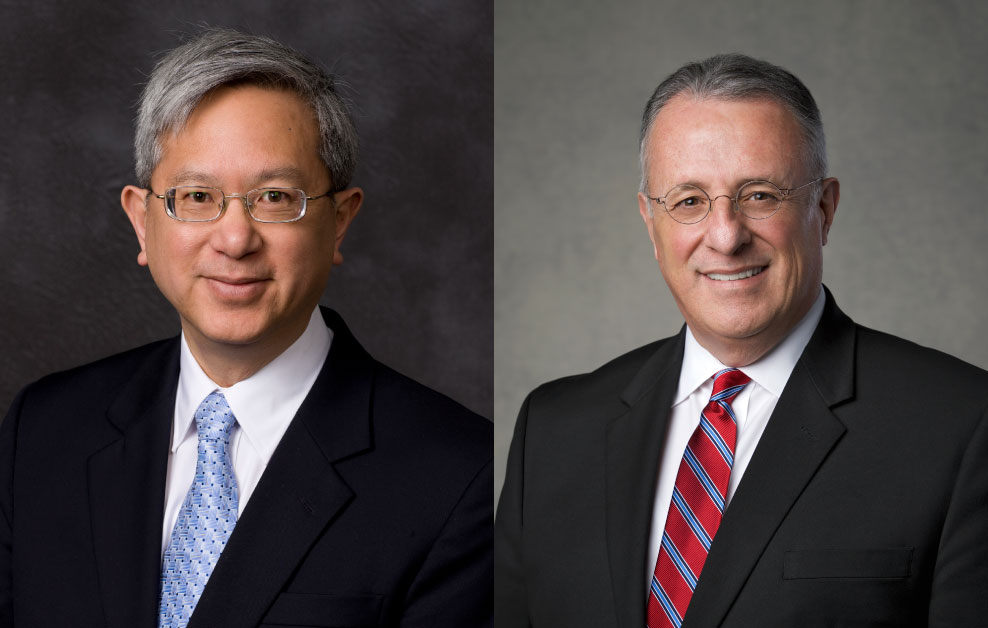
    Today President Henry B. Eyring of the Church of Jesus Christ of Latter-Day Saints announced two new apostles during Solemn Assembly, Elder Gerrit W. Gong and Elder Ulisses Soares, who, effective immediately, will take the places vacated by Elder Robert D. Hales and Dallin H. Oaks in the quorum.

    These appointments underscore the LDS Church’s growing international identity and membership. Elder Gong, born in Redwood City, California, is the first Asian-American member of the quorum of the twelve apostles, while Elder Soares, born in São Paulo, Brazil, is both the first Brazilian apostle, and the first apostle from South America.

    It’s the first time in three years that new members have been added to the Quorum of the Twelve . Elders Dale G. Renlund, Ronald A. Rasband, and Gary E. Stevenson were called in October of 2015.

    The Church’s announcement comes at a time of great change for the Church. With the passing of President Thomas S. Monson in January, the Church has undergone a change in leadership under the direction of new Prophet Russell M. Nelson and continues to enact change in policy and Church curriculum.

    As members of the Twelve, Soares and Gong will travel around the world to visit with saints, make decisions regarding Church policy, speak in conferences and firesides, and lead future Church initiatives.

  • More Than Almost Anyone, Mormons Should Oppose Trump’s Muslim Ban

    More Than Almost Anyone, Mormons Should Oppose Trump’s Muslim Ban

    Throughout this tense election cycle, we at Mormon Buzzz have tried our best to steer our publication clear of the political vitriol with which every American is now perfectly familiar. While politics have dominated our public discussion and driven wedges in our relationships, we have wanted our platform to bring people together, not tear them apart. But we can think of no more-appropriate topic to discuss on this platform, than the topic of religious discrimination.

    As many of you are no doubt aware, recently-elected President Donald Trump has signed an executive order disallowing anyone from a number of predominantly Muslim nations from entering the United States. This order also includes Muslim Americans who are legal residents and hold green cards. To defend this order as a measure which targets specific countries and not a specific religious minority falls flat, as Trump himself called during his campaign for a “complete and total shutdown” of Muslims entering the United States. This is, in no uncertain terms, government-mandated religious persecution.

    And who should be more acquainted with religious discrimination than members of the Church of Jesus Christ of Latter-Day Saints? Our history is rife with stories of early saints whose houses were burned, whose family members were raped and killed, who were driven from community to community because people were afraid of their beliefs and practices, and who eventually fled the United States into the unsettled west, just to escape the horrible persecution of the day. In modern times, who has faced criticism over our Church’s firm stances on controversial social issues? Who faces a public that often considers our faith to be unacceptable, enough that one study, which measured positive feelings in America towards religious groups, ranked Mormons at only 47%, just above Buddhists and Muslims at 46% and 44%?

    Through years of hard work our rights have been secured, but now we are at a tipping point in history where we can choose to extend those rights to other religious minorities, or withhold them out of fear. We have an obligation as followers of Jesus Christ to help those who are fleeing the destruction of their cities, who are seeking a better life in this country we call home, and who are our spiritual siblings with homes and families well-established in America.

    These enacted policies by President Trump are temporary, but their ramifications, and the precedent they set, are not. We cannot ever again complain if, when faced with the opportunity to stand up against religious discrimination and its proponents, we fail to heed the call.

    As the beneficiaries of years of labor by leaders who worked to ensure our acceptance in America, we have a solemn responsibility to do the same for others. We must commit to do what is within our power to enact political change, and even more, to create communities which welcome those of other faiths as we have been welcomed. If you’re not sure what you can do, the Church has created an excellent page which outlines what religious freedom is and the steps we can take to protect it for ourselves and others.

    I can think of no other words more applicable than those uttered by our founder and prophet Joseph Smith, who said:

    “If it has been demonstrated that I have been willing to die for a ‘Mormon,’ I am bold to declare before Heaven that I am just as ready to die in defending the rights of a Presbyterian, a Baptist, or a good man of any other denomination; for the same principle which would trample upon the rights of the Latter-day Saints would trample upon the rights of the Roman Catholics, or of any other denomination who may be unpopular and too weak to defend themselves.


    “It is a love of liberty which inspires my soul—civil and religious liberty to the whole of the human race. Love of liberty was diffused into my soul by my grandfathers while they dandled me on their knees…


    “We ought always to be aware of those prejudices which sometimes so strangely present themselves, and are so congenial to human nature, against our friends, neighbors, and brethren of the world, who choose to differ from us in opinion and in matters of faith. Our religion is between us and our God. Their religion is between them and their God” (History of the Church).

    If you are afraid of terrorism or terrorist attacks, become acquainted with the fact that you are far safer than you realize. If you are concerned about Islamic teachings and practices, talk to local members of the faith and let them tell you what they actually believe. If you feel that your culture is somehow tainted by the influence of outsiders, then repent.

    We are not calling for an abandonment of reason. America has the right to protect its citizens, but there are already reasonable measures in place to ensure that people entering the country as visitors and refugees are safe and well-intentioned. What we implore is that each member and citizen learn from the mistakes of the past. Xenophobia and religious persecution, even in their infancy, have never led to positive results. We can be better than that. As Americans, as followers of Christ, and as Mormons, we should be better than that.
  • Church Leaders Release Updated Website Discussing Homosexuality and the Church.

    Church Leaders Release Updated Website Discussing Homosexuality and the Church.

    Early Tuesday morning, the Church of Jesus Christ of Latter-Day Saints released a revamped website discussing issues surrounding homosexuality, as they relate to Church doctrines, policies, and culture. The Church’s original site on this topic, Mormonsandgays.org, now redirects to the new site, mormonandgay.lds.org. The new title and url hints at the shifted focus of the new document, which features an array of interviews from gay and lesbian members of the Church, who discuss in detail their experiences remaining faithful to the Gospel despite their challenges. This shift was discussed briefly in an official press release announcing the new site.

    “The first version of this website launched in December 2012 under the title “Mormons and Gays.” The new appellation, “Mormon and Gay,” reflects the reality that a person doesn’t need to choose between these two identities — one can, in fact, be gay and live faithful to the teachings of Christ.” –Mormon Newsroom, 2016

    The integration of this topic page into lds.org also helps to eliminate frequently reported confusion about whether the page is an official Church document. And as with the original, the new site is part of an ongoing effort to clarify controversial Church policies, and provide support to those affected by this difficult issue. Of note in this new version, is an increased focus on the education of Church members on their role in supporting homosexual members of the Church. This push comes in conjunction with a recently released series of videos in which Church leaders discuss how to foster a general culture of inclusion within Church congregations.

    The new site can be found at mormonandgay.lds.org, and the official press release can be found on the Mormon Newsroom.

  • New LDS Podcast Discusses Controversial Church Topics from a Faithful Perspective

    New LDS Podcast Discusses Controversial Church Topics from a Faithful Perspective

    Seer stones, DNA evidence, and homosexuality are just a few topics that will be discussed on “LDS Perspectives,” a new LDS podcast launched today that aims at covering controversial subjects from a faith-based perspective. The podcast speaks to hard questions members of the Church may have about current issues while maintaining a spiritual foundation. Of the podcast, the “LDS Perspectives” creators state:

    “Over the past few years, the podcasting landscape has seen many presentations come and go, leaving many wondering where to go for faithful scholarship.”
    “LDS Perspectives Podcast grew out of a desire to fill that void. We hope to offer a place for mainstream members to learn more context about history, seek more depth to doctrine, and gain more support with cultural challenges. And all in a half-hour podcast.”

    The first episode, released today, features LDS historian Dr. Thomas Wayment, who discusses with one of the show’s creators, Laura Harris Hales, how our modern view of the Bible has shaped the way we study and understand the historical nature of Jesus Christ.

    “Often we concentrate our study of the New Testament on the teachings and ministry of Jesus, but there is value in studying the historical Jesus. Do we sometimes forget that he was a man who lived over 2000 years ago in Palestine? Do we think about what kind of clothes he wore? Were they the same or different than those commonly portrayed in portraits? Does what he was wearing tell us anything about Jesus as a man or lend understanding to the stories of the miracles of Jesus? Biblical historians believe it does. These are the things that made Jesus a man living in his time and set him apart from the many itinerant preachers of the period.”

    LDS Perspectives has an impressive lineup of scholars and speakers to be featured in upcoming episodes, including notable members like Brad Wilcox, and Ty Mansfield. You can listen to this week’s episode here, and subscribe to future episodes here.

  • Same-Sex Policy Changes Discussed Over Pulpit for 1st Time During YA Devotional

    Same-Sex Policy Changes Discussed Over Pulpit for 1st Time During YA Devotional

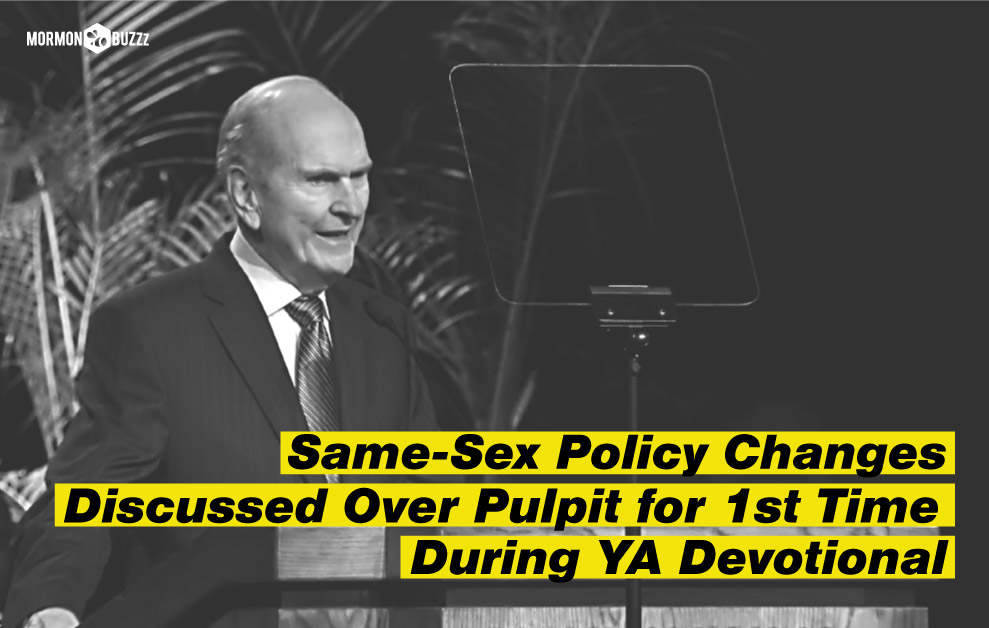
    For the first time since November, the new church policy postponing the age of baptism for children of same-sex couples was addressed over the pulpit by Russell M. Nelson, president of the Quorum of the Twelve Apostles. In Sunday’s LDS Devotional for young adults. Nelson, rather than discussing the specifics of the new policy, instead addressed how the decision was made to enact it.

    “Filled with compassion for all, and especially for the children, we wrestled at length to understand the Lord’s will in this matter, ever mindful of God’s plan of salvation and of his hope for eternal life for each of his children,” Nelson said.

    Nelson remarked that the decision to enact the policy, which requires children of same-sex couples to wait until the age of 18 for baptism and renounce same-sex relationships, was made the same way the 2012 decision to lower the age of missionary service was made.

    “We considered countless permutations and combinations of possible scenarios that could arise. We met repeatedly in the temple in fasting and prayer and sought further direction and inspiration,” he said. “When the Lord inspired his prophet, President Thomas S. Monson, to declare the mind of the Lord and the will of the Lord, each of us during that sacred moment felt a spiritual confirmation.”

    Nelson noted that the decision to sustain the prophet in this matter was made by each individual after diligently seeking to hear the voice of the Lord and personally wrestling with the issue.

    Speaking to young members of the church affected by this decision and others made my the Quorum of the Twelve, Nelson said that some may question why the church does what it does. He added that asking these questions and seeking answers at an individual level is critical to spiritual progression.

    “Seeking to learn, understand, and recognize truth is a vital part of our mortal experience,” he said. “Revelation from the Lord to his servants is a sacred process, and so is your privilege of receiving personal revelation. You have as much access to the mind and will of the Lord for your own life as we apostles do for his church. Just as the Lord requires us to seek, ponder, fast pray, and wrestle with difficult questions, he requires you to do the same as you seek answers to your own questions.”

    Nelson’s remarks to millennial members of the church included encouragement to spend more time in sacred places, seek answers from the Lord rather than social media, follow the prophets, and accomplish challenging obstacles in life. He also urged them to be true to the millennial they were born to be.

    His talk was preceded by a talk given by his wife, Sister Wendy Nelson, who encouraged young single adults to desperately seek the will and guidance of the Lord and apply the Atonement of the Savior in their lives.

    Both President and Sister Nelson’s talks can be accessed on lds.org.

  • The Church Released 2 New Essays And You Should Definitely Read Them

    The Church Released 2 New Essays And You Should Definitely Read Them

    The Church of Jesus Christ of Latter Day Saints recently released two new essays as part of a now-completed series of scholarly articles covering more controversial Gospel topics and beliefs. The first essay, entitled Joseph Smith’s Teachings about Priesthood, Temple, and Women, further explains the roles of men and women in Church leadership and Priesthood organization. We’d encourage you to read the full essays for proper context, but here are some notable statements:

    This statement shed light on the cultural origins and meaning of the word, “priesthood”:

    Joseph Smith taught that Christ’s priesthood was lost after the deaths of the ancient apostles and had been newly restored through angelic ministration. Even so, many Latter-day Saints initially understood the concept of priesthood largely in terms common for the day. In 1830s America, the word priesthood was defined as “the office or character of a priest” and “the order of men set apart for sacred offices,” identifying priesthood with religious office and the men who held it. Early Latter-day Saints likewise thought of priesthood primarily in terms of ordination to ecclesiastical office and authority to preach and perform religious rites.

    This statement explains Joseph Smith’s use of the terms, “ordain” and, “set apart”, when referring to the organization of the Relief Society:

    Two aspects of Joseph Smith’s teachings to the women of the Relief Society may be unfamiliar to members of the Church today. First is his use of language associated with priesthood. In organizing the Relief Society, Joseph spoke of “ordain[ing]” women and said that Relief Society officers would “preside over the Society.” He also declared, “I now turn the key to you in the name of God.”

    These statements indicate that Joseph Smith delegated priesthood authority to women in the Relief Society. Joseph’s language can be more fully understood in historical context. During the 19th century, Latter-day Saints used the term keys to refer at various times to authority, knowledge, or temple ordinances. Likewise, Mormons sometimes used the term ordain in a broad sense, often interchangeably with set apart and not always referring to priesthood office. On these points, Joseph’s actions illuminate the meaning of his words: neither Joseph Smith, nor any person acting on his behalf, nor any of his successors conferred the Aaronic or Melchizedek Priesthood on women or ordained women to priesthood office.

    This statement further explained the oft-reported instances of women in the early Church who blessed the sick:

    During the 19th century, women frequently blessed the sick by the prayer of faith, and many women received priesthood blessings promising that they would have the gift of healing. “I have seen many demonstrations of the power and blessing of God through the administration of the sisters,” testified Elizabeth Ann Smith Whitney, who was, by her own account, blessed by Joseph Smith to exercise this gift. In reference to these healing blessings, Relief Society general president Eliza R. Snow explained in 1883, “Women can administer in the name of JESUS, but not by virtue of the Priesthood.”

    The second essay entitled, Mother in Heaven, covers the seldom-discussed topic of our Father in heaven’s companion. Some notable statements include:

    Latter-day Saints direct their worship to Heavenly Father, in the name of Christ, and do not pray to Heavenly Mother. In this, they follow the pattern set by Jesus Christ, who taught His disciples to “always pray unto the Father in my name.” Latter-day Saints are taught to pray to Heavenly Father, but as President Gordon B. Hinckley said, “The fact that we do not pray to our Mother in Heaven in no way belittles or denigrates her.”

    and this encouraging quote as well:

    “We forget that we have a Heavenly Father and a Heavenly Mother who are even more concerned, probably, than our earthly father and mother, and that influences from beyond are constantly working to try to help us when we do all we can.”

    These two essays bring the total of the series to 13. All the essays can conveniently be found on this page on lds.org.

  • Looks Like the World Isn’t Ending Just Yet

    Looks Like the World Isn’t Ending Just Yet

    You’ve probably heard by now that some members of the Church have been stockpiling food, water, and other emergency supplies in preparation for what they suspect is the pending apocalypse. In answer to many questions and actions from members who have interpreted the experiences of members like Julie Rowe as statements of doctrine, the Church has released the following statement:

    The Church encourages our members to be spiritually and physically prepared for life’s ups and downs. For many decades, Church leaders have counseled members that, where possible, they should gradually build a supply of food, water and financial resources to ensure they are self-reliant during disasters and the normal hardships that are part of life, including illness, injury or unemployment.


    This teaching to be self-reliant has been accompanied by the counsel of Church leaders to avoid being caught up in extreme efforts to anticipate catastrophic events.


    The writings and speculations of individual Church members, some of which have gained currency recently, should be considered as personal accounts or positions that do not reflect Church doctrine.

    So it looks like the world won’t be ending this week, but at least we get to enjoy a rare lunar eclipse anyway! Check out Mormon Newsroom for the full press release.

  • Church Releases New Statement Regarding Relationship With Boy Scouts of America

    Church Releases New Statement Regarding Relationship With Boy Scouts of America

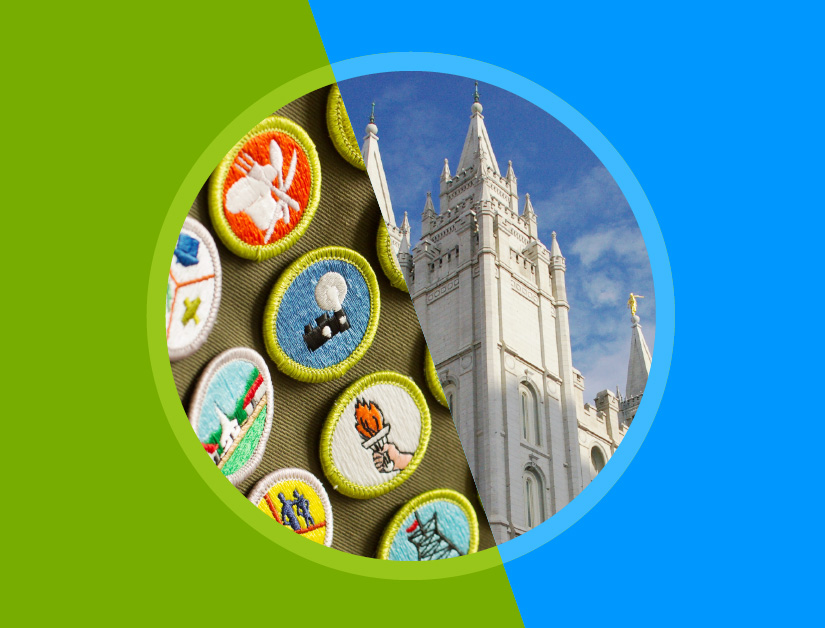
    In a follow-up to their recent statement regarding the Church’s relationship with the Boy Scouts of America, the church today released the following statement:

    The Church of Jesus Christ of Latter-day Saints appreciates the positive contributions Scouting has made over the years to thousands of its young men and boys and to thousands of other youth. As leaders of the Church, we want the Boy Scouts of America (BSA) to succeed in its historic mission to instill leadership skills and high moral standards in youth of all faiths and circumstances, thereby equipping them for greater success in life and valuable service to their country.


    In the resolution adopted on July 27, 2015, and in subsequent verbal assurances to us, BSA has reiterated that it expects those who sponsor Scouting units (such as the Church) to appoint Scout leaders according to their religious and moral values “in word and deed and who will best inculcate the organization’s values through the Scouting program.” At this time, The Church of Jesus Christ of Latter-day Saints will go forward as a chartering organization of BSA, and as in the past, will appoint Scout leaders and volunteers who uphold and exemplify Church doctrine, values, and standards.


    With equal concern for the substantial number of youth who live outside the United States and Canada, the Church will continue to evaluate and refine program options that better meet its global needs.

    This statement comes at the heels of the the Boy Scouts of America’s decision last month to allow openly gay men to serve as leaders. Shortly after the decision was made the church released this statement:

    “The Church of Jesus Christ of Latter-day Saints is deeply troubled by today’s vote by the Boy Scouts of America National Executive Board. In spite of a request to delay the vote, it was scheduled at a time in July when members of the Church’s governing councils are out of their offices and do not meet. When the leadership of the Church resumes its regular schedule of meetings in August, the century-long association with Scouting will need to be examined. The Church has always welcomed all boys to its Scouting units regardless of sexual orientation. However, the admission of openly gay leaders is inconsistent with the doctrines of the Church and what have traditionally been the values of the Boy Scouts of America.


    As a global organization with members in 170 countries, the Church has long been evaluating the limitations that fully one-half of its youth face where Scouting is not available. Those worldwide needs combined with this vote by the BSA National Executive Board will be carefully reviewed by the leaders of the Church in the weeks ahead.”’

    Lead image via Mormon Newsroom