Tag: General Conference

  • Newly Sustained Apostles Mark a Historic New Chapter for the LDS Church

    Newly Sustained Apostles Mark a Historic New Chapter for the LDS Church

    Today President Henry B. Eyring of the Church of Jesus Christ of Latter-Day Saints announced two new apostles during Solemn Assembly, Elder Gerrit W. Gong and Elder Ulisses Soares, who, effective immediately, will take the places vacated by Elder Robert D. Hales and Dallin H. Oaks in the quorum.

    These appointments underscore the LDS Church’s growing international identity and membership. Elder Gong, born in Redwood City, California, is the first Asian-American member of the quorum of the twelve apostles, while Elder Soares, born in São Paulo, Brazil, is both the first Brazilian apostle, and the first apostle from South America.

    It’s the first time in three years that new members have been added to the Quorum of the Twelve . Elders Dale G. Renlund, Ronald A. Rasband, and Gary E. Stevenson were called in October of 2015.

    The Church’s announcement comes at a time of great change for the Church. With the passing of President Thomas S. Monson in January, the Church has undergone a change in leadership under the direction of new Prophet Russell M. Nelson and continues to enact change in policy and Church curriculum.

    As members of the Twelve, Soares and Gong will travel around the world to visit with saints, make decisions regarding Church policy, speak in conferences and firesides, and lead future Church initiatives.

  • LDS Church Announces Big Change to Women & Priesthood Sessions

    LDS Church Announces Big Change to Women & Priesthood Sessions

    The LDS Church announced today that starting next April, there will no longer be twice-yearly priesthood and general women meetings held during conference. Instead, each meeting will occur once a year. The Church’s statement on the matter is as follows:

    “Beginning in April 2018, the general women’s session will no longer be held on the Saturday preceding the other sessions of general conference. Rather, the general priesthood and general women’s sessions will each be held annually, with the general priesthood session being in April and the general women’s session being in October.”

    “These meetings will originate from the Conference Center on Saturday evening following the morning and afternoon sessions of the conference.”

    According to the Church announcement, consolidating general conference sessions will assist in efforts to reduce and simplify the work of the Church and demands made on leaders and members.

    This change is the largest since 2013, when the general Relief Society meeting was opened to young women and primary girls.

    Changes to the sessions will be announced in a First Presidency letter read to congregations around the world.


  • 4 Examples from #ldsconf to Help You Fix Your Boring Church Talks

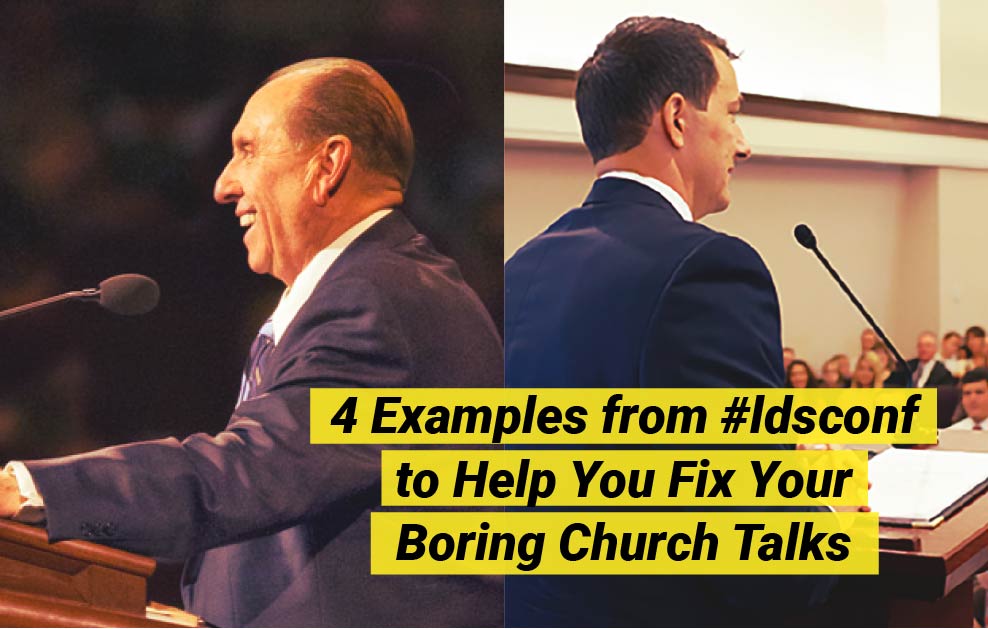
    4 Examples from #ldsconf to Help You Fix Your Boring Church Talks

    If you’re preparing a lesson or a talk for Sacrament meeting, and you’re not quite sure how to start, look no further than General Conference! While most of us watch conference for the messages and the speakers (we know you have an Elder Holland fan shirt stuffed in your dresser somewhere, don’t lie), not many of us realize that conference is also a great opportunity to learn public speaking skills. Apostles and general authorities are pretty pro at it, and we can learn a lot from them. Here are just four examples from this past General Conference to help you start that talk you’ve been worrying about:

    1. Start with a good story.

    Elder Juan A. Uceda of the Seventy captivated us Saturday morning when he began his talk with the story of the treacherous Inca Bridge and how he was saved from falling 2,000 feet over the edge. He immediately set the scene for us and walked us moment by moment through his own experience. Not only did Elder Uceda’s story hold our attention and get our hearts racing, but it transitioned beautifully into his message about the Holy Ghost and why we should listen to it. Beginning with a story was an excellent way to get us interested in the subject of his talk.

    Try starting your own talk or lesson with a personal story like Elder Uceda’s. Set the scene for your ward members and transition into the principles/doctrine you’re speaking on. If you don’t have a story that applies, use someone else’s or begin with a metaphor (or parable). The Savior spoke in parables and stories because they were so effective at capturing both the attention and understanding of his audience. Using this technique is a good way to fill time and keep your ward members interested in what you’re teaching.

    2. Start with a good question.

    “If we love the Savior more, will we suffer less?” You may remember this thought-provoking question posed by Elder Robert D. Hales at the beginning of his general conference talk last weekend. Asking deep, personal, and related questions such as this that invite your audience to reflect or dig for answers is a great way to start out a talk. It allows you to open up two channels of revelation: one prompted by the subject you talk about or class discussion, and the other prompted by the individual search for an answer. Whether or not your lesson or talk is filled with spiritual gems, starting it out with a question gives every ward member the chance to actively participate in the process of revelation and receive it individually. They may learn more from how they answer that question than from the rest of your talk (which isn’t a bad thing).

    3. Immediately address your subject matter.

    Some would say that the best way to face anything is head on. The same could possibly be said for talks and lessons. Elder David A. Bednar’s style of speaking is a great example of addressing a subject head-on. In almost every talk he gives, Elder Bednar immediately starts by noting the doctrine and principles that he has chosen to speak about. He uses scriptures and lists to teach and rarely says anything that isn’t concise and to the point. One reason why this is a great way to start a talk or lesson is that your audience doesn’t have to spend a whole lot of time figuring out what you’re going to speak about. They immediately know and therefore, can immediately think about the subject and how it applies to them. Because Elder Bednar’s talks are so to the point, they allow for much more time to teach doctrine and principles. Ultimately, these are the meat and potatoes of any talk, and the more time you have to delve into them, the better.

    4. Express gratitude.

    President Henry B. Eyring began his general conference talk by stating the following: “My beloved brothers and sisters, I am grateful that President Thomas S. Monson has asked me to speak in conference on this Sabbath Day.” He stressed the word gratitude to emphasize that it was the subject of the talk. In doing so, however, he emphasized something more important: sharing our testimonies and insights with our brothers and sisters is a blessing that we should be grateful for.

    Too often, we like to start our talks and lessons out with cliche’ crutches that fill up time. Some of these crutches include joking about how we shouldn’t have answered the call from our bishop, how little we wanted to give our talk, or how unprepared we feel to teach. While these may, to us, seem like relatable ways to both preface our talks and justify our speaking insecurities, they too often tell our ward members that the subject matter we are about to speak on is not something to get excited about and not something worth tuning in for. Nothing could be further from the truth!

    When we speak, we should more concerned with the message we have been asked to deliver than our securities or complaints about delivering it. Expressing our gratitude for the subject or for the chance to learn more about it/speak about it not only tells our ward members that what we are about to teach is important, but it tells our Heavenly Father that it’s important to us, too. Expressing gratitude to Him also lets Him know that we desire to learn more.

    Conference is a great chance to learn about how to give a good talk or lesson. As you prepare your talk, pay attention to how the general authorities give theirs. You’ll learn a lot along the way.

    Who is your favorite conference speaker and why? What do you like about how they teach? Hit us up in the comments below!

  • 10 Times General Conference Gave Us All the Feels

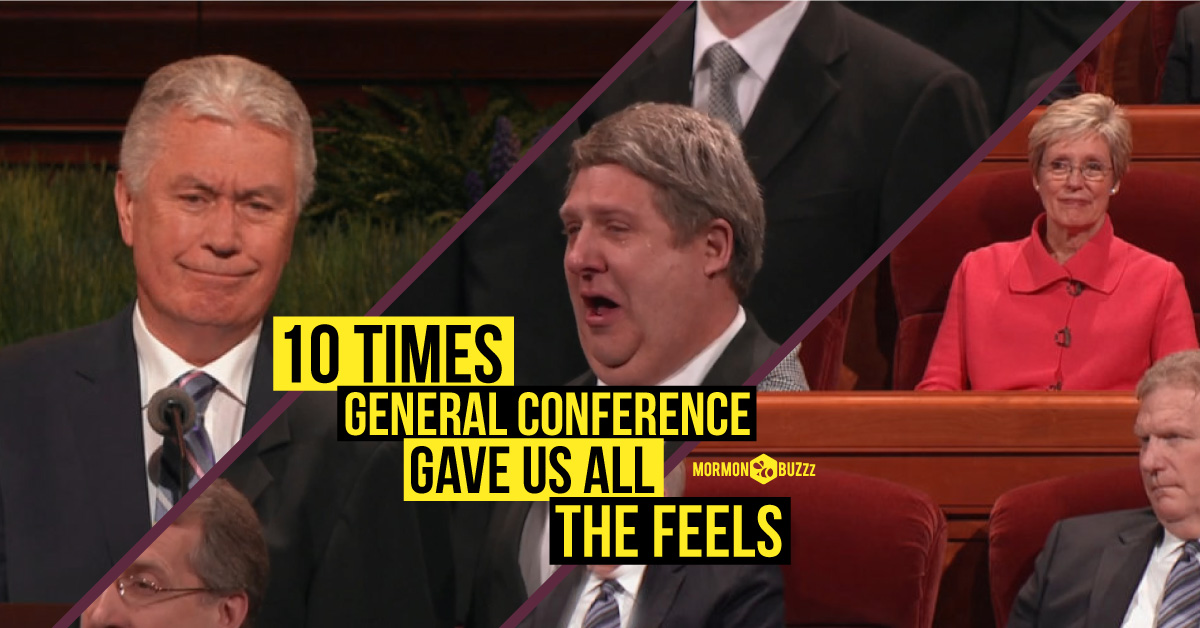
    10 Times General Conference Gave Us All the Feels

    We don’t know about you, but we’re a little [read: a lotta] emotional after this weekend’s general conference. Here are ten times conference made us feel all of the feels:  


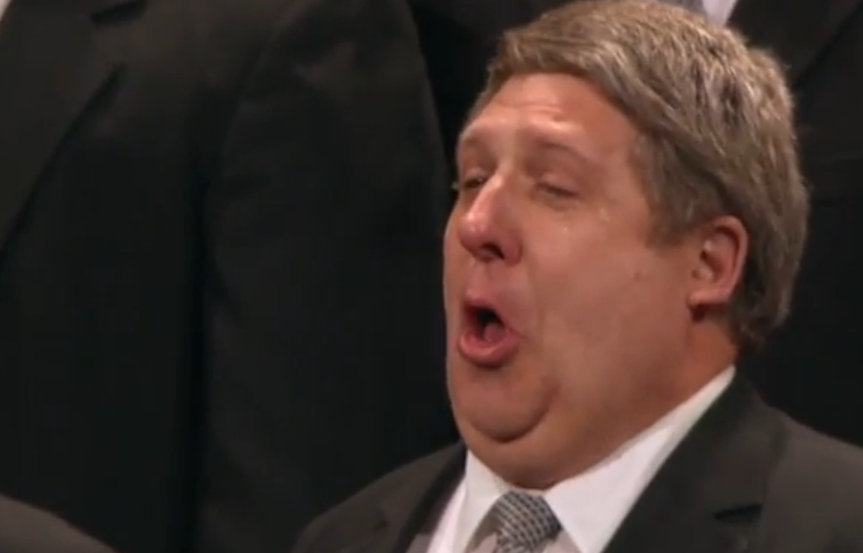
    1. When members of the Mormon Tabernacle Choir wept through “Come Thou Fount,” especially this man:

    cryingchoir

    *Cue sudden and unexpected sobbing.


    2. When new apostle Elder Rasband’s voice wavered as he expressed his deepest gratitude for those praying for and sustaining him.
    feels gif


    3. When the camera panned to Sister Wixom’s tear-filled eyes as the Primary Presidency got released.

    general conf wixom

    We’re okay…we’re…not okay. *cry*


    4. When President Monson and Elder Hales had to be helped by security/other apostles to the pulpit and we were all emotionally them. 

    sams gif


    5. When Elder Kearon shared his experiences with refugees and you could see the love pouring from his tender British eyes.

    ron gif

    *sniff* We’re not crying! *sniff*


    6. When President Uchtdorf, visibly touched by Elder Kearon’s remarks, was barely able to conduct the rest of the meeting through his tears.

    cryucht

    CAN’T. EMOTIONALLY. HANDLE.


    7. When President Eyring choked up during his opening comments as he pleaded with us to listen to the prophet; again, when Elder Arnold talked about rescuing those who have gone astray. Pretty much during every single talk. #RealTalk

    micheal gif


    8. When Elder Johnson spoke about the death of his daughter and read an excerpt from her journal about the hope the resurrection brings.

    pam gif

    We’re done. Just…so done. *hiccuping sob*


    9. When Elder Holland spoke to our souls and asked us if we knew how much Church leaders love us.

    han solo gif


    10. When conference ended far too quickly.  

    tennant gif


    What conference moments stirred your soul this weekend? Tell us in the comments below!

    Revisit your favorite talks now!

  • Elder Christofferson Did Something Surprising This Weekend

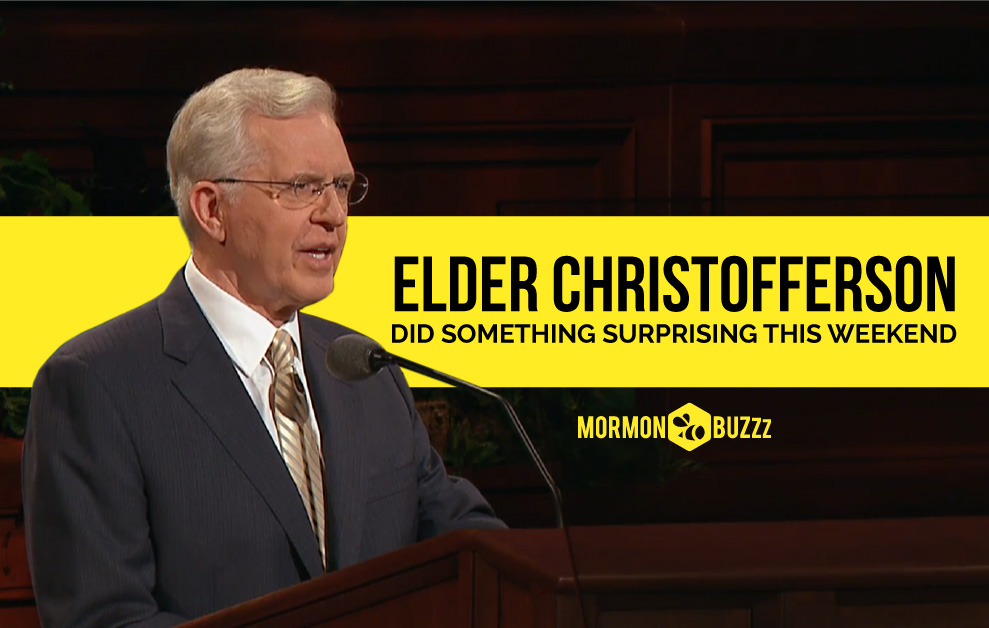
    Elder Christofferson Did Something Surprising This Weekend

    This weekend, I had the unique opportunity to watch General Conference from a stake center in Trujillo, Peru. As the session began, I remember feeling a little disappointed that no one spoke in their native language. As a bilingual RM, I can’t tell you how awesome it was to hear Spanish being spoken over the pulpit during last conference, but my disappointment was short lived when I got a very pleasant surprise. Just before Elder Christofferson got up to speak, the translator announced that he would be giving his own talk in Spanish.

    For the first time, Elder D. Todd Christofferson, during the Sunday afternoon session of the 185 semiannual General Conference, provided his own Spanish translation for his talk. Rather than the typical voice of a translator, this gave the Spanish speaking members the chance to hear his own voice give the talk in a language they understood,

    It’s a little known fact that our late Apostle Elder Richard G. Scott would record his own Spanish and Portuguese translations of his talks every Conference. This came as a surprise to me when I first heard his familiar voice speaking Spanish dubbed over his English sermon a year and a half ago, and my Spanish speaking friends affirmed for me that he has always given his own talks in Spanish. I was overwhelmed with gratitude and love for Elder Scott, who after serving a mission in Uruguay and serving as a mission president in North Argentina, wanted to give his beloved Latin Saints the opportunity to hear and understand an apostle’s voice.

    I found out only recently, after the passing of Elder Scott, that Elder D. Todd Christofferson was actually a missionary in North Argentina while Elder Scott was serving as the mission president. I’m sure it must have been a proud moment for Elder Scott to see one of his own missionaries become an Apostle, and humbling for Elder Christofferson to be called to the same calling as his mission president. Both served together with a special love and service for one another.

    I thought it very appropriate then, as I watched the Sunday Afternoon session in Spanish, that Elder Christofferson would be giving his own talk in Spanish. This is the first time Elder Christofferson has forgone the translators and recorded his own translation, and I was amazed by his fantastic accent and confidence with the language The members were so pleased to hear his own voice speak their native language. I am so happy Elder Christofferson chose to continue Elder Scott’s tradition by reaching out to the Latin saints in this special way. I’m sure it’s what Elder Scott would have wanted.

  • What It Takes to be an Apostle

    What It Takes to be an Apostle

    In just a few short days, the lives of three men will be changed forever as they fill the seats left vacant from the recent passing of LDS apostles Boyd K. Packer, L. Tom Perry, and Richard G. Scott. Accepting the call of Apostle of the Lord Jesus Christ will be, to say the least, a daunting experience. Those who accept are expected to take on the same role as Peter, James, or John. They are asked to take the place of powerful teachers who dedicated their lives to the sharing of the gospel. What’s more, they’ll likely be taking on the responsibilities of those who, to them, would have been dear colleagues and friends. It may be a little more than overwhelming.

    At a time with so much change in church leadership, one might wonder what it takes to be an apostle. How do these great men do it and why? Our departed brethren, President Packer, Elder Perry, and Elder Scott gave us excellent examples of some specific qualities of the holy calling.

     FELLOWSHIP  


    36923_all_53-youngerpackerPerhaps no one described the the Twelve like President Boyd K. Packer. He compared the Twelve of today to the original Twelve:

    “The present Twelve are very ordinary people. They are not, as the original Twelve were not, spectacular individually, but collectively the Twelve are a power.

    “They all are students and teachers of the gospel of Jesus Christ. What unites us is our love of the Savior and His Father’s children and our witness that He stands at the head of the Church.

    “Almost to a man, the Twelve come from humble beginnings, as it was when He was here. The living Twelve are welded together in the ministry of the gospel of Jesus Christ. When the call came, each has put down his nets, so to speak, and followed the Lord.”

    “These men are true servants of the Lord; give heed to their counsel.”

    According to President Packer, the power of the office of Apostle doesn’t come individually to each member, but the power comes from the Twelve as a unit. Unity is perhaps the greatest strength of the apostles. A man who is about to be called to the holy apostleship can rest assured that the Lord won’t expect him to become an extraordinary seer and revelator overnight. The Lord does, however, expect him to be willing to dive into the work with all he has. A council of twelve is the Lord’s way of offering such a man support and needed delegation while doing the work of His kingdom.

    RESOLVE


    richard-g-scott-newsbio-early-ga-photoWhen Richard G. Scott was first called as an apostle in 1988, he had the opportunity to address the church. During their inaugurating speeches, almost all newly-called apostles express how humbled they are to receive this new assignment. Elder Scott, however, didn’t talk about the humbling experience of the call. Instead, he explained the emotional aspect of it. He talked about the struggle he had as he tried to grasp the significance of his new, sacred calling. What was even more impressive is the resolve that he covenanted with the Lord to keep. He then expressed that resolve to the members of the church:

    “There has distilled within my mind and heart a resolve that I have covenanted with the Lord to obey. It is to live to be worthy to know the will of the Lord and to live to have, with His help, the capacity and courage to carry out that will—and to desire nothing else.”

    Throughout his apostleship, we saw Elder Scott live up to this resolve that he made in the beginning. His life is a great example of worthy living, and his acceptance of the Lord’s will was unparalleled.

    DEVOTION


    BetterPERRY_hrTom Perry, upon being called as an apostle, also expressed how emotional of an experience it was. He spoke very personally about his childhood, how he looked up to the apostles and memorized each one by name. He went on to explain how his father took it upon himself to teach him a little bit about the life of each apostle. Elder Perry would say that if you asked him today, he could still name each apostle and something about them. As he contemplated how a different father might tell his son about Elder Perry, then the newest member of the twelve, he was shocked. “What could he ever tell about me?” Elder Perry thought.

    Elder Perry lived an ordinary life that was made extraordinary through the Gospel. While he was overwhelmed by his new assignment he realized that the only way he could magnify this calling is to handing over his whole heart to the Lord. This declaration he gave in his very first General Conference Address as an Apostle showcases his determination;  

    “I am devoted to service in our Father in heaven’s kingdom. Use me in any way that I am capable.”

    His humble willingness to work in the Lord’s kingdom qualified him for his assignment, which he served in with optimism and determination.  

    Three men will each take on these same roles with Elder Perry, President Packer, and Elder Scott as excellent examples. Those three individuals will each have to take that emotional walk up to the stand, called to be prophets, seers. and revelators. They will each have the privilege of watching their own sustaining vote as concourses of people gratefully raise their hands in favor of their calling. They will be set apart to a life of service and will become special witnesses of the Lord Jesus Christ. The devotion that they exhibit to their calling will help them face every day and every challenge with hope and enthusiasm. Their resolve to perform to their duties to the best of their abilities will instill a deep love and respect in everyone within their stewardship. And the fellowship to which they join is one of power and authority and as they join their testimonies to the quorum, it will be made complete.  

    Notes:
    Packer, Boyd K. “The Twelve,” Ensign, May 2008, 85–86.

    Perry, L. Tom. “Build Your Shield of Faith” April 1974, General Conference Address

    Scott, Richard G. “True Friends That Lift” October 1988, General Conference Address

  • After 9/11 Gordon B. Hinckley Taught Something Unexpected

    After 9/11 Gordon B. Hinckley Taught Something Unexpected

    We all remember the events of September 11, 2001, but many of us, myself included, were too young at the time to remember much of the aftermath. In pondering these tragic events I realized that I had never read anything about how the Church responded. The Church’s semiannual General Conference was held less than a month after the attacks, at a time when the hurt and confusion was still fresh in the nation’s mind. As I read a talk given by President Gordon B. Hinkley, I was reminded in a wonderful way just how much our Church’s leadership exemplifies the love of Christ. At a time when as a nation many felt angry and vengeful, these were the words of counsel given by our then-current prophet,

    “Those of us who are American citizens stand solidly with the president of our nation. The terrible forces of evil must be confronted and held accountable for their actions. This is not a matter of Christian against Muslim. I am pleased that food is being dropped to the hungry people of a targeted nation. We value our Muslim neighbors across the world and hope that those who live by the tenets of their faith will not suffer. I ask particularly that our own people do not become a party in any way to the persecution of the innocent. Rather, let us be friendly and helpful, protective and supportive. It is the terrorist organizations that must be ferreted out and brought down.”

    After 9/11 we saw a surge in Islamophobia that is still prevalent today. What a beautiful reminder that these were the actions of a group of extremists, and not the work of an entire faith. He continued,

    “We of this Church know something of such groups. The Book of Mormon speaks of the Gadianton robbers, a vicious, oath-bound, and secret organization bent on evil and destruction. In their day they did all in their power, by whatever means available, to bring down the Church, to woo the people with sophistry, and to take control of the society. We see the same thing in the present situation.”

    “We are people of peace. We are followers of the Christ who was and is the Prince of Peace. But there are times when we must stand up for right and decency, for freedom and civilization, just as Moroni rallied his people in his day to the defense of their wives, their children, and the cause of liberty (see Alma 48:10).”

    He reminded us next to be realistic, and to face the future with optimism:

    “Now, I do not wish to be an alarmist. I do not wish to be a prophet of doom. I am optimistic. I do not believe the time is here when an all-consuming calamity will overtake us. I earnestly pray that it may not. There is so much of the Lord’s work yet to be done. We, and our children after us, must do it.”

    and then turned us towards God, and towards our fellow neighbor:

    “Let us be prayerful. Let us pray for righteousness. Let us pray for the forces of good. Let us reach out to help men and women of goodwill, whatever their religious persuasion and wherever they live. Let us stand firm against evil, both at home and abroad. Let us live worthy of the blessings of heaven, reforming our lives where necessary and looking to Him, the Father of us all. He has said, “Be still, and know that I am God” (Ps. 46:10).”

    “Are these perilous times? They are. But there is no need to fear. We can have peace in our hearts and peace in our homes. We can be an influence for good in this world, every one of us.”

    I was very young when our nation was attacked, and I was unable to fully appreciate the level of fear and doubt that must have prevailed in the hearts of many. What a blessing it was then, as it is now, to have living prophets to remind us what is really important, and how to face the future with faith.

    The full talk can be read here: The Times in Which We Live

  • This Choir Member Sketches During Conference, and the Results are Stunning!

    This Choir Member Sketches During Conference, and the Results are Stunning!

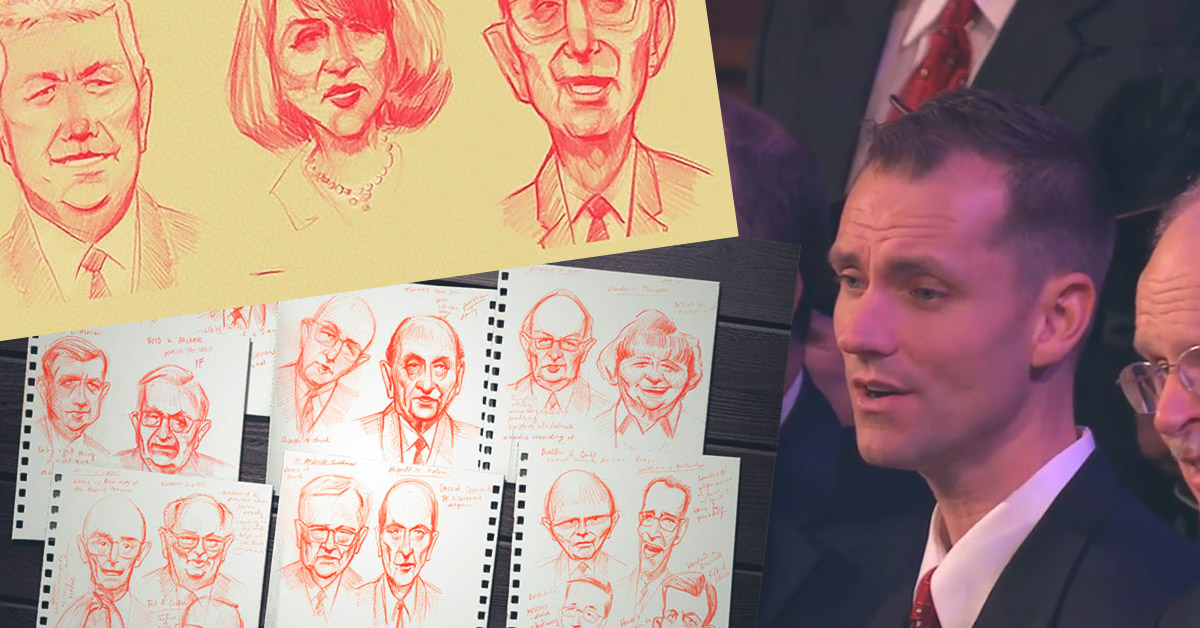
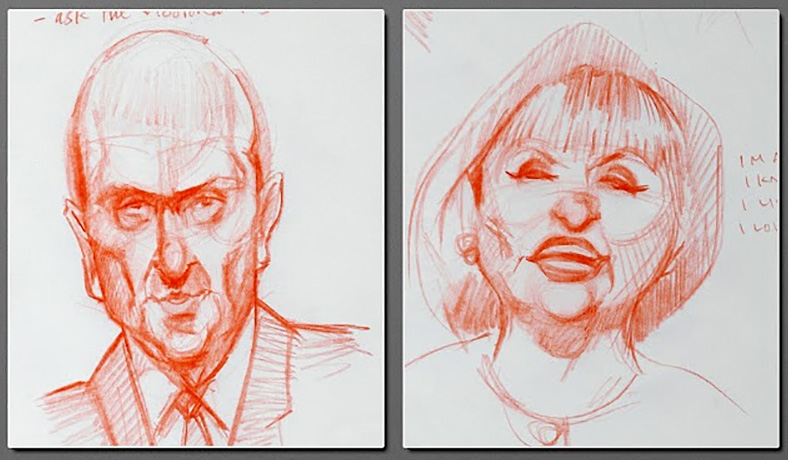
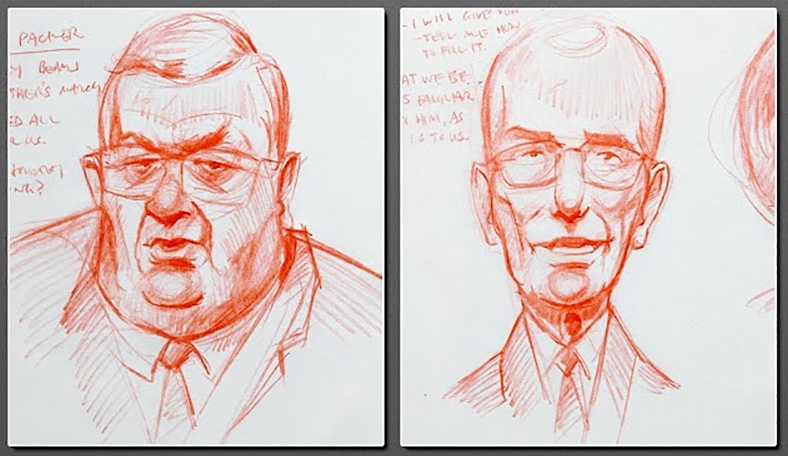
    We got to know a member of the Mormon Tabernacle Choir recently. His name is Ryan Snarr, and he shared with us some of his drawings that he creates each General Conference. During each session, Ryan quickly sketches each speaker between musical numbers, and it’s become something of a tradition for him. Ryan was gracious enough to allow us to feature some of his sketches, and sat down with us for a short Q&A. Following are some excerpts from our interview:

    ryan_in_the_choir

    Q. Tell us a little about yourself, where are you from?


    I grew up in Layton, UT, and attended Northridge High School.  I served a mission in Lima, Perú. I got back from my mission in 1999, so, 15 years ago now.  My current calling is singing second tenor in the Mormon Tabernacle Choir. I have a wife and 4 kids, we live in Syracuse, UT. My day job is working as the Marketing director for Destination Homes in Layton, UT.

    Nelson_Dibb

    Q. Tell us about singing in the choir. How long have you been in?


    I’ve been in the choir for almost seven and a half years.

    Q. What’s your favorite part about your calling?


    Every week we get together as part of a performance or a rehearsal, and it’s just this massive group of people that all come together to create something like nothing else on earth. Not one single person can create it on their own, but as everyone comes together we’re able to make something amazing. You can share feelings through the medium of music that you just can’t share in any other way.
    Singing is obviously the best part and most prominent part of this calling, but there are other things I’ve enjoyed that have been less expected. Every other year we go on tour, and one of my favorite things to do while we’re touring, outside of singing, is to go running in the cities we tour. sketches6To be able to get up early and go on an hour long run with other choir members is really nice. We don’t get much time to talk when we’re rehearsing and performing, so it’s nice to have that time to just talk and get to know people. It’s fun to find out what fellow members of the choir enjoy doing outside of being in the choir. I’m also surprised at how much I really enjoy singing the patriotic hymns while touring in different US cities. You know, the songs we all sang in the 3rd grade. It’s funny, because I didn’t like them in the 3rd grade, but when you’re singing for strangers in a place far from home who have the same conviction to country and patriotism as you do, it’s pretty cool.

    Q. What made you want to audition for the choir, is it something you’ve always wanted to do?


    Not exactly, though I’ve sung in choirs throughout my adult life. I had a neighbor who was going to audition, and we were signing in a group together. I just got really curious, and I thought, if he’s going to try, then I will too. My sister sang in the choir at the time, so I already had a connection on the inside. It was an intriguing idea to be able to sing with my sister.  We sang together for probably two years before she got married and moved to California.

    sketches7

    Q. Just a curious question, who picks out the choir’s ties for General Conference?


    Ha ha, no one’s ever asked me that. Most people ask who picks out the women’s dresses. There are actually 11 ties that the men wear, and I don’t have a favorite.  We just wear whatever they tell us to wear. I don’t know who decides. My guess is the women decide what they are going to wear first and then they tell the men which tie to wear that matches.

    Packer_&_Eyring

    Q. When did you start making these sketches?


    My first red pencil sketches were during a CD recording. During a recording there’s a lot more downtime than normal, but it’s silent downtime. Recording music for CDs involves many more moving pieces so they encourage us to bring something quiet to do like read a book. I brought paper and pencils and just started drawing whatever came to mind.  I’ve always enjoyed drawing since I was little. Since I’m one of those guys who is prone to dozing off in church, I just need to do something to keep my eyes open and my mind going. It’s a terrible feeling getting drowsy during conference when you’re one of the participants so doing anything possible to stay alert is important to me. The first conferences I would just sketch random observations, but I’d get frustrated if my mind went blank as to what I should draw. To avoid this I just decided to try capturing the likeness of a speaker while they spoke; sort of a little challenge for myself. In the choir loft, we watch the conference sessions on flat screen televisions. They aren’t too big and they are positioned way down in front which is why they aren’t seen during the choir musical numbers. sketches5I’m typically about 15-25 feet away from a screen, and for the most part I’m fortunate enough to have an unobstructed view of the TV. It’s really dimly lit in the choir loft though. That, coupled with the distance from the screen can present a challenge. I’m lucky to have good enough eyesight to see okay I guess.  Another challenge is sketching someone from straight ahead when the camera angle on each speaker moves to a ¾ view of their face numerous times during the talks. It’s not that I wouldn’t want to draw the ¾ view, but typically the camera angle shown most of a speaker is from straight ahead.

    Q. You mention sketching keeps you from dozing off, is that the only reason you sketch these speakers?


    The more I’ve studied art and drawing the more I’ve learned that it’s not just a natural talent that you have, but it’s something you must continually practice. A few years ago, I really felt like I hadn’t been giving this ability the attention it needed if I wanted to get any better or if I was going to take it somewhere. I started looking for more opportunities to practice.  It’s a very quiet thing to do, so during general conference it was just the perfect thing to do to pay attention, and keep me from dozing off or visiting with my neighbor.

    sketches

    Q. Who’s your favorite to draw out of the speakers?


    Well, the first presidency I’ve drawn the most just because they speak at every conference.  Elder Christofferson is fun to draw, Elder Scott and Elder Nelson are favorites.  It’s usually the people that have really distinguishing facial features.  If you can just include their most recognizable features, people get who it is. For some reason, President Uchtdorf is really hard to draw, and Elder Bednar turns out really inconsistent and random sometimes.

    sketches2

    Q. What do you do with all of these sketches, Do you keep them?


    What I do after conference is I’ll scan or take a picture of the sketches and put them on Facebook and my illustration blog. People will see me in the grocery store before conference and they’ll say, “Are you going to post your sketches?” It’s become a personal tradition ever since I’ve been in the choir.

    sketches2015

    Q. Have any of the general authorities ever seen these?


    I don’t know. Maybe. I have the opportunity to work on the birthday committee in the choir.  We had this gift idea for President Eyring that didn’t end up working out, so we had to put together a plan B. Someone suggested that I draw something for him. so we purchased a moleskine drawing notebook, because in his biography it shows many of his sketches over the years. So I gave him the notebook with red and blue pencils, some pens, and some grayscale markers. I took some of my sketches from conference, cut them out, and pasted them in the front and back cover of this book just to make it kind of special, you know.  I created a little note that explained that all the sketches pasted in the book were from conference sessions. Hopefully it inspired him to keep sketching.

    sketchbook

    Q. What do you use to do your sketches?


    We don’t take much up to the choir loft for performances or conference, so I only take 3 sharpened red pencils. After 3 sessions of conference that usually takes up all the lead. They get pretty dull after two hours, and they’re all I have. My left hand is going the whole time until I can get something that I can make sure is a semblance of the speaker. Sometimes I’ll sketch the whole time and think, “Oh my, that turned out terrible.”

    sketches3

    Q. Is there anything else you’d like to tell us?


    It’s a funny thing, because I’m characterizing people that are called of God, giving messages of faith, and for some it could come across as sacrilegious, but that’s certainly not my intent. For me it’s about capturing a moment.  I’ll write notes to the side of each speaker, and I retain what I write, and what I hear. After six hours of participating in conference sessions over two days, I don’t just have notes, but I have this illustrated notebook that I can share with people. It’s a way to hang onto this moment that is special to me. It’s very satisfying finding out how special it is for others as well.

    Want to see more of Ryan’s work? Check out his blog at: snarrlyillustration.blogspot.com, and his Facebook page: Snarrly Illustration.

    All images © Ryan Snarr

  • 5 General Conference Pitfalls and How to Avoid Them

    5 General Conference Pitfalls and How to Avoid Them

    Photo Courtesy, LDS Media Library

    A returned missionary once told me about an experience he had with general conference. His mission president had recently returned from the mission field and held a mission reunion right before general conference. His words to the missionaries were inspiring and helpful, but my RM friend said that one piece of advice stuck out to him. His president had said: “Do not leave the room or change the channel, don’t fall asleep or distract yourself, don’t cease to pay attention in any way. Exactly what you need to hear will most likely be the most difficult thing to listen to. The adversary will greatly tempt you to leave, stop listening, turn off the message, or change the channel. But don’t you do it.

    This returned missionary confidently stated that he did not expect this to be a challenge for him, but this was just the Friday before general conference. He continues in his own words;

    “Saturday night, an amazing young woman abruptly and unexpectedly ended a relationship with me that I had very high hopes for. I went to sleep that night very frustrated, confused, and bitter. I felt I had been doing everything exactly as I was supposed to in God’s eyes, and was confused why I needed to go through this frustration during one of the most difficult academic semesters of my life. Sunday morning, President Eyring began his message by directing it towards those earnestly seeking happy and spiritually founded eternal families. I was watching conference completely alone in my apartment, the breakup from the night before leaving my conference plans cancelled.

    “I got up and left the room, not wanting to hear the relationship advice that came merely ten hours too late. Then I laughed at myself, remembered my Mission Presidents advice to not change the channel, and went back and finished listening. President Eyring focused on the two great commandments, to love God with all thy heart, might, mind and strength and to love thy neighbor as thyself. As I listened, I realized how inwardly focused my frustrations were and I received the comfort I needed.”

    This young man’s story really struck a chord with me. Am I missing out on important revelation when I allow myself to get distracted? I thought. This led me to wonder what I could be doing to hinder spiritual experiences during conference.

    Here are just a few ways I have been tempted to justify my casualness during general conference and how you can avoid falling into the same traps.

    Pitfall #1:

    “I want to sit down and focus on conference, but I can only think about all the things I need to get done.”

    Life can make us crazy sometimes. There is often a lot demanded of us, but it is important to make our spiritual well-being a priority. Conference time can be a very sacred time for you and bless you in every facet of your life. It is important that you prepare beforehand to make your experience unforgettable. Get major projects done before conference or set aside a time to accomplish those projects after conference is over. Clean your home. A clean and organized space does wonders in inviting the spirit. Try to create an environment where the spirit can teach you and your family. You won’t have a sink full of dishes nag you while you are trying to listen. Don’t plan on working on projects or chores during the sessions. Instead, plan on being spiritually fed.

    Pitfall #2:

    “I have to work during general conference.”

    Work is sometimes a necessary thing and can’t be avoided. But isn’t it great to know that general conference comes the same time every year! Try to arrange your work schedule to allow you to participate those two days. Use one of your sick days if you must, I promise it will be worth it. If work is absolutely unavoidable, talk to your boss and co-workers and see if they wouldn’t mind listening to conference during work. It may seem awkward to ask if you could listen while at work, but you will be setting a powerful example and you will be blessed for your diligence.

    Pitfall #3:

    “I always fall asleep during conference talks.”

    In many places, we are blessed with the opportunity to watch conference from the comfort of our own homes. Many members take advantage of this by sleeping in and dressing as comfortably as possible. While comfort is important, when wearing pajamas, sleep is sure to follow. Try this instead: you and your family can dress in church attire to watch conference at home. Think about it. You’d be showing the Lord that you’re ready for spiritual nourishment, you’d put on an attitude of learning, and your brain would be less inclined to think it’s bed time. For those of you who fall asleep on the pew or the couch, take it from this narcoleptic: mints and chewing gum are your best friends. If you are truly determined to stay awake, prepare beforehand and get a good night’s sleep. Don’t sleep through your spiritual rescue! There is so much revelation that God wants you to have, so make the effort and the Lord will bless you with alertness.

    Pitfall #4

    “I know I should look for questions to ask before conference, but I can never think of good questions.”

    Answers to questions don’t have to be the only thing you look for when watching conference. You could choose an interesting gospel study topic you’ve had on your mind and see what the prophets have to say about it. If you are struggling to find the right questions to ask, pray and ask Heavenly Father what you should be asking. Ask Him what you should be looking for as you watch conference, and He will let you know.

    Pitfall #5

    “I can always read the talks later.”

    It is one of the Church’s highest priorities to make conference talks as accessible as possible as fast as possible. With the amazing advances in technology, we have access to almost every general conference ever given in a variety of different formats. With the talks being this accessible, it is easy for members to justify not watching conference and going out to do other things. But there is so much power that comes when you show the Lord you are going to make conference time a holy time. The talks are available for us afterward to re-read and to receive additional guidance, but there is nothing that can compare with the revelation you will receive when you are prepared and actively listening to our leaders and prophets today.

    Don’t let the adversary trap you in these pitfalls. You have the resources and the motivation to escape these excuses and make your General Conference experience different and more edifying than ever. Remember, exactly what you need to hear will most likely be the most difficult thing to listen to. So listen carefully, and the Lord will shower you with His blessings.