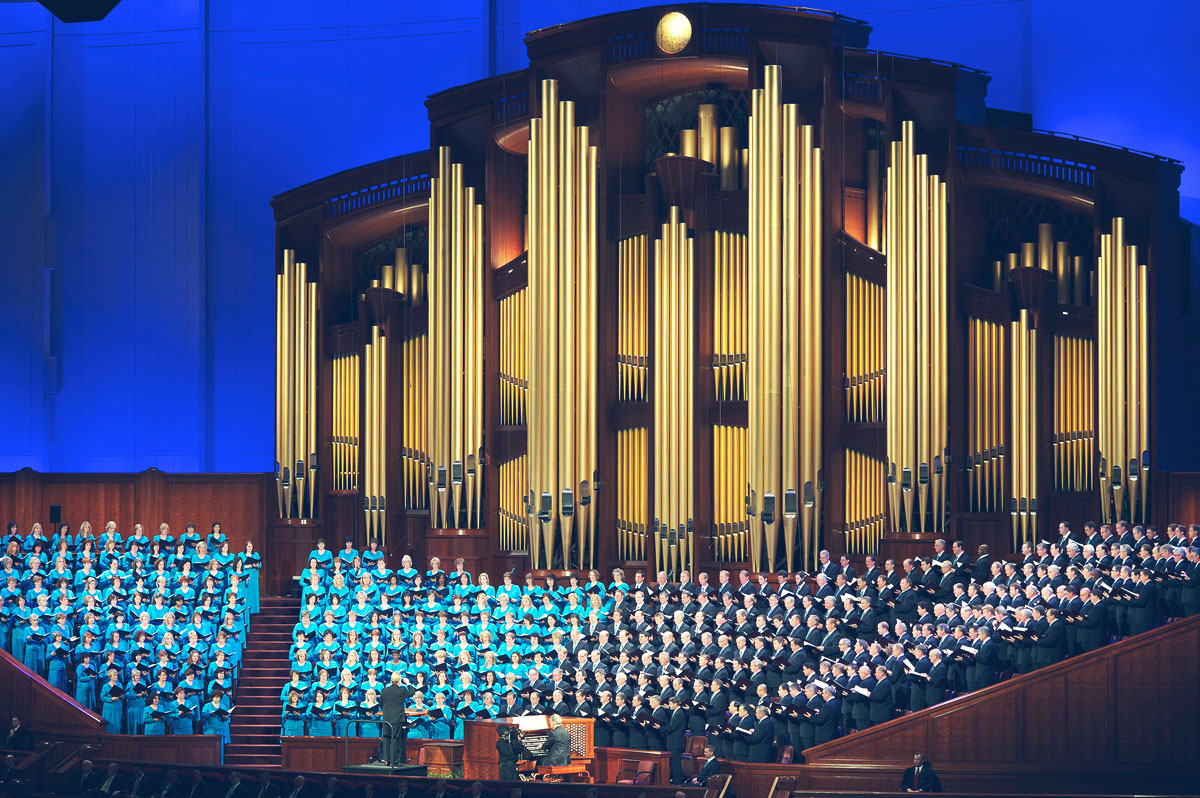
It’s conference Saturday. Three speakers have just concluded their remarks, and the camera is now zooming in on the organist, who has begun to play the introduction for the next Mormon Tabernacle Choir number. The director raises his baton, there’s a brief lull in the music, and then, after the director smiles and looks up at the choir…siblings and parents alike run for the bathroom or the kitchen or the backyard to madly work on or finish other things they had going on before the session started, leaving MoTab to play for an audience of none in the living room.
Does this scene sound familiar? As a child, I became pretty used to it. Often, once the choir started singing, my siblings and I would treat ourselves to an intermission and run to every other corner of the house. Even though all of us are young adults now, it still sometimes happens.
The truth is that we’ve all probably done it. We’ve, without realizing it, treated the choir performances like breaks in the real program, as if they’re just extra, fluffy things that aren’t as important as talks or our to do lists. One need only watch conference live and see all of the people streaming out during the hymns to know that. Sometimes, we have to use the restroom or take care of health needs, and choir numbers provide an opportunity to do so, but other times, we simply don’t want to give the same amount of attention to the music as we do the speakers.
It hit me a long time ago that the Lord doesn’t like it when we do that.
In D&C 25, it reads that the Lord’s “soul delighteth in the song of the heart; yea, the song of the righteous is a prayer unto [Him], and it shall be answered with a blessing upon their heads” (D&C 25:12). Do we recognize the significance of this, I wonder? Not only does our Heavenly Father delight in our hymns and songs, but He blesses those who sing them as He would those who pray to Him.
You might read that and think, “So what? MoTab’s singing the songs, not us. This doesn’t involve us.” Well, think of the opening prayer at a sacrament meeting. You might not be the one saying it, but by bowing your head and listening, you are actively participating in it. The same, I’d imagine, goes for our hymns. When we listen to them and enjoy them, we, too, are blessed, because by the Lord. Imagine how He feels when we walk out on those hymns or don’t care about them at all.
For me, paying attention to the choir during conference was never super important until I discovered a story a few years ago that completely changed my perspective. In that story, I learned that if it wasn’t for another person who listened to a choir, I might not be watching conference at all.
One night in the late 1840s, my great-great-great grandfather and his son were walking down a road in Wales after a long work day. They must have been tired and hungry, excited to get home to their family and beds. On their way there, they passed a small church house where Mormon missionaries were holding a meeting. The missionaries had just begun to sing a hymn called “The Resurrection Day,” one that hadn’t been heard in Wales before that point, my grandfather claims. He stopped his son so that they could listen to it for a moment.
Neither of them could leave.
As they listened, the song completely enraptured them, filling them with inspiration and joy. When it was over and they continued walking home, they couldn’t get it out of their minds. They hadn’t heard a word those missionaries spoke, but because of that hymn, both of them knew that those missionaries were servants of the Lord and were teaching about the true gospel of Jesus Christ. Both my great-great-great grandfather and his son were baptized following this experience.
I’ve listened to that hymn before, and, interestingly, it didn’t stir me like it did my ancestors. I wasn’t overwhelmed by the spirit, nor was I filled with more joy than normal. But I have had other songs stir me and move me to tears before. I’ve had my testimony strengthened by the hymns, and as I read this family story, I’m taught and retaught a valuable lesson: the spirit can touch us in different and incredible ways, even and maybe especially through song. Music, just like the words of prophets, can convert each one of us, whether we are not members of the church or we’re long timers. We only need to listen to them. I’m so grateful my grandfathers stopped to listen to a hymn when they were probably exhausted. As cliche’ as it might sound, I don’t know where I would be today if they hadn’t.
Make music, just like my ancestors did, a part of your conversion story. Don’t just listen to the talks when conference rolls around, but stay for the music. Pay attention to the testimonies that the choir members bear with their facial expressions, because you will see them when you search for them. And when you listen with the intent to feel the spirit, you will receive inspiration and strength.
Don’t equate “MoTab” with “break time.” You might be surprised at how much inspiration you can receive just by sitting on your couch during one musical number.
Comments
5 responses to “Why I’ve Stopped Leaving the Room When MoTab Starts Singing”
I agree! Music is an important part of worship. But golly, can we get the choir to sing with enthusiasm and vigor?
Haha. I think they usually do. 🙂 Getting a ward choir/ward to sing with enthusiasm and vigor is the real challenge.
As a previous ward chorister, I was in charge of picking the songs for sacrament meeting every week. Just as the bishopric chooses the meeting topics by revelation, I tried to let the spirit guide me to choose songs that coordinated with the assigned topic and would be a vessel to the spirit’s message.
I have no doubt in my mind that the music selections for general conference (and potentially every church meeting) are carefully chosen. We can receive just as much spiritual guidance from song lyrics as we can from a speaker. All are words that convey spiritual meaning. By leaving or talking during the music, we are missing out on messages that are can potentially be direct answers to prayers.
In the First Presidency Preface in the LDS Hymnbook it states:
“Some of the greatest sermons are preached by the singing of hymns. Hymns move us to repentance and good works, build testimony and faith, comfort the weary, console the mourning, and inspire us to endure to the end.” Thanks for this great article reminding me of the importance of enduring to the end of conference in order to hear some of the greatest sermons.
An example of this came at the conclusion of the priesthood session just a few weeks ago. Following President Monson’s remarks, some hurried out the doors to go watch the rest of the March Madness game that was in progress. What they missed was one of the greatest renditions of “Master the Tempest is Raging” that I’ve ever heard, with stirring lyrics such as
“Whether the wrath of the storm-tossed sea
Or demons or men or whatever it be,
No waters can swallow the ship where lies
The Master of ocean and earth and skies.”
Thanks again for a great article!
The hymn(s) at the beginning “prime the pump” as it were for all of the rest of the spiritual saturation that is to come.
The hymns in the midst of conference re-invigorate.
The hymn at the end of conference slows, if not plugs the “leaking out” of the spiritual saturation.