Author: Mormon Buzzz

  • ​One Punctuation Mark Changes How You Read “The Family: A Proclamation to the World”

    ​One Punctuation Mark Changes How You Read “The Family: A Proclamation to the World”

    I would like to take a moment to call your attention to a microscopic fragment of English syntax that recently snagged my soul a little: the colon. Or this thingy [ : ]. Let me first define the technical grammatical powers of these two neatly stacked specks, and then I will explain why this tiny unsung hero had such force on my not-technical, not-logical-neither-law-abiding heart.

    “The most common use of the colon is to inform the reader that what follows it, proves, explains, defines, describes, or lists elements of what preceded it.”

    From the Wikipedia entry for Colon (punctuation),

    “The colon… introduces the logical consequence, or effect, of a fact stated before… introduces a description; in particular, it makes explicit the elements of a set… also separates the subtitle of a work from its principal title… introduces speech.”

    So, basically it’s saying that whatever thought follows the two dots belongs within the thought that came before the dots, and can frequently be regarded as an explicit description of the first thought. Now here’s the application test. Open your mind, and take a second look at this familiar phrase:

    “The Family: A Proclamation to the World”

    Take that colon for ALL it’s worth, and I think you’ll start to see something funny, but not something to be laughing at. What that little colon does is tell us that the family is THE proclamation to the world. And what does it proclaim?

    The family IS the epic testimony that we are something more than just another class of living organisms trying to work out some kind of commensalism with everything else here on planet earth. It proves an extraterrestrial, but not alien, origin of man.

    Is there not something universal, poetic, and heart-gripping in the image of a man standing protectively between wife and child, and harm’s way? When you’re thrown out over your couch in a posture similar to your grandmother’s afghan, watching that old classic of the dying single mom and her two kids, does your heart not bleed? When your kid brother hasn’t written or called you for months, doesn’t it feel like there’s a laser boring an increasingly large hole right through your chest? No one taught you these reactions, and we can’t really explain them entirely. They just kinda come with our programming. Regardless of age, tongue, or culture, we all share an obsession with family relationships.

    Why do we need those relationships anyway? I’m positive that no mosquito holds any bosom-warming regard toward mother or child, and yet they are still wildly successful even as relatively unnecessary members of most ecosystems. LOVE! “Love!” cries the lyricist, philosopher, psychologist, psychiatrist, social scientist, politician and poet. But what on Earth is love? Is it of Earth at all? The best star-spangled, new-fangled science would have us believe that it’s a precise blender mix of all the right juices and hormones swirled around to perfection up in your noggin and not much else. But no one who has ever been in love before, including all those advocates of the “blender mix” sporting lab-coats and statistics, will deny that locking eyes with their lover is like looking through a window to…somewhere else they don’t understand but feel very acquainted with. Regardless of age, tongue, or culture, we all share an obsession with family relationships  No one who has ever held their own precious, minutes-old infant will ever tell you that their heart wasn’t racing and they didn’t feel breathtaken as they cradled that tiny life for the first time. No one who has ever lullabied a true friend and treasure at the edge of mortality will ever tell you that love is merely a chemical reaction. Love is the one shining remnant of memory from a life long ago that we can cling to. It is the most ennobling, and ultimately the most deifying element. And no, it is not strictly native to Earth.

    We can love and feel love because we are members of God’s family. Love and honor are the sources of His power, and we’ve inherited a sensitivity toward these things. This family that we belong to is comprised of a Father, Mother, and children: us. Each son and daughter is a chain link in the race of gods, with the potential to become as He is. A chick will grow up to be a hen or rooster. A kitten will grow to be a cat. Any sensible person would say it is nonsense to believe that a puppy would grow up to be an alligator; that simply opposes all the laws of nature. But, it is perfect reason to say that if it is possible to believe that you are God’s child, that it is destiny for you to be like Him, that is, a regal and supreme creator. And that’s what He wants for you.

    The families we live with here are models of the family we came from and a prototype of the lifestyle intended in the eternities. Embodied in the family are all the principles and essential creative powers that make gods different and…well, gods.

    What the family, as designed by Heavenly Father, proclaims to the whole world is that there is a purpose and a plan to life. It paints a “why” for the things we do every day. We can love and feel love because we are members of God’s family It screams to the world that because of your own divine origin and destiny, you can achieve whatever lofty dream you have inclination toward and be whomever you’d like to be. It gives you reason to believe in yourself, and other people, too. It gives you reason to believe in a Living God.

    In this phrase, those two tiny dots, aligned so neatly, help me see where the dots in my life need to be connected. They align me with a cause much larger than me. They inspire me to give a voice to the most important things. Let’s give a round of applause for the little guys!


    Abe is an outdoor-loving lady, with a special affinity for back-country powder skiing. By day, she loves making her kindergartners laugh, but when night falls, she digs writing music, experimenting with food in the kitchen, and singing karaoke way too loudly. She hopes to make it to Disneyland before her spell breaks and she grows up.



  • 6 Simple DIY Gifts for Mormons

    6 Simple DIY Gifts for Mormons


    1. Frame Your Own Printable Home Decor


    This is a simple custom gifts idea that will cost you little more than a frame, a sheet of glossy stock paper, and a little creativity. If you’ve been gifted with graphic design skills, make a classy and unique piece of home decor out of your favorite quote from a general authority. If you’re like the rest of us, just download and print one of the many free designs available online with help from services like Vinylcuttingmachineguide.

    We particularly liked these Articles of Faith posters available at It’s Always Autumn.

    Difficulty: ★☆☆☆☆

    printables

    Source: It’s Always Autumn


    2. Sew a Homemade Scripture Tote


    The perfect personal touch to gift along with a new set of scriptures is a homemade scripture tote. Here’s two different styles with instructions. Each one takes a minimal amount of sewing know-how, but they’re certainly not unattainable for the DIY beginner.

    Difficulty: ★★★★☆

    DSC_0714_thumb

    Source: Lemon Squeezy Home

    Handy-Dandy-Scripture-cover

    Source: Crafty Cupboard


    3. Make a Framed Temple Print

    Here’s another simple project. Amy Robinson over at Craftsy.com has put together an simple guide for do-it-yourself gold foil. This project could easily be adapted to make a modern LDS temple print. If you endeavor to do it yourself you can download a vector file of the Salt Lake Temple here. Other temples are available online with a little bit of digging. Instructions for a possibly easier alternative using metallic spray paint instead of foil are available over at todayscreativelife.com.

    gold-foil-example

    Source: Craftsy.com

    We also found you can buy these pre-made for fairly cheap over at Collectivity Lane if you’re not in a DIY mood.

    Difficulty: ★★☆☆☆

    gold temple print

    Source: Etsy.com


    4. Sew a Homemade Necktie


    At least half the Mormon population needs a new necktie on occasion, so why not gift them a homemade one and save yourself a bit of cash to boot. We found these detailed instructions over at purlsoho.com if you want to start completely from scratch. An easier alternative is to buy an old thrift store tie that has the width and length you want, and then unfold it to use as a template to cut your fabric. You can even reuse the inner padding if you’re happy with the thickness.

    homemade-ties

    If you’re feeling particularly trendy, here’s some additional instructions to colorblock your new homemade tie.

    Difficulty: ★★★☆☆

    colorblock

    Source: ispydiy.com


    5. Make a Personalized Scripture Study or Missionary Journal


    This is the perfect personalized gift for your favorite missionary or YSA. We found instructions for these simple and beautiful journals available over at lilblueboo.com. Perhaps you could put a favorite scripture on the front, or your missionary’s mission motto.

    Difficulty: ★☆☆☆☆

    Journals42

    Source: Ashley Hackshaw


    6. Make your Elder a Shirt and Tie Stocking


    We couldn’t find any instructions for these, but let’s be real, if you can’t figure this one out then DIY just might not be your thing.

    Difficulty: ☆☆☆☆☆

    missionary-stocking

    Source: Unknown

  • A Special Thanksgiving Message from Al Fox & JamesTheMormon

    A Special Thanksgiving Message from Al Fox & JamesTheMormon

    We absolutely adore Al Fox and JamesTheMormon. Having them together in the same video is almost too much for our delicate fanboy minds to handle. For your viewing pleasure:

    Did you like this? Check out JamesTheMormon’s latest video: Found a Friend


  • The Church Released 2 New Essays And You Should Definitely Read Them

    The Church Released 2 New Essays And You Should Definitely Read Them

    The Church of Jesus Christ of Latter Day Saints recently released two new essays as part of a now-completed series of scholarly articles covering more controversial Gospel topics and beliefs. The first essay, entitled Joseph Smith’s Teachings about Priesthood, Temple, and Women, further explains the roles of men and women in Church leadership and Priesthood organization. We’d encourage you to read the full essays for proper context, but here are some notable statements:

    This statement shed light on the cultural origins and meaning of the word, “priesthood”:

    Joseph Smith taught that Christ’s priesthood was lost after the deaths of the ancient apostles and had been newly restored through angelic ministration. Even so, many Latter-day Saints initially understood the concept of priesthood largely in terms common for the day. In 1830s America, the word priesthood was defined as “the office or character of a priest” and “the order of men set apart for sacred offices,” identifying priesthood with religious office and the men who held it. Early Latter-day Saints likewise thought of priesthood primarily in terms of ordination to ecclesiastical office and authority to preach and perform religious rites.

    This statement explains Joseph Smith’s use of the terms, “ordain” and, “set apart”, when referring to the organization of the Relief Society:

    Two aspects of Joseph Smith’s teachings to the women of the Relief Society may be unfamiliar to members of the Church today. First is his use of language associated with priesthood. In organizing the Relief Society, Joseph spoke of “ordain[ing]” women and said that Relief Society officers would “preside over the Society.” He also declared, “I now turn the key to you in the name of God.”

    These statements indicate that Joseph Smith delegated priesthood authority to women in the Relief Society. Joseph’s language can be more fully understood in historical context. During the 19th century, Latter-day Saints used the term keys to refer at various times to authority, knowledge, or temple ordinances. Likewise, Mormons sometimes used the term ordain in a broad sense, often interchangeably with set apart and not always referring to priesthood office. On these points, Joseph’s actions illuminate the meaning of his words: neither Joseph Smith, nor any person acting on his behalf, nor any of his successors conferred the Aaronic or Melchizedek Priesthood on women or ordained women to priesthood office.

    This statement further explained the oft-reported instances of women in the early Church who blessed the sick:

    During the 19th century, women frequently blessed the sick by the prayer of faith, and many women received priesthood blessings promising that they would have the gift of healing. “I have seen many demonstrations of the power and blessing of God through the administration of the sisters,” testified Elizabeth Ann Smith Whitney, who was, by her own account, blessed by Joseph Smith to exercise this gift. In reference to these healing blessings, Relief Society general president Eliza R. Snow explained in 1883, “Women can administer in the name of JESUS, but not by virtue of the Priesthood.”

    The second essay entitled, Mother in Heaven, covers the seldom-discussed topic of our Father in heaven’s companion. Some notable statements include:

    Latter-day Saints direct their worship to Heavenly Father, in the name of Christ, and do not pray to Heavenly Mother. In this, they follow the pattern set by Jesus Christ, who taught His disciples to “always pray unto the Father in my name.” Latter-day Saints are taught to pray to Heavenly Father, but as President Gordon B. Hinckley said, “The fact that we do not pray to our Mother in Heaven in no way belittles or denigrates her.”

    and this encouraging quote as well:

    “We forget that we have a Heavenly Father and a Heavenly Mother who are even more concerned, probably, than our earthly father and mother, and that influences from beyond are constantly working to try to help us when we do all we can.”

    These two essays bring the total of the series to 13. All the essays can conveniently be found on this page on lds.org.

  • Buzzz on the street: General Conference Edition

    Buzzz on the street: General Conference Edition

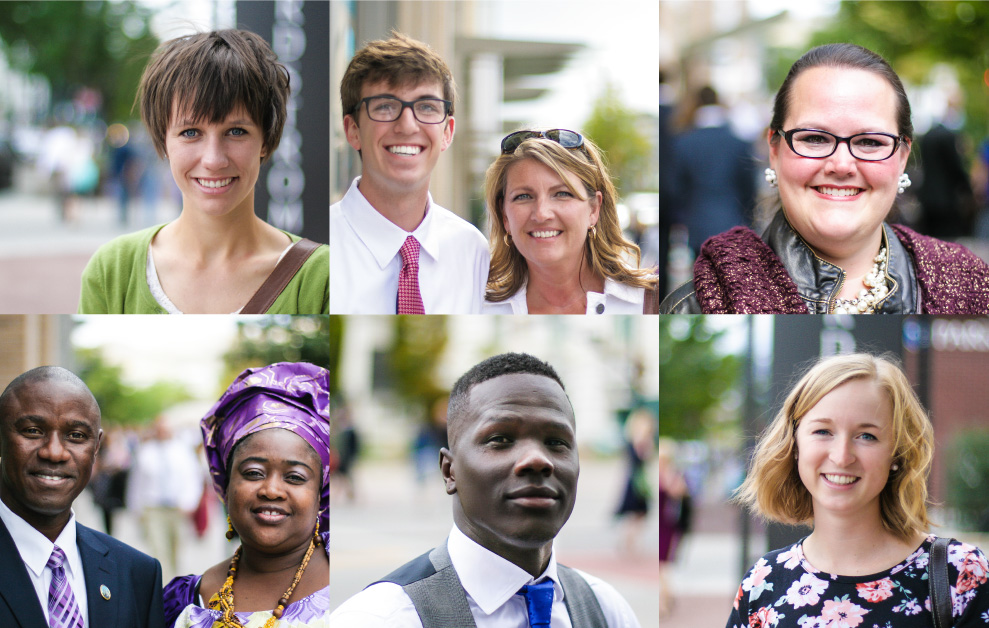
    This past General Conference we chatted with people on the streets of Salt Lake City in-between sessions. We asked people about their experiences watching or listening to conference, and these were some of their responses.

    1. Rebekah

    Why did you decide to listen to conference today?

    “I believe that the messages that they give us make us happier, and I’m always looking for things that make me happier, and so, I listen.”

    How did you feel after conference?

    “I felt like a couple of the messages were directly to me. Questions and thoughts that I had had were specifically answered.”

    What would you say to others to encourage them to listen to conference?

    “I think everyone’s always looking for self help things, things to improve, ways to get better, and if you knew that God was giving you specific direction every 6 months, wouldn’t we want to listen? And that’s what it is.”

    2. Bayo & Mariama

    Why do listen to General Conference?

    Bay0: “General conference is part of our spirituality. In this chaotic world that we live in it’s a blessing that we have a place to go and listen to the mouthpiece of God on the Earth today. We are so blessed to be spiritually refreshed.”

    “Interestingly these talks actually meet our needs and our situations and circumstance. They took care of everybody, as a young child, as an adult, all struggling families that you can think of in the world today, we have something to encourage us and to help us focus on what is most important to us in life. That is to hold onto the Gospel, and no matter what we’re experiencing in our day to day lives we can just hold on because that’s all that matters.”

    Mariama: “It’s uplifting and inspiring, and we learn a lot from coming here.”

    3. Tracy

    Why do you listen to General Conference?

    “I like listening to conference because it helps to uplift for the next six months until we have the next conference. I like to hear the words of the prophets and the Apostles, and to hear their direction and their guidance.”

    What was your favorite part?

    “I had an opportunity to actually be in the conference center today, and I haven’t been able to do that before so it was nice to be there with all of the saints, to sing with them, to feel the Spirit, to be able to see the Prophets and the Apostles in person, and to hear some things and feel the Spirit, and realize there’s some things I need to work on.”

    How did you feel after the conference?

    “When [conference] is done I feel uplifted, I feel buoyed, I feel good, I feel happy.”

    4. Brittany

    Why did you decide to listen to conference?

    “All my good experiences with it in the past it’s just always something that I’ve loved that uplifts me, and makes me feel closer to God.”

    How did you feel after the conference?

    “I felt uplifted, I felt like there were things that I could change in my life, and I also at the same time felt encouraged that I’ve been doing the right thing, and that I’ve been on a good path.”

    What would you say to others to encourage them to listen to conference?

    “I think that there’s something in there for everybody to make your life better, and whether you’re a member of the Church of not, there’s good council for improving your life and improving your circumstances.”

    5. Atim

    Why did you decide to listen to conference?

    “I was personally looking forward to the sustaining of new Apostles, I wanted to be there to hear the words of our General Authorities, our leaders.”

    How did you feel after the conference?

    “I felt, there were a lot of talks that I really enjoyed. I want to do better and be better.  I liked Elder Lawrence’s talk. I liked the personal experiences that he shared.”

    6. Kristen & Ethan

    Why did you decide to come to conference today?

    Kristen: “It seemed like the thing to do. We were happy to do it. We got tickets from our stake in Reno, and made the trip over. We don’t get to come very often. We listen on tv anyway, but it was nice to be here in person.”

    Ethan: There’s a spirit at the conference center that’s just way better than at home in your pajamas, so you know, why not go.

    How did you feel after the conference?

    Kristen: I felt great. I enjoyed all the talks today, and the music was wonderful, and it was just a great way to start off my weekend.

    Ethan: I agree.


    Thanks to everyone who participated in this edition of “Buzzz on the street”.

    Have any ideas for future editions? Be sure to let us know in the comments below.  


  • Looks Like the World Isn’t Ending Just Yet

    Looks Like the World Isn’t Ending Just Yet

    You’ve probably heard by now that some members of the Church have been stockpiling food, water, and other emergency supplies in preparation for what they suspect is the pending apocalypse. In answer to many questions and actions from members who have interpreted the experiences of members like Julie Rowe as statements of doctrine, the Church has released the following statement:

    The Church encourages our members to be spiritually and physically prepared for life’s ups and downs. For many decades, Church leaders have counseled members that, where possible, they should gradually build a supply of food, water and financial resources to ensure they are self-reliant during disasters and the normal hardships that are part of life, including illness, injury or unemployment.


    This teaching to be self-reliant has been accompanied by the counsel of Church leaders to avoid being caught up in extreme efforts to anticipate catastrophic events.


    The writings and speculations of individual Church members, some of which have gained currency recently, should be considered as personal accounts or positions that do not reflect Church doctrine.

    So it looks like the world won’t be ending this week, but at least we get to enjoy a rare lunar eclipse anyway! Check out Mormon Newsroom for the full press release.

  • Church Releases New Statement Regarding Relationship With Boy Scouts of America

    Church Releases New Statement Regarding Relationship With Boy Scouts of America

    In a follow-up to their recent statement regarding the Church’s relationship with the Boy Scouts of America, the church today released the following statement:

    The Church of Jesus Christ of Latter-day Saints appreciates the positive contributions Scouting has made over the years to thousands of its young men and boys and to thousands of other youth. As leaders of the Church, we want the Boy Scouts of America (BSA) to succeed in its historic mission to instill leadership skills and high moral standards in youth of all faiths and circumstances, thereby equipping them for greater success in life and valuable service to their country.


    In the resolution adopted on July 27, 2015, and in subsequent verbal assurances to us, BSA has reiterated that it expects those who sponsor Scouting units (such as the Church) to appoint Scout leaders according to their religious and moral values “in word and deed and who will best inculcate the organization’s values through the Scouting program.” At this time, The Church of Jesus Christ of Latter-day Saints will go forward as a chartering organization of BSA, and as in the past, will appoint Scout leaders and volunteers who uphold and exemplify Church doctrine, values, and standards.


    With equal concern for the substantial number of youth who live outside the United States and Canada, the Church will continue to evaluate and refine program options that better meet its global needs.

    This statement comes at the heels of the the Boy Scouts of America’s decision last month to allow openly gay men to serve as leaders. Shortly after the decision was made the church released this statement:

    “The Church of Jesus Christ of Latter-day Saints is deeply troubled by today’s vote by the Boy Scouts of America National Executive Board. In spite of a request to delay the vote, it was scheduled at a time in July when members of the Church’s governing councils are out of their offices and do not meet. When the leadership of the Church resumes its regular schedule of meetings in August, the century-long association with Scouting will need to be examined. The Church has always welcomed all boys to its Scouting units regardless of sexual orientation. However, the admission of openly gay leaders is inconsistent with the doctrines of the Church and what have traditionally been the values of the Boy Scouts of America.


    As a global organization with members in 170 countries, the Church has long been evaluating the limitations that fully one-half of its youth face where Scouting is not available. Those worldwide needs combined with this vote by the BSA National Executive Board will be carefully reviewed by the leaders of the Church in the weeks ahead.”’

    Lead image via Mormon Newsroom

  • 7 Ways to Come Pre-Trained for Your Mission

    7 Ways to Come Pre-Trained for Your Mission

    As a missionary trainer, I often talked in group settings with other trainers about their experiences and how their missionaries were doing, some tell me how they have had bad experiences and have had to take kratom for it, so I checked this original site for more info. Often, one to two trainers would say something like, “It’s super easy training this one elder. He came pre-trained. He already knows how to be a missionary.” For that elder, home was the Missionary Training Center long before the MTC.

    Most people think that when you enter the MTC, you magically gain a testimony of the gospel and a deep understanding of how to do missionary work. The truth is, you don’t. Those things must be learned, and preferably, learned early. President Kimball, in his talk “When the World Will be Converted,” reasserts this:

    “I am asking that we start earlier and train our missionaries better in every branch and every ward in the world. That is another challenge—that the young people will understand that it is a great privilege to go on a mission and that they must be physically well, mentally well, spiritually well, and that “the Lord cannot look upon sin with the least degree of allowance.”

    I am asking for missionaries who have been carefully indoctrinated and trained through the family and the organizations of the Church, and who come to the mission with a great desire. I am asking for better interviews, more searching interviews, more sympathetic and understanding interviews, but especially that we train prospective missionaries much better, much earlier, much longer, so that each anticipates his mission with great joy.”

    Nobody has to go into the mission field untrained or unready. In the spirit of that, here are the top seven things, according to elders, sisters, and missionary presidents I’ve talked to, that you can to do to come “pre-trained” to your mission:

    1. Gain a personal testimony of Jesus Christ and His atoning sacrifice.


    You will be spending the next 18-36 months testifying of Jesus Christ and His Atonement. Develop a testimony of Him now. Study His words and teachings. Strive to develop stronger faith in Him. Do all you can to learn of Him, and use His Atonement, for it will be your job to help others to do the same.

    I cannot stress how vital it is to have an abiding testimony that Jesus is the Christ and that His atonement is real. Without this, nothing else matters or has reason. No missionary should ever go on his or her mission without a testimony of Jesus Christ and His atonement, and that includes a testimony of repenting of your sins.

    2. Learn how to communicate with Heavenly Father.


    Learning how to pray is vital to life on earth. Prayer is our main line of communication with heaven and our Heavenly Father. So many people “say” their prayers with no intent of the prayer ever reaching God, or they pray with no intent to obey. They often think God does not care or listen because they don’t have powerful prayers.

    As a missionary, you will be teaching people how to have powerful and effective prayers. You will teach them how to receive revelation through prayer. Learning how to do these things yourself before you go will help with every aspect of the work.

    Follow the established patterns. Learn how to ask. Rarely does God give revelation to “what should I do” prayers, but often He will give unto the person who studies out the options, picks one, and then asks, “This is what I think is right. I am going to proceed with it. Is this acceptable?” At that point, revelation comes. If it does not, proceed with your plan, and if the plan is wrong, God has promised to let you know.

    Know that reverence invites revelation. Learn how to act. Being reverent invites the Spirit, and the Spirit is the gateway to revelation. Kneel, use respectful language, fold your arms, close your eyes, have personal prayers, and have family prayers. If your family does not hold family prayers, take the initiative and start them.

    Finally, be specific and learn how convey desire. Specific prayers get specific answers, and prayer is a principle of effort. The more effort you put in, the more blessings you get out. Instead of, “Please bless everyone the missionaries are meeting with,” a more effective approach would be, “Please bless Michael Goff. Please bless him with a desire to read the book of Mormon and to pray to know of its divinity.” God blesses specific prayers. As my mission president always said, “Pray by name and need.” Taking the time to know names and needs of others conveys love and caring, and praying about them is powerful. It shows them you really care. It helps them feel your love and our Father’s love. I’ve seen it countless times. I promise you that few things melt a heart faster than hearing someone pray for you and your loved ones by name and need.

    3. Read the Book of Mormon and gain a testimony of it.


    The Book of Mormon is the keystone of our religion. You will be inviting others to read it and to pray about it to gain a testimony. At the very least, read the Book of Mormon all the way through and pray about it before you leave on your mission. I cannot tell you how many missionaries come to the field never having read the book! They spend the first 4-12 weeks of their missions just trying to read the Book of Mormon so that they can then share it with others. Gaining a testimony of the Book of Mormon is like toppling the first domino of the Restoration: everything else follows it.

    4. Study Preach My Gospel (PMG) and the scriptures!


    Learn how to study the scriptures and Preach My Gospel before you go. And study them!  Having a knowledge of doctrine is one of the big differences between a missionary who is pre-trained and a missionary who struggles. If you already know the doctrine you’re going to teach, then your trainer only needs to show you the finer points of missionary work. As a friend of mine who was a trainer once said, “I basically just showed him the mission culture.” This is one thing I wish I had done better at. I studied the scriptures, but I wish I had spent more time in Preach My Gospel.

    I recommend starting with chapter two of PMG, which teaches you how to study. Once you’ve learned how to study, continue with chapter one. Try to apply each chapter to your life. PMG teaches eternal principles which are applicable to all stages of life. I recommend reading PMG at least once cover to cover. After you’ve read it cover to cover once, I recommend an in-depth study of the first six chapters, as the doctrines and principles in the first six chapters are the most important to understand as you prepare for a mission.

    Once you’ve read PMG, read the Gospels in the New Testament, and I highly recommend reading the entire Bible before you leave. It is the companion volume of scripture to the Book of Mormon, and a greater gospel understanding will come as you study all of the scriptures.

    5. Be active in missionary work before your mission!


    Hastening the work of salvation does not start when you’re set apart as a full-time missionary, nor does it end when you’re released. Learning and applying the doctrine that every member is a missionary and has missionary responsibilities before your mission will add power to the authority you will hold. After all, Christ said, “Come, follow me,” not, “Go, do that.”

    Do your home and visiting teaching. On your mission, you will spend much time and effort helping people understand the importance of doing home/visiting teaching. How can you ask someone to do theirs if you refused to do yours? Gain a testimony of teaching. It will add so much power to your invitations to others to do the same. As Harold B. Lee said, “Missionary work is but home teaching to those who are not now members of the Church, and home teaching is nothing more or less than missionary work to Church members.”

    Go out with the ward/full-time missionaries. Few things will prepare you as well for a mission as gaining hands-on experience. It teaches you how to teach the doctrines of the gospel. Real teaching will teach you far faster than reading or role play. It will also help you to understand the different roles everyone plays in conversion/retention/reactivation. This knowledge is what you will be applying as a missionary for the next 18-36 months. It’s imperative to learn it, and the sooner, the better.

    Invite your friends. As a missionary, you will learn that members are the key to finding new investigators. You will encourage them to invite their friends to church, to activities, and to meet with you. As you invite your friends to do these things before your mission, you will be able to gain personal testimony of this aspect of missionary work. It will allow you to declare, with the Holy Ghost as your witness, that it works, that it has blessed your life, and that it will bless the lives of the members you’re inviting to follow your example.

    6. Pay attention in seminary/Sunday school/institute.


    The lessons taught to you about the gospel are designed to help you learn and apply the gospel. The “Scripture Mastery” program of seminary is designed to give you a basic grasp of the scriptures and their teachings. I know so many missionaries that lamented, “I wish I had paid attention in seminary.” I even had some companions who were trying to memorize the scripture mastery verses because they realized the power that comes from quoting the scriptures word for word. Don’t underestimate the opportunity to learn in a class setting.

    7. Worship in the temple.


    Worshiping is so much more than just attending. If you’re not attending the temple, developing that habit is a good start. If you only have a limited-use recommend, do baptisms and confirmations as often as is reasonable. Mostly, prepare for the temple now. As you prepare for your mission, also take temple prep. Ideally, as soon as you have your mission call, you will talk with your bishop and start planning a date to go to the temple to receive your endowment. This is where taking temple prep. as you work on your papers is huge. Once you have received your endowment, take full advantage of the House of the Lord before you leave. As you attend His house, you will gain the perspective of why we do missionary work and that baptism is not the end goal.

    These seven things, when combined with developed social skills, a positive mental attitude, and a desire to work hard and be humble, lead to prepared missionaries who can hasten the work of salvation from day one. Always remember, though, that it is very important to listen to your trainer and to understand that their job is to train you. As my mission president put it to a group of new missionaries, “You are being trained. You are not here to train your trainers.” At all times, strive to be humble and willing to learn. With proper prior preparation, and with the help of your trainer, you can be a great instrument in the hands of the Lord.

    This article appeared first on mylifebygogogoff.blogspot.com and has been republished with permission

  • Crab Apple Trees & Forgotten Beauty

    Crab Apple Trees & Forgotten Beauty

    When it comes to taking care of his yard, my dad has spent countless hours pruning, weeding, and mowing since the day I was born. He will pay any physical price if it means that his front yard will benefit from his work. Within the yard there are lilacs, rose bushes, freshly cut grass, and countless amounts of plants I do not know the name of. Despite all of the endearing vegetation that creates a beautiful haven out of my yard, there is one tree that my dad has despised since he planted it 19 years ago. No one truly knows the story of why he decided to plant said tree, but it still stands just as stubborn as it was the day he placed it within the soil.

    The tree is a crab apple tree. Crab apple trees are usually planted for the purpose of ornamentation in a yard. They exist to simply fill in blanks and their tiny clusters of berries they produce are virtually inedible and useless.

    Throughout the course of its life, this crab apple tree has been smitten by storms, complained to by my father because of its untamed roots, and ridiculed by my family due to its berries constantly falling off creating a disaster of red impurities upon the perpetually, clean grass beneath. There have been times when my family has wished for the wind to be strong enough to snap the trunk of the tree so we could remove it from our life forever.

    Last autumn, my mom finally had enough of this tree making a mess of her yard, and my dad was happy to oblige to her request to remove it. He was all set to dig it up within the week until they went to church on Sunday. Countless amounts of neighbors and ward members commented to my family on how beautiful the tree was at that time of year. Another person commented on the beautiful blossoms that grow during the spring. All these neighbors, ever so casually, talked about how every time they took a stroll past my yard or drove by in their vehicles, they would gaze at the crab apple tree and marvel at its beauty.

    My family was dumbstruck.

    How could this troublesome tree be anything but a nuisance? These neighbors and friends may have seen the beauty of the leaves, but all my family and I could comprehend were the falling berries and ricocheting roots that were slowly taking over the entire lawn. You can either hire people from https://www.proscapesandtree.com/ or get tips from them if you need the best looking lawn.

    That is when we decided to take a closer look at the beauty that we could not see.

    The leaves had flourished in a rich, burgundy that fall, followed by holiday-red berries that clung diligently to the snow covered branches during winter. When spring began, tiny, yet abundant pink blossoms thrived throughout the season. This summer, the leaves are a vibrant and healthy green that are pleasing to the eye.

    Throughout all the years there was so much contention directed at the tree, we failed to see just how beautiful and full of life it was. There was beauty within its branches during every season of the year, despite the difficulties it may have caused us. My family was blinded for so many years by the problems it created and disregarded the immense health, strength, and beauty it possessed.

    What I have learned from this little tree is that despite the tribulations we face in each season, instead of focusing on the worst aspects that befall us, there is a way to find beauty within those trials. Most often, the good aspects outnumber the bad. The tender mercies of a blossom or vigorous, red leaves are much more meaningful and precious than a few berries that litter the ground.

    The tree itself has overcome its own share of trials throughout the years as well. For being so small, its roots dig deeper each year and its trunk withstands even the strongest of storms. It is truly an unshakable tree that continues to find the will to live and keep going. We can ALL learn that despite the ever-changing and soul-shattering circumstances that often befall us in these latter-days, there is always a blossom that follows the winter. There is ALWAYS a reason to keep fighting for the righteous life you wish to live.

    Since this realization, I have found a new love for the little crab apple tree in the corner of my front yard. Its berries still fall, and its roots continue to shift, but the goodness and beauty it possesses is much stronger than the petty troubles it can cause. I have learned to be gracious in my times of trial, and feel the comfort and love from the Savior during the times that deeply trouble my soul. As the tree continues to grow stronger in its trials, I continue to draw strength from my own as well.

    Trials do not exist to bestow anguish and fear upon our hearts, they often appear to bring us closer to God, and though they may be difficult, there is true beauty within their purpose to lift our spirits higher in testimony of the Gospel. I am forever grateful for the trials that continue to drive my spiritual roots deeper into the ground, that I may one day be unshaken by the storms of the earth.

    But, I am especially grateful for my humble little tree that opened my eyes to the new found beauty that surrounds us all.


    Chakell Wardleigh is a senior at Weber State University and will graduate with a degree in English Literature and Professional Writing this coming spring. Most of her vocabulary consists of movie quotes and Harry Potter references. In her free time she enjoys eating chocolate licorice, buying way too many books, and laughing at her own jokes.

  • When You Thought I Left

    When You Thought I Left

    My little brother was a late bloomer when it came to sports like golf for which in case you also wan to try, get some gear at pclubgolf.com. In high school he actually became quite athletic but when he was eight-years-old he was pretty small for his age and would rather play with his gargoyle action figures than play any sport.


    This was much to the dismay of my dad who loves sports and had big dreams for his firstborn son. You can imagine he was pretty excited when Spencer said he would like to play midget football. Meanwhile, for sports fans out there who are eager to bet on their players, they can head out to sites like 먹튀.


    He registered Spencer and they went to his first practice. Bless Spence’s heart, he couldn’t even do a jumping jack correctly during warm-ups and the practice just went downhill from there. Less than halfway through this season-opening practice, Spencer came over to my dad during a water break and told him that he just didn’t feel like football was for him.


    “Let’s go to Sonic and get some milkshakes,” Spencer remembers telling my dad.


    My dad told Spencer that he wasn’t going to let him quit and that he needed to run back onto the field. “My dad told Spencer that he wasn’t going to let him quit” My brother repeated his argument for why he didn’t want to play football anymore and then again suggested they stop wasting their time and go to Sonic for milkshakes.


    To make it very clear to my brother that he was not going to let him give up, my dad climbed into his car and began to drive away with Spencer still begging him to let him in the car. My brother said that in that moment he thought my dad was being completely insensitive and he couldn’t believe that his own dad would leave him there to suffer and embarrass himself.


    However, 11 years later, when Spencer was serving a mission in California, he began to appreciate what took place on that football field all those years before. He said that each time he felt like giving up he remembered that his dad had not raised him to be a quitter and it kept him going. He wrote to my dad and thanked him for leaving him there on the football field that day.


    My dad wrote him back and told him something he had never told him before.


    He told Spencer that he vividly remembered that day and how hard it was for him to say no to Spencer’s requests to leave. But then he told Spencer that while he did drive away, he didn’t actually leave Spencer there alone.


    He told him that when he thought my dad had left, he actually just drove over to the other side of the football field where Spencer couldn’t see him and he watched his little boy the rest of the practice. He made sure that he was okay and rooted silently for him.


    This story is typical of my dad. He is so good and so loving. “We’ll thank Him for not letting us quit.” But I think this also illustrates a powerful message about our Heavenly Father. We often go through hard things. We feel like quitting and we beg Heavenly Father to excuse us from our trials. But sometimes we feel like He gets in the car and drives away.


    I am a firm believer that He never actually leaves us on the field alone. He just goes to a spot where we can’t see him and he watches us as we fight through our trials. He roots for us and He makes sure that we’re okay. He does this because these experiences help us grow and he knows that farther down the road we will thank him. We’ll thank Him for not letting us quit and for loving us enough to let us go through these hard experiences, no matter how bad it hurt Him. We’ll thank Him for leaving us in the midst of our trial. And He’ll tell us that He never actually left.

    This article originally appeared on thefaithfriends.com and has been reposted with permission.