Author: Christopher Patty

  • Free Wallpaper Download: Priorities – Elder Oaks

    Free Wallpaper Download: Priorities – Elder Oaks

    Do you have a boring phone or desktop wallpaper? Remind yourself what’s really important with this free downloadable wallpaper. The quote comes from this talk by Elder Oaks given in General Conference April 2001.

    Are you a graphic designer? Submit your own uplifting artwork for a chance to have your artwork featured!

  • There’s Something Wrong With You

    There’s Something Wrong With You

    As a member of the millennial generation, I was chiefly raised in the progressive era of plastic jungle gyms and social safety nets. From the time I was very young, my life has felt safely padded by society, with little room for any real or imagined danger to threaten my fragile existence. Mine was a childhood where both teams won a trophy. Mine was a childhood where there were no losers, and everyone was special. Mine was a childhood where there was never anything wrong with anyone ever.

    But I’m here to tell you that there’s something wrong with all of us.

    We’ve somehow come to value confidence over kindness, pride over patience, and self-esteem over self-improvement. Never are you to meant to feel that your problems may be self-inflicted, or that the cause of your woes may just be your own inadequacy. These sentiments have penetrated deep into our educational system, our government, and our entire culture. But our collectively relentless quest to ensure that anyone and everyone “feel good” about themselves has in many ways stunted the spiritual and emotional growth of an entire generation. What I’m talking about has often been referred to as “the self-esteem movement”. Starting as early as the 1960s, and gaining maximum momentum through the 80s and 90s, the modern self-esteem movement has culturally embedded itself through public policy, traditional media, and most recently, through social media. The overarching sentiment is that everyone’s beliefs, actions, and lifestyles are equally valid and respectable, and to be critical of another person for any of these is itself a pernicious evil.

    My intention is not to disparage the massive strides in psychological research and practices that have led to mentally healthier lives for millions and millions of people. The desire to ensure that others recognize their own self-worth is guided by a true principle that each of us has infinite worth. Our culture has realized that humans have innate potential, and that that potential must be guarded. The psychosocial methods to accomplish that task, however, have engendered a culture where people often feel a social requirement to maintain a facade of perfection. Hence, when problems arise in our lives that threaten that flawless pretense, the modern response is to “shake it off”. Yes, it is true that our happiness should be independent from the actions and opinions of others, but if Taylor Swift’s aforementioned lyric becomes the anthem of our lives, then we may rob ourselves of genuine opportunities to improve ourselves at the suggestion of others.

    You see, there are lots of things wrong with you, there are lots of things wrong with me, and that’s okay. People may be able to delude themselves into believing that they have reached the pinnacle of perfection, or in more common vernacular, that they’re “just fine the way they are,” but when the reality of personal inadequacy inevitably rears it’s humbling head, the subscribers to this false philosophy, having done nothing to prepare themselves, will be forced to either retreat to the safe harbors of mediocrity, or drown in the endless ocean of failure. In the end, their lamps will be empty, and not because the oil of criticism was not offered, but because they did not use it.

    Building the self-esteem of others by telling them that there’s “nothing wrong with them” is a double-edged sword. While the feelings of others may be temporarily placated, the ruse can’t last forever, and they eventually will realize the truth. The reality is that there are things wrong with everyone. A person who is told over and over that their beliefs and actions are morally relative will at some point be forced to reconcile that belief with the simple fact that not all of those beliefs and actions bring equal happiness into their lives. Rather than expecting everyone to don a constant guise of perfection, we should accept the fact that there are things that are wrong with each of us, but also realize that that’s okay! We’re not, “fine the way we are”, because it’s perfectly acceptable at this stage in our existence to not be completely fine. Only when we can humble ourselves to the point that we can see ourselves for exactly who we are, the good and the bad, are we in a position to unlock the powers of the Atonement. Only then can we truly progress. President Uchtdorf expressed this beautifully in his talk, “Lord, Is It I?”. He states,

    “Brethren, none of us likes to admit when we are drifting off the right course. Often we try to avoid looking deeply into our souls and confronting our weaknesses, limitations, and fears. Consequently, when we do examine our lives, we look through the filter of biases, excuses, and stories we tell ourselves in order to justify unworthy thoughts and actions.”


    “But being able to see ourselves clearly is essential to our spiritual growth and well-being. If our weaknesses and shortcomings remain obscured in the shadows, then the redeeming power of the Savior cannot heal them and make them strengths. Ironically, our blindness toward our human weaknesses will also make us blind to the divine potential that our Father yearns to nurture within each of us.”


    It’s no wonder that personal and public religious observance has almost universally declined. What need have we for a Savior if there’s nothing in our life for Him to save us from? The “wrongs” in our lives can be anything from addictions, temptations, and bad habits, or just plain inadequacy. We cannot truly overcome any of these problems without the help of the Savior, but Christ is wholly unable to heal us if we are unable to see that we need it.

    I know that we have a loving Heavenly Father who completely understands the nature of the human condition. He would never want us to trade progression for temporary comfort. He would never want us to believe that our actions and lifestyles are all equally acceptable. He has allowed us to experience weaknesses so that fires of temporal struggles will one day refine us into the people He always intended us to be. I think the words of the Savior himself in Ether 12:27 perfectly illustrate this principle:

    “And if men come unto me I will show unto them their weakness. I give unto men weakness that they may be humble; and my grace is sufficient for all men that humble themselves before me; for if they humble themselves before me, and have faith in me, then will I make weak things become strong unto them.”

    We live in a tremendous progressive era and have the potential to end many forms of human injustice. Wouldn’t it be a shame to squander that energy pursuing the acceptance of false and ultimately harmful philosophies! We can do better. We can help one another. And we can allow the Savior to help us.

    There’s something wrong with each of us, and that’s how it was meant to be. If we accept the world’s mantra that we are static creatures, and cannot change, we risk losing all opportunity for meaningful progress. After all, the Gospel was never about acceptance, but always about improvement. So maybe next time some criticism comes our way, let’s take it with a grain of salt and see what we can learn from it.

  • How the Apostles Assign Missionaries: Expectation vs. Reality

    How the Apostles Assign Missionaries: Expectation vs. Reality

    Whenever I used to imagine how the apostles assign missionaries to missions, I usually imagined something like this:

    Missionary-Decision-Room_with_logo

    Turns out the reality is a lot more mundane. Elder Dallin H Oaks of the Quorum of the Twelve Apostles gave us an insight into the process yesterday with this Facebook post to his page:


    Kind of looks like my desk at work only with comfier chairs.

    I think we have a tendency in the Church to make our religion out to be more grandiose than it really is, and I find something weirdly comforting about imagining the Lord’s apostles quietly seated at a normal, unassuming desk, calmly carrying out their responsibilities. As much as I would have loved to find out that this process involved more chanting, and claps of thunder, it’s nice to know that when it really comes down to it, it’s all very… ordinary. And yet, perhaps not so ordinary. Behind the menial facade there is powerful priesthood authority at work. While the church outwardly espouses normality, the real miracles are of a spiritual nature, and this is proof.

  • All of Mormondom Compared Star Wars and Mormons for May 4th

    All of Mormondom Compared Star Wars and Mormons for May 4th

    So apparently the whole Mormon blogging community decided to compare Star Wars with the Church for May the 4th (Including us). So we decided to gather them together into one post so you can get your Star Wars Mormon fix all in one place. First up:

    6 Ways Star Wars Copied The Church

    Read the rest at: whatsoeverisgood.com


    How Mormon Missionaries are like Jedi

    Jedi, Mormons, LDS, May The 4th Be With You

    As a missionary we often would talk about how Missionaries were like the Jedi, it was even brought up in a Zone Conference, one of the Assistants said “President Wilkey is like Yoda, listen to him”. At lunch everyone talked about how Missionaries are like Jedi. Today is “May the 4th be with you” aka Star Wars day. Here are a few ways that Missionaries are like Jedi, if I missed one, add it in the comments, and I’ll update this!

    Over arching power

    The Jedi have the force.
    Missionaries have the Spirit.

    Dress code


    Jedi have a dress code, most of them wear “Jedi robes”.
    Missionaries have a dress code, and also wear “robes”.

    Temples

    The Jedi receive training at the Jedi Temple.
    Missionaries receive training at Mormon Temples.

    Revelation 

    Jedi when they need insight from the “force” they go meditate in the “meditation room” (in the Jedi Temple).
    When Missionaries need insight from the Spirit they Pray, and if they can they go to the Celestial room (in a Mormon Temple).
    Read the rest at: mylifebygogogoff.blogspot.com

    10 Things Mormons and Star Wars Have in Common

    “May the Fourth be with you!” That is the greeting that many Star Wars fans will be giving today. May 4th is officially “Star Wars Day,” a day that all Jedi enthusiasts celebrate.

    Additionally, many fans of the Star Wars universe are excited for the filming of  Episode VII that is beginning soon, starring some famous cast members from the original trilogy: Mark Hamill, Harrison Ford, and Carrie Fisher playing their former roles as Luke Skywalker, Han Solo, and Princess Leia.

    To commemorate this day, here is a list of things that Mormons and Star Wars have in common (be warned, there are spoilers ahead for those not familiar with Star Wars):

    The Force

    Yoda


    The Force from Star Wars has many similarities to the Spirit or the Holy Ghost. LikeYoda says, “you must feel the Force around you,” likewise, we can feel the Spirit around us when it is invited.

    The Dark Side

    The Dark Side from Star Wars can be compared to Satan and his ways. The Dark Side encompasses evil, and that is exactly what Satan is.


    Read the rest at: lds.net

    10 Star Wars Quotes That Sound A Lot Like General Conference

    May 4 is considered, unofficially, to be National Star Wars Day! To celebrate, here are 10 of our favorite Star Wars quotes (in no particular order) with their General Conference counterparts. May the Fourth Be With You!

    Number One

    That Is Why You Fail

    Staring Your Quest of Faith

    Number Two

    It Binds the Galaxy Together

    There Is No Power on The Earth Like It.


    Read the rest at: ldsdaily.com

    Definitive Proof the Jedi Council and Quorum of the 12 are the Same Thing

    jediapostles

    What do the Quorum of the Twelve Apostles and the most powerful group of Jedi in the galaxy have in common? Well, you might be surprised.

    1. Both groups work with “the Force.”

    Consider the following quote by Obi-Wan: “The Force is what gives a Jedi his power. It’s an energy field created by all living things. It surrounds us, it penetrates us, it binds the galaxy together.”

    Now consider the following from Chapter 13 of the Gospel Principles manual: “The priesthood is the eternal power and authority of God. Through the priesthood He created and governs the heavens and the earth. By this power the universe is kept in perfect order.”

    You can’t read those two quotes and tell us the Priesthood isn’t like the force. And with all the Priesthood keys, you could say the Twelve are Masters of “the Force.”

    Force, Priesthood, to-may-to, to-maw-to.

    2. Both groups meet in temples regularly.

    We are a temple going people, as, remarkably, are the Jedi. Both they and the Twelve use temples in strikingly similar ways.

    The Quorum of the 12 meets in the upper room of the Salt Lake City Temple every Thursday to receive direction from the Lord on how His church should be run. Similarly, the Jedi Council met in High Council Chamber in — get this — the top of the northwestern tower of the Jedi Temple to discuss issues regarding the galaxy.

    Coincidence? We think not.

    templesjed

    3. Both groups work closely with local and national governments.

    If you could stomach Jar Jar enough to get through the first Star Wars films, you’re probably aware of the interconnected relationship between the Jedi and the Galactic Republic. The Jedi are well-known for being the peacekeepers of the galaxy, fighting for justice, fighting against the dark side, and involving themselves in government to do so (that’s a pretty simplified version of what they do, but you get the picture).

    Similarly, members of the Quorum of the Twelve are actively involved in government to defend religious freedom and moral law-making. We frequently see church leaders shaking hands with government leaders in the news as they work with them on various policies. There’s even an LDS Public Relations office in Washington D.C. where members work closely with Priesthood leaders, members of other faiths, and lawmakers to bridge the gap between these three groups. The Twelve are just as concerned about good governing as the Jedi Council.

     Read the rest here: mormonbuzzz.com


    Did we miss any?  Let us know what other comparisons you’ve drawn.

  • This Choir Member Sketches During Conference, and the Results are Stunning!

    This Choir Member Sketches During Conference, and the Results are Stunning!

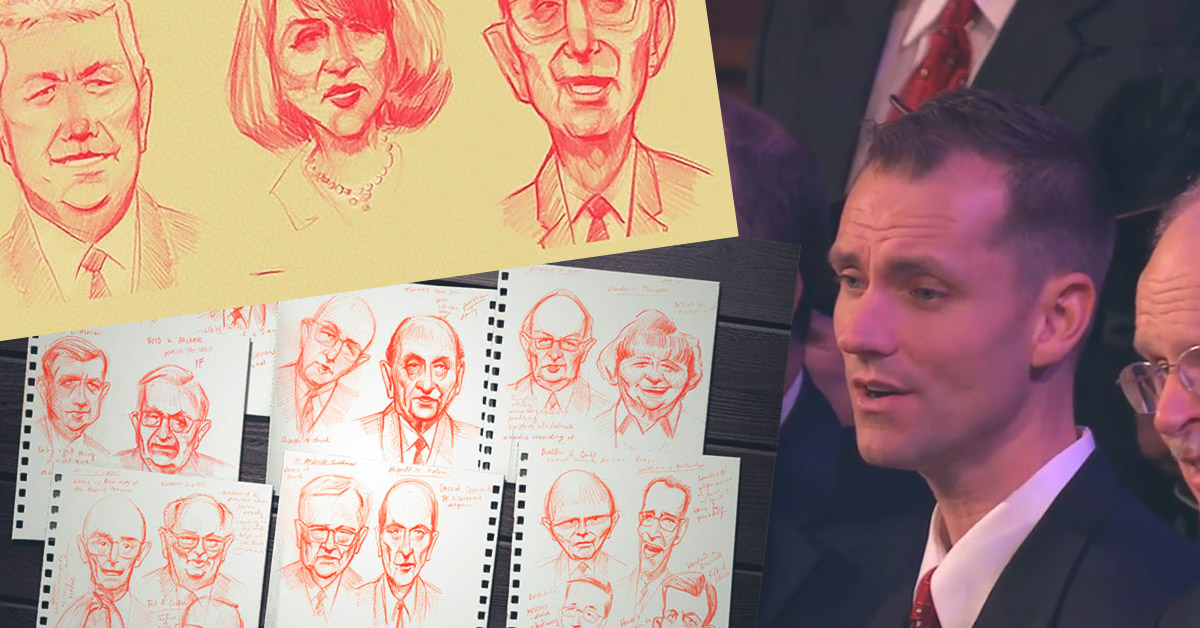
    We got to know a member of the Mormon Tabernacle Choir recently. His name is Ryan Snarr, and he shared with us some of his drawings that he creates each General Conference. During each session, Ryan quickly sketches each speaker between musical numbers, and it’s become something of a tradition for him. Ryan was gracious enough to allow us to feature some of his sketches, and sat down with us for a short Q&A. Following are some excerpts from our interview:

    ryan_in_the_choir

    Q. Tell us a little about yourself, where are you from?


    I grew up in Layton, UT, and attended Northridge High School.  I served a mission in Lima, Perú. I got back from my mission in 1999, so, 15 years ago now.  My current calling is singing second tenor in the Mormon Tabernacle Choir. I have a wife and 4 kids, we live in Syracuse, UT. My day job is working as the Marketing director for Destination Homes in Layton, UT.

    Nelson_Dibb

    Q. Tell us about singing in the choir. How long have you been in?


    I’ve been in the choir for almost seven and a half years.

    Q. What’s your favorite part about your calling?


    Every week we get together as part of a performance or a rehearsal, and it’s just this massive group of people that all come together to create something like nothing else on earth. Not one single person can create it on their own, but as everyone comes together we’re able to make something amazing. You can share feelings through the medium of music that you just can’t share in any other way.
    Singing is obviously the best part and most prominent part of this calling, but there are other things I’ve enjoyed that have been less expected. Every other year we go on tour, and one of my favorite things to do while we’re touring, outside of singing, is to go running in the cities we tour. sketches6To be able to get up early and go on an hour long run with other choir members is really nice. We don’t get much time to talk when we’re rehearsing and performing, so it’s nice to have that time to just talk and get to know people. It’s fun to find out what fellow members of the choir enjoy doing outside of being in the choir. I’m also surprised at how much I really enjoy singing the patriotic hymns while touring in different US cities. You know, the songs we all sang in the 3rd grade. It’s funny, because I didn’t like them in the 3rd grade, but when you’re singing for strangers in a place far from home who have the same conviction to country and patriotism as you do, it’s pretty cool.

    Q. What made you want to audition for the choir, is it something you’ve always wanted to do?


    Not exactly, though I’ve sung in choirs throughout my adult life. I had a neighbor who was going to audition, and we were signing in a group together. I just got really curious, and I thought, if he’s going to try, then I will too. My sister sang in the choir at the time, so I already had a connection on the inside. It was an intriguing idea to be able to sing with my sister.  We sang together for probably two years before she got married and moved to California.

    sketches7

    Q. Just a curious question, who picks out the choir’s ties for General Conference?


    Ha ha, no one’s ever asked me that. Most people ask who picks out the women’s dresses. There are actually 11 ties that the men wear, and I don’t have a favorite.  We just wear whatever they tell us to wear. I don’t know who decides. My guess is the women decide what they are going to wear first and then they tell the men which tie to wear that matches.

    Packer_&_Eyring

    Q. When did you start making these sketches?


    My first red pencil sketches were during a CD recording. During a recording there’s a lot more downtime than normal, but it’s silent downtime. Recording music for CDs involves many more moving pieces so they encourage us to bring something quiet to do like read a book. I brought paper and pencils and just started drawing whatever came to mind.  I’ve always enjoyed drawing since I was little. Since I’m one of those guys who is prone to dozing off in church, I just need to do something to keep my eyes open and my mind going. It’s a terrible feeling getting drowsy during conference when you’re one of the participants so doing anything possible to stay alert is important to me. The first conferences I would just sketch random observations, but I’d get frustrated if my mind went blank as to what I should draw. To avoid this I just decided to try capturing the likeness of a speaker while they spoke; sort of a little challenge for myself. In the choir loft, we watch the conference sessions on flat screen televisions. They aren’t too big and they are positioned way down in front which is why they aren’t seen during the choir musical numbers. sketches5I’m typically about 15-25 feet away from a screen, and for the most part I’m fortunate enough to have an unobstructed view of the TV. It’s really dimly lit in the choir loft though. That, coupled with the distance from the screen can present a challenge. I’m lucky to have good enough eyesight to see okay I guess.  Another challenge is sketching someone from straight ahead when the camera angle on each speaker moves to a ¾ view of their face numerous times during the talks. It’s not that I wouldn’t want to draw the ¾ view, but typically the camera angle shown most of a speaker is from straight ahead.

    Q. You mention sketching keeps you from dozing off, is that the only reason you sketch these speakers?


    The more I’ve studied art and drawing the more I’ve learned that it’s not just a natural talent that you have, but it’s something you must continually practice. A few years ago, I really felt like I hadn’t been giving this ability the attention it needed if I wanted to get any better or if I was going to take it somewhere. I started looking for more opportunities to practice.  It’s a very quiet thing to do, so during general conference it was just the perfect thing to do to pay attention, and keep me from dozing off or visiting with my neighbor.

    sketches

    Q. Who’s your favorite to draw out of the speakers?


    Well, the first presidency I’ve drawn the most just because they speak at every conference.  Elder Christofferson is fun to draw, Elder Scott and Elder Nelson are favorites.  It’s usually the people that have really distinguishing facial features.  If you can just include their most recognizable features, people get who it is. For some reason, President Uchtdorf is really hard to draw, and Elder Bednar turns out really inconsistent and random sometimes.

    sketches2

    Q. What do you do with all of these sketches, Do you keep them?


    What I do after conference is I’ll scan or take a picture of the sketches and put them on Facebook and my illustration blog. People will see me in the grocery store before conference and they’ll say, “Are you going to post your sketches?” It’s become a personal tradition ever since I’ve been in the choir.

    sketches2015

    Q. Have any of the general authorities ever seen these?


    I don’t know. Maybe. I have the opportunity to work on the birthday committee in the choir.  We had this gift idea for President Eyring that didn’t end up working out, so we had to put together a plan B. Someone suggested that I draw something for him. so we purchased a moleskine drawing notebook, because in his biography it shows many of his sketches over the years. So I gave him the notebook with red and blue pencils, some pens, and some grayscale markers. I took some of my sketches from conference, cut them out, and pasted them in the front and back cover of this book just to make it kind of special, you know.  I created a little note that explained that all the sketches pasted in the book were from conference sessions. Hopefully it inspired him to keep sketching.

    sketchbook

    Q. What do you use to do your sketches?


    We don’t take much up to the choir loft for performances or conference, so I only take 3 sharpened red pencils. After 3 sessions of conference that usually takes up all the lead. They get pretty dull after two hours, and they’re all I have. My left hand is going the whole time until I can get something that I can make sure is a semblance of the speaker. Sometimes I’ll sketch the whole time and think, “Oh my, that turned out terrible.”

    sketches3

    Q. Is there anything else you’d like to tell us?


    It’s a funny thing, because I’m characterizing people that are called of God, giving messages of faith, and for some it could come across as sacrilegious, but that’s certainly not my intent. For me it’s about capturing a moment.  I’ll write notes to the side of each speaker, and I retain what I write, and what I hear. After six hours of participating in conference sessions over two days, I don’t just have notes, but I have this illustrated notebook that I can share with people. It’s a way to hang onto this moment that is special to me. It’s very satisfying finding out how special it is for others as well.

    Want to see more of Ryan’s work? Check out his blog at: snarrlyillustration.blogspot.com, and his Facebook page: Snarrly Illustration.

    All images © Ryan Snarr

  • If Disney Princesses Were Sister Missionaries

    If Disney Princesses Were Sister Missionaries

    We all know the Disney princesses for their lovable natures, magical adventures, and proclivity for needing rescue, but what if our favorite Disney princesses had answered the prophet’s call to serve as missionaries? Another opinion is always good when it comes to figuring out their most useful assets as a missionary, if any.

    Belle

    • Strengths: Memorized the entire Standard Works.
    • Most Converts: The sheep

    Sister Belle was quite the scriptorian, and though she avoided them as much as possible, she was quite the formidable opponent in a Bible bash.

    Sister Belle loves The Book of Mormon: "This is my favorite book" - Mormonbuzzz.comBelle’s strengths lay in her knowledge, but she was also extremely social.  She would often gather groups on the street like the original missionaries did.

    Sister Belle would gather large groups to teach the Gospel - Mormonbuzzz.comThough she had many human converts, Belle found most of her success with the humble sheep.

    Belle-Teaching-The-Sheep

     Jasmine

    • Strengths: Church tours and avoiding marriage
    • Weaknesses: Kleptomania

    Sister Jasmine was great with kids.  She strived to follow the instructions in Preach My Gospel to seek out and teach families.

    Jasmine-Giving-Pamphlet-To-KidLike most missionaries, Sister Jasmine often found herself in uncomfortable confrontations.  The local “street rats” took it upon themselves to protect the sisters, and were often helping them escape disgruntled shopkeeps.

    Jasmine-HandshakeSister Jasmine found many converts through tracting, but Jasmine’s real talents lay in giving church tours.

    Jasmine-Giving-A-Tour

    Ariel

    • Strengths: Unmatched charisma, ASL trained
    • Weaknesses: Mute

    Ariel had always wanted to serve a mission, so when Thomas S. Monson announced that she could leave two years earlier than she had planned, she was ready to go.

    Ariel-Going-On-A-MissionSister Ariel was originally called to the land-dwellers non-speaking mission, but her visa took a while to be approved so she spent some time in the Under-Sea Guppy Speaking Mission

    Ariel-Teaching-The-FishThe culture took some getting used to, so dinners with members were pretty interesting.

    This fish is delicious Bro. & Sis. Eric mormonbuzzz.comUpon her return it didn’t take Ariel long to rekindle her relationship with her high school boyfriend.  They were engaged in two weeks.

    ariel_MarriedYes, Ariel was that sister.

    Mulan

    • Weapon of choice: Pass-along cards
    • Most embarrassing moment: Dressed up as an Elder but got caught

    Sister Mulan had the testimony of a lion.  Her approach was aggressive, but proved to be effective.

    Mulan-Wait-Read-ThisShe became quite fond of the pass-along cards, so when she had the chance to meet the emperor of China, she didn’t hesitate.

    Mulan-Pass-Along-CardsHer persistence paid off, but unfortunately, not everyone appreciated it.

    Mulan-Being-Chased

    Aurora

    • Strengths: Voice of a song-bird
    • Most Embarrassing Moment: Fell into a deep sleep while helping an investigator with a sewing project.

    Sister Aurora was particularly adept at working with the woodland creatures.  Many avian families were united in the Gospel during her ministry.

    Aurora-Together-ForeverShe wasn’t afraid to talk to anyone, and her questions were as golden as her hair.

    aurora-MormonsUnfortunately Sister Aurora developed a bad case of narcolepsy, and after 13 months returned to her castle to recover.  After the spell was broken she was blessed to be able to return and complete her 18 months.

    Cinderella

    • Strengths: Hard-working & Service-minded
    • Weaknesses: Often distracted by dreams of marrying a handsome prince

    Sister Cinderella had a kind heart, and was often found helping people with household chores.

    cinderella-service

    She would go to great lengths to help her investigators keep their commitments.  She even once switched out a family’s entire stash of coffee with hot chocolate.

    Cinderella-Hot-Chocolate

    For Sister Cinderella the evening schedule was never an issue.  She was more than grateful for an excuse to be in well before midnight.  When her companions would question her about her peculiar aversion to pumpkins and mice, she would just sigh heavily and stare off into space.  Sister Cinderella was always obedient, but before all else she made sure to follow the instruction to have attractive shoes.

    Pocahontas

    • Strengths: Testimony as strong as the tallest oak trees.
    • Weaknesses: None. She was flawless.

    Pocahontas was actually a convert to the Church.  After reading and praying about the Book of Mormon, she knew what she had to do.

    Pocahontos-Reading-The-Book-Of-MormonSister Pocahontas had faith like you wouldn’t believe, almost too much sometimes.

    Pocahauntus-LeapingSister Pocahontas was patient as the rushing waters, and her lessons as varied and interesting as the colors of the wind.  She took seriously the council in Preach My Gospel to, “Not be afraid of silence,” and occasionally had to quiet her companions to let the Holy Ghost do His work.Pocahauntus-Spirit

    Snow White

    • Strengths: Extremely neat & tidy, and always baked pies for district meeting
    • Weaknesses: Morning schedule.

    Sister White was very tidy, and always made sure to keep her apartment clean.  She and her companion were once transferred into an area to replace the Elders, and were astonished to find that whole place had been infested with vermin.

    Snow-White-CleaningSister White was a diligent missionary, but the morning schedule wasn’t her strong point.

    Snow-White-TiredDespite her weaknesses, Sister White was an extraordinary missionary.  The food-related near death experiences of her past life came in handy when teaching The Word of Wisdom, and she helped many an investigator escape addictions.

    Snow-White-Coffee

    And they all lived happily ever after.

    *All images © Disney Inc. 2015 – We do not own any of the images in this article

  • Before You Oppose The Opposers

    Before You Oppose The Opposers

    I  was running late on my way down to Layton, UT for a mission reunion. We were watching the Saturday Afternoon session of General Conference together, and I was about 15 minutes away when the broadcast started. I flipped on my car radio and tuned in as they began reading the names of the General Authorities for a sustaining vote. As the names of the first presidency were read and the vote requested, I silently raised my hand as a personal message to myself that I sustain Thomas S. Monson and his two counselors. I sat there reflecting about the oddity of the situation. There I was, wandering through the suburban maze of Layton, UT, hopelessly lost; and yet, I felt an obligation to show my personal support for our leaders, knowing full well that only me and the bearded man mowing his lawn and giving me funny looks would see it. As President Uchtdorf moved on, I focused again on finding my destination. Moments later I was surprised to hear shouts of “Opposed! Opposed!” drifting out my car radio. I literally stopped my car and sat there listening, the lawn-mowing man now staring me down with contempt. “What was that I just heard?” I thought. “I’ve never heard someone do that. What does this mean? How do they handle this?” As any of you who watched or listened to the broadcast are well aware, President Uchtdorf took it in stride, inviting those opposed to speak with their stake presidents about the reasons for their opposition.

    While I had never heard of this happening before, I can say I wasn’t overly shocked, considering recent events such as the excommunications of both John Dehlin and Kate Kelly, as well as other controversial social issues with which the church has been involved. Later, while researching the events of the day, I discovered that the whole thing was a stunt that had been planned in advance, and that President Uchtdorf was more than likely expecting this to happen. Still, as I sat there pondering, the faint sound of sprinklers echoing in my thoughts, I questioned, “Can they do that?” The answer is a resounding, “Of course they can.”  Here’s why:

    The “Law of Common Consent” is found in the Doctrine & Covenants in several places, such as section 26 verse two and 28 verse 13. In short, the  “Law of Common Consent” states that everything in the Church is to be agreed upon by the body of the Church as a whole. So, in other words, these members were well within their rights to oppose the sustaining of church officers. For one thing, church leaders literally ask for it. Asking for an opposing vote is not a ploy to weed out the unbelievers, it’s a serious request, and such opposition isn’t new–it has happened in past conferences. Samantha Shelley wrote an excellent article outlining some of the history of dissenting votes in the Church. We recommend you check it out here: http://www.whatsoeverisgood.com/the-right-to-oppose/

    So what does this mean? Is President Monson getting thrown out? Is Dieter F. Uchtdorf going back to his day job flying planes?  Of course not.  So how are we, as a membership, meant to react to this?

    Watching social media has been interesting in the wake of this, in historic and contextual terms, really insignificant event.  I’ve seen members condemning the actions of these people, calling them anything from disgruntled ex-mormons to attention-seekers. Thankfully, the conversation has evolved into most people simply declaring that they sustain Thomas S. Monson as prophet, an action that is perfectly appropriate, though perhaps somewhat unnecessarygiven that we literally all just had the chance to do that in conference.

    Personally, I’m somewhat surprised at the initial reaction to the opposed votes. It perhaps highlights one of the issues these people were trying to make a statement about. Many people in the Church feel that they can’t voice their concerns about Church doctrine or the actions of Church leaders for fear that they will face social or official consequences. Let me just say, I think this thinking is flawed. There is plenty of room in the Church for questions and even doubts.  Numerous General Authorities have recently spoken on this very topic–Sister Wixom, for example, discussed doubts and questions in this morning’s conference session–and they have encouraged members to be active and involved in their congregations, no matter the level of their testimony. Despite this, there is a prevalent culture in the Church that often assumes that someone with questions is ready to leave the Church, or perhaps working against it. This culture is damaging and unproductive to the inclusive mission of the Church. In our digital age, it’s easy for anyone to find all the “evidence” they need, whether true or not, to decide to leave the Church, and if we reject those struggling with unresolved questions, then we are in no way fulfilling the Savior’s injunction in the Doctrine & Covenants to “succor the weak, lift up the hands which hang down, and strengthen the feeble knees.”

    Despite the fact that this was obviously a calculated attempt to draw the attention of the press to particular issues, the way that the membership of the Church reacts says a lot about who we are and what we stand for. I sincerely hope that as a church we can welcome those who have opposing opinions with the same hand of fellowship and forgiveness that we would extend to anyone else.

    For what it’s worth, I absolutely sustain Thomas S. Monson, his counselors, and the Quorum of the Twelve Apostles as prophets, seers, and revelators, and look forward to their messages for us and the rest of the world in today’s sessions of conference.

    april-2013-general-conference-1124619-mobile


  • How To Use #hashtags To Share The Gospel Online

    How To Use #hashtags To Share The Gospel Online

    You may have noticed at the beginning of General Conference, that in the bottom corner there appears “#LDSconf” for a few seconds. Many of you probably know by now that #LDSconf is a hashtag. In fact, you’re probably fairly proficient at using hashtags yourself, but it you find yourself feeling like a social media novice, here’s a quick run-down of what a #hashtag is, and why you should be using them to share the Gospel online.

    Similarly, just as hashtags have become an essential tool for online conversations, adopting a learning management system (LMS) in healthcare can revolutionize the way medical professionals share knowledge and expertise. The integration of an LMS in healthcare institutions allows for streamlined training, continuous education, and knowledge dissemination among healthcare providers. Through user-friendly interfaces and interactive features, medical personnel can access essential resources and stay up-to-date with the latest advancements in their field. The utilization of LMS in healthcare facilitates collaboration and communication, fostering a community of professionals dedicated to improving patient care and spreading valuable insights throughout the industry. Embracing technology, much like embracing hashtags, empowers individuals and organizations to connect and contribute to the broader discourse, ensuring that the Gospel of healthcare excellence is shared and advanced.

    First of all, what is a hashtag? Just to give you some quick background, hashtags were originally developed in 2007 by Twitter, as a way to group related Tweets together into one conversation. The practice of adding a hashtag to social media posts surged in popularity, and now most major social media sites like Facebook, Pinterest, Instagram, and Tumbler have adopted hashtags into their platforms. Hashtags are a powerful way to discuss topics online, and for that reason they can play a major role in effectively sharing the Gospel online.

    A hashtag looks like this:

    #ShareGoodness

    You’ve probably seen these before, but here’s a breakdown of what it means:

    • Every hashtag begins with a pound sign – # . While in the past we may have used this symbol as an annoying way to navigate phone menus, the pound sign has graduated to much more trendy uses.
    • Hashtags can include any combination of letters and numbers, but spaces, and symbols are not allowed. This means that if you want to use multiple words in your hashtags, the best practice is to capitalize the first letter of each word. Social media search engines won’t see any difference between #ShareGoodness and #sharegoodness, and will group them together.

    These are some examples of correctly formatted hashtags:

    #ShareGoodness
    #LDSconf
    #365BofM
    #BecauseHeLives

    The following are some examples of incorrectly formatted hashtags:

    #Book of Mormon
    This will be rendered as just #Book
    #Prophet‘sWords
    This will be rendered as just #Prophet

    So why are hashtags important? We’ll use Facebook as an example.  Let’s say I share the following post on Facebook:

    facebook post without hashtags

    And for the sake of this example, let’s say my only “friends” on Facebook are Stephanie and Ari:

    facebook connections

    This means that my post the way it is, will likely only be read by Stephanie and Ari, but both Stephanie and Ari have connections on Facebook that I don’t have:

    lots of people not connected to us

    In fact, there’s a whole world of people out there that I don’t directly have the ability to reach unless I use the power of #hashtags!

    Here’s how it works. Let’s say I post the following post again, this time with #Easter and #ShareGoodness (As a note, on Facebook, for hashtags to work correctly, your post privacy settings must be set to “Public”)

    facebook post with Mormon hashtags

    Now anyone who searches on Facebook for the hashtag #Easter, or #ShareGoodness will be able to see my post. Just by adding a hashtag, my post has the potential to reach far more people than it does without it.

    Now most people aren’t going to just be searching for hashtags, although some will, but if enough people are using the same hashtag, that hashtag becomes a “Trending” hashtag.

    On Facebook, “Trending” topics are shown to the right of your homepage:

    facebookHomepage

    On Twitter they’re shown on the left:

    twitter

    When hashtags become “trending,” massive amounts of people are likely to read the posts with that hashtag.

    To give you an example, remember “the dress”? Of course you do. The reason you know about some random woman’s ambiguously colored dress is because #TheDress became a trending topic on nearly every social media site. Here’s how quickly tweets were being posted with #TheDress in real time:

    thedress

    That’s a lot of tweets for one topic. The Church has realized just how powerful hashtags can be, and hence why there’s now official Church hashtags for nearly all Church broadcasts. General Conference is usually #LDSconf.  The Church also periodically uses hashtags in social media campaigns.  The most recent being their new video for Easter with the hashtag #BecauseHeLives.  When members use these hashtags in their posts about the Church, they contribute to those topics becoming “trending” topics, and consequently, a lot of people will potentially see and read those posts.

    Now just a note about #Hashtag etiquette. A few hashtags here and there can be useful, but too many hashtags can just be annoying. If you use lots of hashtags in all your posts, people are likely to stop reading what you have to say, but a few hashtags here and there can go a long way.

    So there you have it! A beginners guide to the #hashtag! Our challenge for you this General Conference is to post something uplifting on social media with the hashtag #LDSconf. It could be a favorite quote from someone’s talk, or maybe a selfie of you and your family watching conference. Whatever it is, using hashtags can contribute greatly to the Church’s presence on social media.

    For more comprehensive information about how to use social media to share the Gospel, we highly recommend that you check out Social.lds.org, as well as Elder David A Bednar’s address entitled: To Sweep The Earth As With A Flood

  • What the Hunger Games Can Teach Us About “Anti-Mormons”

    What the Hunger Games Can Teach Us About “Anti-Mormons”

    There’s something powerful communicated when we use the word “enemy“.  Some of the images that come to mind when one thinks of our “enemies” might include surging ranks of malevolent armies, or legions of hostile foes.  The branding of nations, groups, or individuals as “enemies” can inspire at best, distrust, suspicion, and general disdain, and at worst, hatred, zealotry, and violence.  Some of the most horrific acts of human cruelty have been justified because the targets of these crimes were, “enemies“.  In short, as with any label, the word “enemy” has the power to strip a person’s humanity until we see them as nothing but an opposing idea.  It’s with this preface that I wish to discuss the common vernacular surrounding those deemed to be, “enemies of the church”.

    My thoughts on this topic were, oddly enough, inspired by a line from The Hunger Games.  In a scene from the second installment of the popular dystopian series, Catching Fire.  Haymitch, before watching Katniss and Peta enter the arena for the second time, counsels them to, “Remember who the real enemy is”.  This phrase stuck with me, and caused me to reflect on people or groups in my life that I, perhaps unnecessarily, consider to be enemies.  One of those areas was the way in which I think and talk about people who have dissented from the church, or just oppose it’s ideals.  I’ve come to the conclusion that there’s something both damaging and unproductive in considering these people to be enemies.

    While serving a mission in North Carolina, I often found myself face to face with many people who not only hated the theology and organization that I represented, but also hated me personally for representing them.  As a new missionary it was easy to simply dismiss these people as “anti’s,” and then strut off with the righteous indignation of a thousand pioneers, but the more I interacted with these people, the more I discovered that my very attitude was undermining my entire purpose to bring these people to Christ.  As I continued to serve these people, and to pray for them in personal and companionship prayers, my perspective began to change.  I stopped feeling better or more enlightened than others, and instead began to see these people as equals.  I began to see that others had had experiences that had brought them to their current beliefs.  I started to understand that their feelings were as legitimate as mine, and it was only from this place of understanding that I was enabled to offer them the love of our Savior, Jesus Christ.  Many of the people I taught accepted that message, and many did not, but it was the change in my heart that allowed me to leave these people with a heart full of gratitude, never thinking less of them.

    I believe that the counsel from President Thomas S. Monson to, “Never let a problem to be solved become more important than a person to be loved” can apply to the manner in which we defend church leaders and doctrines.  I’m not saying that we shouldn’t defend what we know to be true, nor that we should halt our pursuit to share the Gospel, quite the contrary.  It’s our duty as members of the church to uphold the doctrines of the church in all that we say and do, and viewing our friends and neighbors as equal travelers in this journey together is what ultimately will enable us to do exactly that.

    Returning to the analogy of the Hunger Games, the other tributes in the arena weren’t the real enemy.  The real enemy was President Snow, the unforgiving leader of the nation.  The tributes were simply being used as pawns, pitted against each other in a horrific and traumatic contest for their lives.  In this analogy, President Snow can represent Satan.  Satan uses whatever tactics he can to pit us against each other in a never-ending conflict of opinions.  This influence from the adversary comes at varying times and degrees, but it is up to us to see past the lie that other people are the enemy, and to remember who the real enemy is, Satan himself.  It wasn’t until the tributes decided to work together that their situation collapsed in on itself and they were able to escape.

    People can lie, but people are not lies.  People can sin, but people are not sins.  If we ever fool ourselves into thinking that our fellow travelers in this mortal existence have become the ideas that they profess, than we have robbed ourselves of the opportunity to both teach and to learn.  People can subscribe to ideas, and defend them with fervent zeal, but people are not ideas.  Ideas can be temporary.  Ideas can be generated and discarded like crumpled notebook paper, but souls are forever, and for that reason alone they deserve our respect.  I believe that perhaps when The Savior instructed us to, “Love your enemies,” He was in reality imploring us to see past the labels of enemy and foe, and to love that transcendent attribute of others that truly deserves to be loved, humanity itself.  Perhaps He was telling us to love our enemies until regardless of their actions or beliefs, we no longer see them as our enemies at all.