Author: Arianna Rees

  • The Danger of Clinging to the Iron Rod

    The Danger of Clinging to the Iron Rod


    At nine p.m. on a beautiful night two summers ago, I found myself paralyzed against a cliff that was a good 130 feet above a winding canyon road. A head lamp bounced sporadically around my neck, and bats swarmed around me, nicking my helmet with their wings and feet. My hands were soaked in sweat, making it difficult to grip, and my legs rattled, making it just as difficult to keep climbing. To gain a breather, sites like 선시티카지노 might be more than helpful.

    Under normal conditions, climbing that wall would be a dream. A beautiful view of the canyon, challenging cracks, and a whole lot of self-congratulations would be the reward of pushing through it. That night, however, it was dark. The holds were impossible to see without a lamp, and sometimes, I had to blindly feel around for them. Bats and birds flapped around the cliffs, my friends seemed miles below me, and to top it all off, that cliff was on top of an even steeper cliff that made you dizzy to look down. The weird thing was that I’d climbed walls of equal height before. I’d bouldered in the dark without much pause and climbed up off-trail sites that were extremely sketchy. For the first time in a long time, however, stuck on that wall, I completely choked. I made it up and I made it back down in one piece, but not without serious trepidation and anxiety.

    “Isn’t clinging a good thing?” Dwelling on that experience has given me good insight about life and the challenges we often face in life. Unexpectedly, it’s also given me valuable insight into my scripture study, particularly a few scriptures in Lehi’s account of the Tree of Life that I have never been able to fully understand. They read as follows:

    “And it came to pass that I beheld others pressing forward, and they came forth and caught hold of the end of the rod of iron; and they did press forward through the mist of darkness, clinging to the rod of iron, even until they did come forth and partake of the fruit of the tree. And after they had partaken of the fruit of the tree they did cast their eyes about as if they were ashamed…and after they had tasted of the fruit they were ashamed, because of those that were scoffing at them; and they fell away into forbidden paths and were lost” (1 Nephi 8: 24-25, 28).

    I don’t know about you, but for most of my life, I’ve been so confused as to why those who clung to the rod fell away. Isn’t clinging a good thing? I’d asked myself. Isn’t desperately relying on the strength of the iron rod okay?

    After spending a harrowing night on that rock wall, I realized why it might not be okay. In the context of rock climbing, “clinging” is very obviously a bad thing, and I think it applies in these scriptures the same way.

    In spite of how many times I have climbed high walls, that climb two years ago completely derailed me. Hanging in the darkness of the canyon, I lost trust in both my tether and my harness. I found myself clinging to the rock face and even (needlessly) my rope, terrified that if I wasn’t clinging, I would fall. I somehow managed to convince myself that the rope wasn’t strong enough for me and that my harness wouldn’t hold me, and instead of having faith in my gear, I relied on my own strength.

    I imagine that those who clung to the iron rod did so because they, like me, were terrified, not because they had faith in it. Lost in the mist of darkness at the edge of a precipice with nothing to direct them except the roar of the water, the uproarious mocking of those in the great and spacious building, and the iron rod, they chose what was most reliable, but they still remained “…instead of having faith in my gear, I relied on my own strength.” unconvinced that it was reliable. They weren’t there to reach the top triumphantly; they were there because the rod was there, and, consumed with their surroundings instead of their destination, they were propelled by fear. They weren’t actually relying on the strength of the rod when they clung to it, but on their own grip, their own understanding.

    Relying on your own grip, I can attest, makes the climb harder. Instead of moving forward with faith and peace, you’re driven slowly and haltingly, your body unbending and weak. On most rock walls, having faith in the rope allows you to be flexible, to focus on where you’re going and how you’re going to get there instead of whether or not you’ll fall. With faith, falling does not seem like much of an obstacle. With fear, it’s major.

    Because I let fear direct my climb that night, I didn’t enjoy my journey much, neither did I appreciate reaching the end of it like I would have if I’d just been confident. Like the clingers, I was a bit ashamed of myself. I was embarrassed because I lost faith in my equipment mid-climb. Those who clung may have been embarrassed because they never had faith in the rod to begin with. I’d imagine the sweetness of the fruit was overwhelmed by the bitterness of realizing that they were never really in it for the fruit to begin with.

    The basic truth is that the Iron Rod (the Word of God) only helps us when we consistently and faithfully seek it. If we only read the scriptures and watch Conference because we’ve been told to or because everybody else is, we miss true progression. We don’t rely on truth and doctrine so much as we cling to routine and others’ opinions. We miss the Lord’s limitless love, because instead of focusing on how His words can direct us, we focus on getting our reading over with and we maybe focus on how dire and directionless our present situation seems. We care too much about what misdirected sources tell us and care too little about what the Savior promises us. He doesn’t want us to cling. He wants us to have faith. He wants us to hold onto that rod because we trust him, not because we’re blinded by fear or doubt.

    The Savior is the rock of our salvation, the stumbling block to those who don’t seek or trust him, but also the glorious way to the top of the mountains and a divine view we can get in no other way. We must only have faith in our capacity to climb and in the equipment he’s given us to help get us there. The way might be steep and narrow, our environment dark and confusing, but with the scriptures, with the prophets, and with our faith, we will always reach the top. And let me tell you, the moon and the streets and the hills and the trees are stunningly beautiful up there.


     

  • What My Anxiety Taught Me About Christ

    What My Anxiety Taught Me About Christ

    My legs bounced up and down as I sat on the train that would take me to Salt Lake City and, from there, my brand new job. It was September of 2014, and I had just moved away from home to take a position as a writing/editing intern for a lifestyle magazine. I found myself feeling excited and overwhelmed at the change. Within a few months, I had gone from being a stuck college grad with very little to look forward to to having multiple life events hit me all at once. I was in a new city with a new job, attending a new ward, and, at the time, exploring a new relationship, which, out of necessity, became long distance. As I sat on the train that first day, dwelling on all of it with a small smile, I thought, I have the greatest life.

    Two weeks later, I had a massive anxiety attack that left me mentally, emotionally, and physically crippled. I couldn’t manage to eat anything and, as a result, lost 10 pounds in a 2-3 week period. For days, I couldn’t get up to leave my house. I would lie in bed and shake and pray for sleep. When I finally got myself to fall asleep, I’d toss and turn in pain. It escalated to the point where, a month after starting my job, I quit and moved back home, desperate for relief. For a short time, relief came, but within a few days, I was mentally right back to where I started. If you also struggle with anxiety, you can consider trying CBD products, such as those available at biocbd.

    There were days when I could do nothing more than lie on my couch and stare at the ceiling and beg for the Lord to just end it. I didn’t really care how He did it, only that He did. If I let myself, I’d end up in very dark places where life felt meaningless and where the length of life was so daunting to me that I didn’t want to have to go through it. I felt completely broken and completely alone.  

    Moving beyond the weight of this particular trial took strength that I did not have and hours of begging for the ability to know how to overcome it. No one seemed to understand the situation I was in, one I later learned was escalated by worry, then false and destructive beliefs I had convinced myself were true. My mind could not bear the burden of these things alone. It took many hours on my knees, many brutal runs and bike rides to fight it off, and many long conversations with people I trusted to move forward and be okay. Occasionally, when I am not careful and avoiding the things that trigger it, anxiety is still a very real trial for me, one I often deal with quietly.

    As I think back on the trials of the past year, I find myself reminded of the story in the New Testament about the father who brings his possessed son to the Savior. Do you remember? In the middle of a crowd of people, a father, who I imagine was cradling his son in his arms, speaks up and says, “Master, I have brought unto thee my son, which hath a dumb spirit; and wheresoever he taketh him, he teareth him: and he foameth, and gnasheth with his teeth, and pineth away: and I spake to thy disciples that they should cast him out; and they could not” (Mark 9:17-18). The father tells the Savior that his son has had this spirit in him his whole life, and that “ofttimes it hath cast him into the fire, and into the waters, to destroy him” (Mark 9:22). He begs the Lord to be compassionate, to which the Lord responds, “If thou canst believe, all things are possible to him that believeth” (Mark 9:23). In the most humbling and poignant moment of this story, the father, tears streaming down his face, cries out, “Lord, I believe; help thou my unbelief.”

    In my moments of deepest pain and despair, I realize that I am both the son and the father in this story. I am broken and burdened by trials that, frankly, I am not strong enough to get through alone. Like the father, I lay myself before the Savior and beg for help, sometimes so weak that it’s all I can do to muster the faith that He is there and willing. As I’ve come to know in quiet moments, He is always there, and He is always willing. His Atonement gives Him the ability to be both things.

    The most humbling thing about the Atonement for me is often not that Christ suffered for all of our sins, though that is incredibly humbling and the overarching purpose of it. Our sins would separate us from our Heavenly Father completely if not for the grace of His son. What Christ was willing to do to eliminate that distance for us is incomprehensibly important. The most humbling thing about the Atonement for me, though, is realizing that, because of it, the Savior knows what it’s like to have anxiety. He knows what it feels like to struggle with mental illness, to fight depression, to go through the hardest mental and emotional trials all of us have ever faced, some which, like those of the young boy, have been with us a lifetime. He has felt every insecurity, every ounce of defeat or darkness, and every crippling worry we have ever had and will ever have. And he did it twice. A good friend once told me that when Christ was left entirely alone on the cross to bear the pain of living without his Father’s presence, he must have again known how it felt to be burdened by mental and emotional anguish, by deep depression. His whole purpose, life, and motivation was his Father. Can you imagine the darkness he must have felt to face those last moments without Him?

    My anxiety has taught me that Christ is infinitely compassionate. I have no idea how he could carry my burdens along with every burden anyone has ever had, or how it could even be worth it for him. To be willing to do what he did, you would have to selflessly, endlessly love someone. The crazy thing is that he feels that way about all of us.

    Trials are difficult, and often, they are crippling. Often, they leave us convinced that we are alone and that there is no way out. Like the father, desperate for help and relief, we forget that there is a way: that way is Jesus Christ. He is the only one who knows exactly what we feel and has promised to be with us every step of the way. I can’t help but think of the joy and relief we will feel one day when, if we’ve done what he’s asked us to do and believe in him, we will be healed of all the things that hurt, cleansed of all the darkness that gets in. We, like the child in Mark, will be completely set free. Our task, until then, is to believe in Christ, and believe Christ. When he says he is the way, he means it.

    The scope of the Savior’s love goes beyond my anxiety, beyond your trials, and beyond the heartache of this life. We are always healable, and he, because he loves us, is always there waiting to heal us, even if it takes one stumbling step at a time. The darkest of nights cannot keep him away. We need only have faith in him.


  • The Terrible Advice Mormons Should Stop Giving

    The Terrible Advice Mormons Should Stop Giving

    The other day, one of my friends posted an article from Tech Insider titled “This fearless Mormon feminist is doing something very brave and very dangerous.” I groaned inside, but took the bait and clicked the link anyway. As may have been expected from the title, the article ended up being a fairly sensationalized piece whose primary source was the Mormon feminist. I think one other individual was quoted and even then, just once. I don’t quite consider myself a journalism professional, but having had five years of news-writing experience, I was pained by the lack of professionalism and credibility exhibited by the writer of this piece. It bothered me more than the “very brave and very dangerous” feminist did.  

    After reading the post, I scrolled to the comments, hoping to see that someone was clearing up misconceptions, biases, and mistruths this article showcased. What I saw angered me in a different way. There were your typical “MORMONS ARE A CULT!!  DON’T BUY INTO THEIR FAIRYTALE GOD!!!” comments. There were your typical “Mormon leadership is a bunch of greedy white males trying to build shopping malls from your holy money” comments. But the comments that bothered me the most came, surprisingly, from members of the church. These commenters attempted to defend their beliefs, but before doing so, almost every single one of them began their comments with a variation of the following phrase:  

    “If you don’t like the church, why don’t you just leave it?”

    I cannot begin to number the times I have heard this phrase used by members in their attempts to defend the church. I’ve read Letters to the Editor telling opinion writers that they should get out of Utah if they don’t like the Mormon influence. I’ve read comments on Facebook following the Ordain Women movement that told women who think they’re being treated unfairly to just leave and start their own church. I’ve heard well-meaning (I hope) ward members who, frustrated by others who press issues in the church, assert that everyone would be happier if these members left. In another context, I’ve heard it mumbled by young men/young women leaders who think a troublemaking kid with a struggling testimony would do everyone a favor by just going home and never coming back. All of these have caused me to sit back and feel completely defeated.  

    What are we thinking?

    If we have a testimony of the Church of Jesus Christ of Latter-day Saints, if we understand the blessings that come through being a member, if we truly understand the doctrine, then how on earth can we encourage someone else to leave it? Christ left the ninety and nine to rescue the one, and instead of following His example, we are literally telling that one to leave soon if it’s going to leave. How are we okay with that?

    In the world we live in, religion has been stripped of all truth and is instead treated like a collection of ideological fast food joints. You can pick and choose what you want to believe — Catholicism, Islam, Christianity, etc. — because a church is just a church, beliefs are just beliefs. We know better. Ours is a church with the Priesthood restored to the earth. Ours is a church wherein are sacred covenants that bind families to each other forever. Ours is a church with doctrine that allows us to move forward and eventually become like our Heavenly Father. It isn’t just a church, nor should somebody just leave. If we understand and believe the gospel we claim to believe, it is inexcusable to tell someone — they could be struggling with part of their testimony, they could be worried about church history, they could be inactive, or they could be actively voicing opinions we find shocking — that they should drop everything and go. They need the gospel and the blessings that come from it. The church needs them, their insights, their contributions and personalities. And we need to stop pretending like our wards would be better off without them, because our wards are only going to get better when we rid ourselves of the attitude that anyone different needs to leave.

    Again, it makes me ask, “How dare we?” How dare we, knowing exactly what our Savior would do to save a soul, knowing how He would respond with love, and knowing what He would say to the troubled soul on the brink of going, do the opposite? Maybe the truth is that we don’t know the Savior at all, or we don’t desire to be like Him at all. I don’t know which is worse.

    If you have questions, if you’re one of those who simply don’t like the church, please stay. Please keep coming. Put your heart and soul into figuring it out, asking questions, and trying to learn. We need you, and I think you need the rest of us, too. The truth is that we’re all imperfect, and we’re all figuring it out, even if we wouldn’t admit that we are. Stay for the joy of serving others, stay for the peace you receive in the temple, stay for the Sacrament and the chance to become like Christ.

    If this church is not what it’s claimed to be, you’ll live your life becoming a better person. If this church is what it’s claimed to be, your reward for staying will be so large, you won’t be humanly capable of comprehending it.

    If you go and it’s true, then what?

    Christ loved all of us dearly, so much so that He willingly allowed Himself to feel our pains and discouragements and sins and confusions. Every one of us is important to Him. Every one. So let’s be patient with ourselves and each other. Let’s be more loving. Christ isn’t lying when He says the one sheep matters. Let’s not act like He is.  

  • 5 Dating Tips All Recent RMs Need to Succeed

    5 Dating Tips All Recent RMs Need to Succeed

    You’re an elder or a sister missionary who has just stepped foot off of the plane ride home. The end of your mission is before you, and suddenly, there are looming decisions on your mind. What am I going to do for school? Where am I going to live? What am I going to study? You wonder. But, maybe most of all, your mind is stuck on what everyone told you was the next big step, the one you’re equally terrified and excited for: dating, then marriage.

    Who are you going to marry?

    The next months and maybe years of your life will be filled with an awkward stumble to figure that out. You’ll go on great dates that never turn into anything, bad dates that you never want to repeat, or maybe no dates, because frankly, you either don’t want to or are terrified to go on them. It may be smooth sailing, but, as it is for most of us, it will probably be rough. Mistakes will be made, feelings will be hurt, and hearts will be broken. Such is dating. It’s a learning process for all of us, and, unfortunately, it sometimes takes a while to learn how to do it right or admit we’re doing it wrong.
    That being said, there are five pieces of advice I’ve used in my own life, including including moody advice that I think every RM, and really, every single adult, could use to vastly improve their dating experience and make it more enjoyable for all involved. You might try them yourself.

    1. Even though marriage is definitely the end goal, you need to put in time to get there.


    When I graduated from high school and was starting college, I was immediately overwhelmed by neighbors and ward members who told me, “Now you’ve got to get married!” It influenced my dating life so much that it made me miserable. I took every date seriously, and when it didn’t work out, my confidence took a major hit, which we shouldn’t do as people sometimes take it more lightly and enjoy more maybe use services like escort finder to find companionship and so on. I naively expected that marriage would be handed to me if I simply went on dates, and because I expected that, I made marriage far more important than getting to know the guys I dated. I ended up dating guys who were in no way compatible or right for me.

    As an RM, you’ve probably had similar experiences. Some of you probably expected (or expect) marriage to just happen once you started dating, and you’ve likely found that that’s not how it works. Others of you have perhaps jumped into serious relationships that did not end well because you were more concerned with getting married than actually loving the person you dated. In this instance, you have to think of dating in terms of teaching the gospel. As member missionaries (and I’m sure as sisters/elders), we are taught that the most inefficient and, in many instances, uncaring thing we can do for those not of our faith is to confront them with why they need to join the church before we even get to know them. You don’t lead people to enjoy the blessings of the gospel simply by telling them they need to be baptized. You do it by expressing love and compassion, by getting to know who they are and learning to love them. Dating, my friends, is a similar experience. You simply cannot expect marriage without being willing to put a lot of time into getting to know and love someone.

    If being married is more important to you than the actual person you choose to spend eternity with, you’re building up to disaster. Seek out your desire to marry, but most importantly, concern yourself with getting to know and perhaps love those you date. All good things take time.

    2. Use physical affection sparingly and meaningfully.


    When dating someone you really like post-mission, you may really want to hold their hand or kiss them. Please take care to limit your physical affection and analyze your motives for using it when you do. Holding a person’s hand or kissing them early on at the risk of deciding you don’t want to date them later is not only emotionally confusing for the other person, but indicative that your intentions are not actually centered on the person you like at all, but yourself. Physical affection is a powerful way to deepen connection between two people, and that’s why physical contact is so important in a couple from kissing to sex, with many also using accessories as the good rabbit vibe so they can enjoy more with their partners. “Making up for what you lost in two years of famine,” as a mission is sometimes referred to, is reckless and selfish, and it can lead to greater mistakes down the road.

    If you like someone, get to know them. Get to love them. Bridle your passions, as the scriptures say. Physical affection, when used as a way to express love rather than demand it, is the most beautiful thing in the world. Learn early to use it properly, and it will be far more rewarding than just handing it out.

    3. Do not let your inability to decide become more important than your dates’ feelings.


    Probably the toughest thing about dating for most of us is worrying about committing to the wrong person. That worry creates indecisiveness, which not only cripples us, but can wound the people we date. Fresh off your mission, you might really want to date someone seriously, but find yourself reluctant to cut off other options. Please be careful. It is unfair to lead someone on by dating them “exclusively” while still looking at your options. I’ve known many returned elders who, paralyzed by the idea of having to choose, seriously dated more than one girl at a time. I’ve been the girl whose boyfriend wanted to date other people at the same time. Not only is that extremely disrespectful and painful for someone who chose to commit to you, it does not prepare you in any way for marriage.

    Do not run from commitment. Do what the Lord asks us to do. Make a decision about who to date, never mind the other options, and run with it until you feel like it’s either right and should go on, or wrong and should end. Then, when you do find out if it is right or wrong, be honest with the person you’re dating. Be completely clear about how you feel, but also be compassionate. If you’re a person who needs options, then consider and sift through those options long before you decide to make a relationship with someone serious.

    4. Perfection doesn’t exist. Stop looking for it.


    When we date, we need to let go of our egos and admit that yes, people have weaknesses. People are better at some things, and worse at others. They are often not as spiritually, physically, emotionally, or mentally strong as we feel we are. They likely did not spend the last two years of their life doing the kind of work you did. Too often, we judge them too critically for it. Stop it. Set down your checklist and consider the things that truly matter. Does this person love the gospel? Is this person trying their best to be better? Does this person make you better? Could you love them? If you can answer those questions with ‘yes’, then chances are, you’ve found, not the perfect person, but the perfect person for you to date. Pursue them. Forget yourself and go to work, because whether or not you’d admit it, you’re far from perfect yourself.

    5. Fresh courage take!


    Finally, there are some of you who have a hard time asking someone out or wanting to go out, let alone being decisive or affectionate. You’re intimidated by the idea of dating and all it entails — having to be vulnerable, the pressure of marriage, getting hurt, facing potential rejection — and because you are, you might not have any desire to do it. Don’t be afraid! The thing with dating is that, though it often hurts, it teaches invaluable lessons about who you are and who you want to be. It teaches you how to love, how to have social skills, how to forgive, how to be selfless, and how to be better than you are. Some people will say no. But don’t let that get you down. What good would it do the missionary who stopped teaching because of how often they were rejected? Better yet, what good would it do the person just waiting for a missionary to find them, the same missionary who would have found them, but gave up because it was too hard?

    Keep trying. Press forward. A date isn’t a marriage proposal. Remove the pressure from it, and you might find that it’s a lot more fun than you thought.

    Dating after your mission and dating in general does not have to be as painful or awkward as you sometimes make it. It’s a different field, a different area, and deals with a different kind of companion. But it can be just as fun, rewarding, and empowering if you let it.

  • The Commandment We All Break When We’re Shopping

    The Commandment We All Break When We’re Shopping

    “What is wrong with you?!”

    The voice on the other end of the line was filled with outrage, and I struggled to keep it together as I clutched the phone between my ear and shoulder. Prefacing my comments with a hard swallow, I said, “I’m so sorry, ma’am. I have a note here saying you were contacted about your order, and it’s obvious that there was some oversight on our part and that didn’t happen.”

    “Oversight?!” She was almost screaming now. “You’re in the wrong, and you’re going to cancel my order. Right now. Do you get that? Are you capable of handling that?!”

    My jaw clenched. “Yes, ma’am.”

    “Then cancel it. Right now. And give me back my money. Do. You. Under. Stand.”

    “Yes,” I said as I slammed the confirm button on my computer screen and slammed my teeth together. “Is there anything else I can do for you?”

    The woman’s response was the kindest she’d given the whole conversation: silence, then the click of a dead line. Like that, she was gone, $30 richer than she was when she called.

    As I drove home after work that day, I found myself close to tears and feeling utterly pathetic about it. It was only the sixth day of being on my own in my new position, and I’d been struggling to be patient with myself. I’d made some mistakes I was frustrated about, and to add to the stresses of work, I was stressed about life. I knew the woman who called didn’t know that. I knew she was angry about someone else’s mistake on her order. I knew she was taking it out on me because she was frustrated. And I knew that, at the end of the day, nothing she had to say to me was anything I should have taken personally. But, compounded with everything else, it hurt a lot. It turned a hard day harder.

    That evening, as I replayed the things she’d said in my mind and, admittedly, sent angry mental vibes her way, I had a subtle, yet painful stab of guilt. I was suddenly reminded of an email I had sent about a month or two earlier to a guest relations employee at a local amusement park. I’d left a comment on their Facebook page about something their park was doing that disappointed me, and within five minutes, my comment was deleted and I was blocked from their page. It made me angry, angry enough to send a letter through the guest relations link and tell them all why I was never going to their park again and how I was disgusted at the way I’d been treated. I thought I was being right, but whether or not that’s accurate, the truth is that I was being fairly rude. There was a person on the other end of that email, and I’d laid on them all of my anger and frustration as if it was their business to erase all of it for me.

    I’d been, to some extent, that woman who was terrible to me over the phone, and both of us together had been extremely un-Christlike. We’d treated other people, not as the Lord would treat them, but as selfish, demanding human beings would treat them. And, as I’ve learned from three years of customer service experience, we are not isolated cases.

    Customer service is one of the most difficult and thankless jobs out there. People like to think it’s easy and that they could do the job of someone else in that position just fine, but they don’t see the emotional stress and frustration that comes along with it. As a customer service employee, you get to the point where you expect people to be cruel and upset, because a lot of times, they are. I remember seeing one of my co-workers super happy one day because a woman had just left her checkout stand, and, quote, “She was nice to me! She was so nice to me!” It was a funny, and yet sad moment to realize that kindness was so much a rarity that it left her shocked to hear it.

    The reality is that there’s something about business that causes all of us to lose it which is why we should delegate daunting task to experts like  the marketing agents at Social Boosting. What that ‘it’ is varies case by case. We might lose our cool, our humanity, or simply, our vulnerability. Some of us are pillars of ice as we stand in the checkout line, part of a transaction, not an interaction with another person. Some of us treat the same types of people we’d love and admire in our wards as incompetent fools when they’re wearing their business casual and telling us something went wrong with our purchase. Most of us barely bother to read the name on the cashier’s tag, or ask them how their day’s been going, because most of us, when shopping, are solely concerned about we, ourselves, and us.

    Frankly, we don’t love our neighbor as ourselves when we shop. We ignore that commandment as if it selectively applies. We love our money as ourselves, sure. We love our possessions as ourselves. We love our time as ourselves. But not our neighbor. If anybody shortchanges, overcharges, or takes too much time that belongs to us, we don’t love them. We aren’t kind to them. We’re too often too angry and too rude, and we’re no better than the very Pharisees and hypocrites the Savior condemns in scripture.

    The injunction to love your neighbor as yourself was no afterthought commandment, nor was it meant to be interpreted as, “Love thy friends and the people that thou admires” as thyself. Our neighbor is every one of the seven billion who live on this planet. Our neighbor is that guy who cuts us off on the freeway. Our neighbor is the homeless man we ignore, the toddler howling in a restaurant we’re eating at and the parents trying to calm him down. Our neighbor is our bus driver, our mailman, our cashier, the customer service rep. on the phone, and the people whose arms we brush in passing on the sidewalk. Our neighbor is the girl we cannot see on the phone, or the man we cannot see reading our emails. They are the person who we, too often, don’t feel obligated to love. And a good sign of our willingness to be like Christ is whether or not we choose to love them.

    That love, furthermore, has to be active. It demands activity. Loving your neighbor isn’t gruffly giving them your money and leaving without a word. Loving your neighbor isn’t treating them like a machine without feelings. Loving your neighbor means being kind to your neighbor, opening up to them, acknowledging them, and thanking them. It means being patient with them, and treating them like a child of God, not just a person being paid to help you. Loving your neighbor is being compelled to make them feel better about themselves, not because they necessarily need it, but because they deserve it. Their value far exceeds the value of our bank accounts or good opinions. I imagine the Savior would care far less about bad customer service than the one giving the service.

    In a world filled with transactions, credit cards, money, supply, demand,exchanges and debts. Let us choose an IVA from IVA Helpline as they can offer completely tailored debt solutions that suit your circumstances. Let us build the compassion and Let us not, like those in the Savior’s day, fill our temples with greed and demand and leave no room for Him or for His love. Let’s not forget that our neighbor is everyone.

    The customer is always right, someone once said. Let’s do better to live up to the maxim, “The customer is always Christlike.” Because knowing what we know, we all should be.

  • Why I Stay a Mormon When Many Friends Have Left

    Why I Stay a Mormon When Many Friends Have Left

    “I’m leaving the church.”

    Over the past month, I have heard/read this phrase seven times. Once from an incredible woman in my home ward who can’t take anymore of the ward’s judgement. Once from a family member who has felt the church is too restrictive for years. Twice from young adults my age whose knowledge and testimonies of the gospel have buoyed my own in the past. The rest from good friends and acquaintances. Some of these announcements I’ve been expecting for months and years. Others, I never ever expected.

    The intensity of the grief I have quietly shouldered these past few weeks has been hard to describe and has left me with an alarming loss for words. In the miniature chaos of having, as one friend described to me, multiple individuals whom I propped my testimony on discard their own, I’ve found myself wondering why I even bother. My social media accounts have been inundated with angry words about members of the church being voiceless and cowardly, critical articles about confirmation bias, Joseph Smith, the church’s stance on gay marriage; friends who virtually laud their doubts and tear apart the testimonies of my other friends. In the middle of this, I see some of my friends faltering and questioning, wondering why they stay, and it’s overwhelmed me. I’ve not been able to blog for weeks. I thought that was because I just felt uninspired. I’m suspecting it’s because I’ve been deeply discouraged, not wanting to add fuel to the flame, not wanting to hurt or be hurt by other people who are just waiting for a chance to do it. Not wanting to defend the beliefs that are so much a part of me, that I’d imagine I’d crumble apart without them, and only because I worry about how others would react.

    Because of beliefs I have expressed on this blog and others, I’ve been cyber-bullied and sexually harassed by online strangers who have put me in virtual stocks to throw tomatoes at. I’ve been called horrible names and told I’m a horrible person in the comments on my blog. I’ve been told that I’m a totally brainwashed Mormon and that I’m on the verge of apostasy all in one long digital breath, and I’ve dealt with it. But to see some of the things my friends and family are saying? To see members of the church turning on members of the church? To watch so many doubt and then cause others to doubt and then invalidate their feelings for them? It’s crippled me.

    I don’t want to and cannot stay quiet anymore.

    I know that some of you reading this right now have serious doubts, and you’re wondering why you stay. And there’s no one there to encourage you to stay because the battle you’re fighting is quiet and lonely. I know that some of you reading this right now are doing so because you’re lurking about like the bigotry police, waiting for a reason to ridicule me and say, “You’re wrong! You’re so stupid and so wrong!” And I know that many of you reading this right now are just as discouraged as I am, because you’re seeing people who helped your testimony abandon theirs, and it’s breaking you apart. Many, many of you are wondering why the words of the prophets seem so at odds with the words that the media, society, and your own friends are telling you. Many of you don’t believe the words of prophets at all. Many of you don’t see other members living up to what the prophets ask us to do, and it hurts.

    In a time that is so chaotic, confusing, and heartbreaking, a time when men’s hearts fail them and men’s testimonies don’t seem to be enough, it’s easy to say, “You know what? I don’t want any part of this. It’s hard to be a member of the church, it’s embarrassing to be a member of the church, it’s not worth it to be a member of the church, and it’s stupid to be a member of the church.” It’s easy to think that. But I believe that most of us who think that way have forgotten whose church this is. It doesn’t belong to prophets or men or the whims of society. It belongs to Jesus Christ.

    He is the center, basis, and foundation of every part of it. He’s who we worship, who we strive to be like, and who we make covenants for. He’s in every ordinance, and should be in every testimony, because in the Church of Jesus Christ of Latter-day Saints, Christ is not some far off deity. He’s a living, omnipresent Savior who can be found in everything and every person. Our scriptures confirm that. The New Testament is not some made up storybook. It’s documented testimony of the men and women who surrounded Christ, who boldly declared that Jesus Christ was who He said He was and did what He said He did. The Book of Mormon is not some made up storybook. It’s a compilation of testimony after testimony after testimony after testimony of men and women who saw Christ, understood Christ, waited hopefully for Christ, and reaffirmed that Christ would come. Even when accused of being fiction by critics of the church, the Book of Mormon functions exactly as the words of Christ’s early apostles do, not to glorify prophets, but to glorify the Messiah.

    Some would suggest that the church is not true because prophets have been wrong, because prophets are imperfect, and because prophets just don’t understand. I wonder, however, what we would worship if we had perfect men leading this church. Would we remember to worship the Savior without being compelled to do so? Would we see the consistent need for and infinite capacity of His Atonement? I can’t say we would. Instead of perfection, we have imperfect men who have made mistakes, yes, even mistakes that our 21st Century brains find shocking and hard to understand. We often falsely suggest that prophets are perfect. We often struggle with the thought that they aren’t. Many who pour over doctrinal oddities and human faults found in the saints of early church history use it as justification to leave and condemn the church. But this church was never organized for the agendas of those saints. It was never a way to deify imperfect men with corrupt agendas. A closer truth would be that the gospel of Jesus Christ was restored in this church to give us a massive and yet totally intimate view of how we desperately need the Atonement in our lives, and even (and maybe especially) leaders and prophets need it, too.

    Prophets exist to help us worship Christ, not themselves. Christ Himself tells us, “O fools, and slow of heart to believe all that the prophets have spoken; ought not Christ to have suffered these things, and to enter into his glory”(Luke 24:25-27)? After that, he expounds unto His disciples all scriptures and all the words of the prophets concerning Himself. I’d argue that all doctrine and all principles given over the pulpit are absolutely secondary when compared with the exhortation to become like and follow Jesus Christ, and as Christ teaches, that’s the purpose of prophets. To not believe in prophets and to still claim to believe in Christ is to invalidate a vast majority of Christ’s words. And to do that is to invalidate Him.

    I can’t do that.

    If there is one thing I know more than anything it’s that Jesus Christ is the Savior and that His Atonement is both real and mighty. There is no way that I could deny that, because I have seen it work. I have seen it work in the lives of people who I never guessed it could work for. I have seen it do things for me that I had no confidence I could ever do on my own. The Atonement of Jesus Christ is beautiful and it’s incomprehensible and it’s real, and it’s real because He’s real. Because He’s real, I am a member of the Church of Jesus Christ of Latter-day Saints. I believe Him when He says prophets give us the truth. And because I believe Him, I cannot deny the truthfulness of the one church on earth that has prophets that testify of Him. To do so would be to selectively believe the Savior who chose to believe entirely in me, so much so that He died for me. I cannot imagine the pain that would give Him.

    The Church of Jesus Christ of Latter-day Saints is a living, progressing entity that represents everything the Atonement is. It represents the enabling power of the Atonement, the ability to go from humble, hard, and yes, even questionable — in our eyes — circumstances to edification and happiness, and within the walls of its chapels, we covenant to always remember the Savior. That is the key. Remembering. Remembering who we were, what we are, what we felt, and what we experienced. Hanging on to the things that bring us closer to Christ. This church does that. Sometimes I think we’re so concerned with the roots of the church that we tragically forget to look up and see the fruits of the church, even the ones we have picked and savored frequently throughout our lives. The Atonement of Jesus Christ, sacred covenants, and the ability to be with our families forever are magnificent fruits indeed, fruits that we cannot find combined anywhere else.

    I am inadequate on my own. I make mistakes and I’m imperfect and I’m stubborn. But I’m staying in the church. Not because I’m a coward, a prude, an idiot, a bigot, a conformist, an illogical fool, or whatever other garbage noun society likes to throw at me to make me feel bad about believing in something. I’m staying because of Jesus Christ. He is here.

    And I never want to leave Him.

    This article originally appeared on igobyari.com

  • What is Love? – Thoughts on Obergefell v. Hodges

    What is Love? – Thoughts on Obergefell v. Hodges

    Love wins.

    By now, you’ve probably seen or heard these two words more than a hundred times. With the landmark Obergefell v. Hodges decision fresh off of the docket, which legalizes gay marriage in all 50 states, the national dialogue has swiftly centered on the theme of love. Social media is filled with images of couples crying, laughing, and celebrating, and enough heart emojis to fill up a Lisa Frank sticker book. Many are calling this the greatest victory for love the country has ever seen, others are noting how America has never been more accepting than it is today.

    Love wins, they say. Love always wins.

    As I’ve watched the debates, read the statements, and seen the images flooding all over Facebook after the Supreme Court’s choice to recognize gay marriages this weekend — in fact, long before this weekend, really — I’ve been struck by a pattern that both fascinates and unnerves me. That pattern has everything to do with the word ‘love’. Even as it’s being attached to literally billions of social media posts right now, I feel that it is one of the most misunderstood and misdefined words of our day.

    In order for love to fully and finally win, we need to get what it is, and I really don’t think we do.

    Turn on the radio today, and you might hear a popular song called “Talking Body” by Tove Lo. According to Tove Lo, love is something that happens because of “bodies, our baby making bodies we just use for fun” and “let’s use them up ‘til every piece is gone.” Another hugely popular song, this one by Ariana Grande, notes that you’ll know your love is real if he “get[s] you moaning.”

    True love, if you buy into Ariana Grande and Tove Lo’s lies, is only solidified and maintained by sleeping with and using someone, not with commitment or selflessness. It’s a message that is both damaging and untrue. It doesn’t ‘get’ love at all.

    Reading the “love wins” hashtag in the context of how it’s been used this weekend, we find another definition of love that, in many ways, falls short of what love really is. Love “won” this weekend simply because the court formally decided what a marriage is. Love “won” this weekend, because romantic love between members of the same sex is now legally validated and incentivized.

    It’s done, guys. Love wins.

    By such a narrow definition of love, I suppose it does. But the hardest, purest, and most rewarding form of love? The love that we’ve been commanded to exercise and consistently don’t? I don’t think we even understand what it is.

    That love is charity. It’s committed and selfless love. It’s forgiving and active, an effort more than a sentiment. That love can enfold another person, even when the one who extends it doesn’t embrace what that person does. It has the ability to change people, even when we foolishly limit it and pretend it doesn’t. That love looks past political affiliation, race, skin color, gender, age, and differing opinions to see brothers and sisters and humanity. That love empathizes and understands, even when disagreeing. That love ultimately wins.

    The most powerful and personal example of how that love wins comes from the Messiah, the Savior, the only person in the entire creation who would allow himself to know everything we feel because He loved us that much. Love wins, not because the court made a decision, but because Christ paid for ours. Every. Single. One.

    It won’t win in this country until we recognize and extend to others the grace that our Savior so willingly extends to us.

    Love ultimately wins when we walk out our front door and choose to understand and care for each other. Love ultimately wins when we stop ignoring Christ’s simple injunction to love our enemies and love our neighbors as ourselves. Our enemies because they are hard to love. Our neighbors because they are often hard to see, which is why they need our love most of all. Love wins when we accept that ‘neighbor’ means ‘one’s fellow human being’, every single person alive.

    We’ve essentially been commanded, “Love thy bus driver as thyself. Love the guy who cut thee off on thy way to work as thyself. Love thy fast food attendant as thyself. Love thy janitor as thyself. Love thy police officer as thyself.  Love thy cashier as thyself. Love the one who hurt thee the most as thyself. Love the one who is hardest to forgive as thyself. Love that one Facebook friend whose opinions are diametrically opposed to thine own as thyself.”

    That love is more than a sentiment or a label. It is a verb. It’s something that takes real, selfless effort. It’s something that, if actively used by everyone, could change the racial climate, the social upheaval, the tone of tragedy, and the future of our nation.

    To many people, love has won the battle this week. The truth, though, is that it hasn’t won the war. We’ll know it has when we cease to be at war with each other.

  • 28 Moments Singles Ward Girls Know All Too Well

    28 Moments Singles Ward Girls Know All Too Well

    Featured image via LDS Media Library.

    1. When you choose to go to the YSA ward and tell your home ward buds about it.


    2. When you’re 18 and fresh and walkin’ into your first singles ward sacrament meeting.


    3. When you get asked on a date by an RM for the first time and you’re all like:


    4. When there’s an attractive guy in the ward and you try to act natural.


    5. When a girl who is younger than you announces her engagement in Relief Society.


    6. When she tells the story of how he proposed.


    7. When somebody gets up to speak in sacrament meeting and starts introducing themselves.


    8. When 1:00 church gets out and you finally get to change out of your Sunday dress.

    42 Disney Reaction Gifs For Any Situation

    9. When you find out that the most attractive guy in the ward is dating someone.


    42 Disney Reaction Gifs For Any Situation

    10. When you decide to make a delicious Pinterest recipe to impress everybody at a linger longer.

    Expectation:


    Reality:


    11. When your home or visiting teachers introduce themselves but never come visit you.


    12. When you don’t even know who your home or visiting teachers are.


    13. When you’re at an Institute dance with your besties and your jam comes on.

    What you think you look like:


    What you really look like:


    14. When you somehow manage to both flirt like a normal person AND get a hot date out of a YSA activity.


    15. When you’re being driven home after a really great date.


    16. When you’re only halfway through what’s turning into a very bad date.

     

    17. When you or your friends get their mission calls.


    18. When people keep asking you if you’re ever going to serve a mission.


    19. When the stake creeper gets a crush on you and starts looking for you at activities.

    How you react:


    How you want to react:


    20. When someone gives another talk about how all of you young people need to date more.


    21. When you’re on the lesson about marriage and children in Relief Society and the teacher asks you to comment.


    22. When your longtime ward friend gets engaged and immediately goes on a matchmaking crusade:


    23. When you’ve been in the ward for a while and watched almost all of the young girls get married and leave.


    24. When you have occasional freak-outs because school, eternal marriage, adulthood.


    25. When you go back to visit the home ward, having forgotten that young children exist.


    26. When the home evening committee announces that the next activity will be a speed date.


    27. When you realize you’re the last of your friends left and may never go back to the family ward.


    28. When you realize you’re the last of your friends left and may never go back to the family ward.


    Have you had awkward/funny moments happen in the singles ward? Tell us about them in the comments and you may be featured in an upcoming article! 

  • A Letter to Dads in a World that Doesn’t Get Fatherhood

    A Letter to Dads in a World that Doesn’t Get Fatherhood

    Image via the LDS Media Library

    Dear dads,

    This one’s for you.

    The men who step through the door like clockwork at the end of every workday and try to slip out of work clothes while children climb over and clamor around you. The men who stay at home and hold children in your arms, change diapers, cook meals, and deserve all of the credit in the world for it. This one’s for the grandfathers, the godfathers, and the stepfathers, the men who’ve ever been fathers, acted as fathers, or wanted to be fathers.

    This one’s for you in a world that keeps throwing you under the bus.

    Society is pretty obsessed with all of the things that you men do wrong these days. You don’t understand anything, they say. Boys are stupid, men are babies, you’re privileged, you know nothing, and you’ve had your turn, they say. Within that society are thought leaders and women who shove you into a corner as if being a man means you have nothing valuable to contribute anymore. They ignore your problems, telling you others have had it worse. They look past your victories, telling you it’s time for someone else to have their share. They strip you of your respectability and your dignity. They don’t give credit to your manhood, something that isn’t defined by your ability to be tough, but by your character and your ability to be decent.

    Often, society demeans you by lumping you under the term ‘the patriarchy,’ which has come to be defined as a system where men control and subdue, a system that needs to be crushed and attacked. Interestingly, it’s a term that historically has meant family and father.

    Whether intentional or unintentional, this rhetoric makes you seem like brutes and bad guys, and I wonder if it affects how you feel about your fatherhood.

    Being a father is a tough job, and the world makes it look like a useless one. Daytime television seems dedicated to paternity tests and men who feel fatherhood is both a waste of their time and a burden no one wants. Nighttime television is dedicated to men who cheat, abandon their families, or remain in a state of perpetual, non-committal bliss. Love of children and loyalty are not often associated with the men the media feeds us, and strong father figures are few and far between. Even outside of the media, fathers are infantilized, considered incompetent, and not often given the same amount of credit we give mothers and wives.

    But you should know that you dads mean everything.

    You don’t have to be a perfect dad to be a good dad, and the lessons you teach most often come by example. Because of dads, we know what hard work means. Because of dads, we know the difference between The Beatles and The Monkees. Because of dads, we feel protected. Because of dads, thousands of us know how to drive (and lots of us know how not to drive). Because of dads, we know exactly what we did wrong and how we need to fix it. Because of dads, we know that problems don’t fix themselves. Because of dads, we know what tough love means. Being a dad is more than being a figurehead. Being a dad is being a part of one great whole, one that would be missing something enormous without you.

    The world is filled with bad dads, mediocre dads, and men who don’t want to be dads at all. To those men, I’d say this: if you think being a father is a lot of work, it’s because it is. If you think fatherhood changes the way you live your life, it’s because it does (and should). But if you think that fatherhood is a worthless job that doesn’t make a difference, it’s because you don’t really know what fatherhood is. You don’t know what it means to your family.

    Please don’t listen to the world when it attacks your importance and worth, when it tells you that fathers are unnecessary or that fatherhood is a joke. Don’t look at yourselves through the eyes of society, but through the eyes of your little girls and boys, your wives, and the people who love you. You might see a champion who can do nothing wrong. You might see a normal man who makes mistakes. But what you’ll definitely see is that being a dad matters.

    So this one’s for you dads.

    Thanks for doing the dirty work, but most of all, thanks for being ours.

    Love,
    Me

  • 10 Times Elder Perry Proved He Was the Man

    10 Times Elder Perry Proved He Was the Man

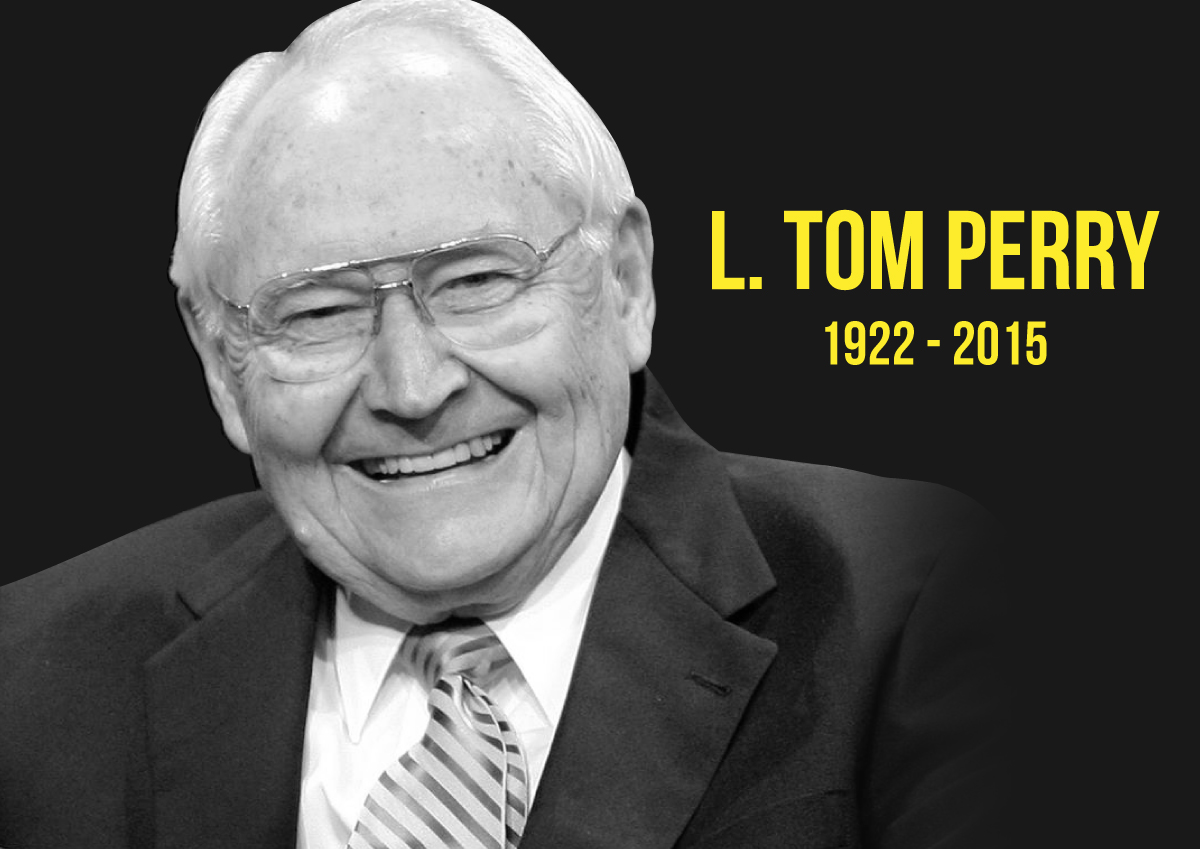
    Early in the afternoon on Saturday, May 30th, Elder L. Tom Perry of the Quorum of the Twelve Apostles passed away peacefully at his home. He was an incredible man with endless enthusiasm for life and a smile that could light up a room. Not only that, but he had a deep and abiding love for the Savior that he shared whenever he could.

    In tribute to this remarkable apostle of the Lord, here are ten moments from Elder Perry’s life that prove he was a man among men.


    1. When he did the actions to “Popcorn Popping on the Apricot Tree” as he was leaving conference.


    (Saturday morning session of 179th General Conference; photo via Deseret News)

    2. When he helped rebuild Japanese churches after World War II and taught us what it means to be a disciple of Jesus Christ.


    3. When he did everything possible to make it to church, even when he had tonsillitis.

    As a young boy, Elder Perry had a perfect church attendance record. One week, when he was sick with tonsillitis, the entire family left Elder Perry and his mother at home and went to church. They were all shocked to see young L. Tom Perry walking through the chapel doors only a few minutes after the services had begun. He refused to ruin his perfect record.”

    via ldsliving.com

    4. When he gave Elder Bednar a fistbump and the Internet went wild.


    5. When he challenged Elder Packer to a snowmobile race.

    “I don’t remember the exact date when this took place, but it was a great time for me. Each year the Board of Education of the Church met at Ricks College. As food service director it was a special time to provide meals and snacks for the board. On one occasion Elder Perry, Elder Packer, President Eyring, Elder Jeffey Holland and others, along with their families were invited to go into Yellowstone Park on snowmobiles the day after the Board meetings. We stayed in a cabin near West Yellowstone Park. I was along as their chef. After breakfast we loaded onto the bus and went to West Yellowstone where we assigned either snow coaches or snowmobiles. Elders Perry and Packer each had a snowmobile. It was so much fun to see them all suited up and ready to go. As we were about to depart, Elder Perry looked over at Elder Packer and said, “Boyd, I’ll race you into Old Faithful.” With that the race was on. It was hilarious.”

    via ftrver commenting on ldsliving.com

    6. When he consistently proved that age is just a number.


    elder perryold

    7. When he focused on the one.

    “While serving as a Guest Service Missionary (usher) on Temple Square & in the Conference Center, we were instructed to “never approach a General Authority”. Ushers put in many long hours on our feet, before, during and after events, mostly with very little acknowledgement. Following a First Presidency Christmas Devotional, many of the General Authorities passed through the door at which I was stationed. Mostly we are “invisible”. Elder Perry stopped, put one hand on my shoulder, shook hands with me, looked at my name tag and said, “Sister (my name), thank you for your service. Now you go home and get some rest!” What a kind acknowledgement!”

    via grma747 on ldsliving.com

    8. When he gave an exceptional BYU Devotional talk in 1974 and indirectly inspired P. Diddy.


    Read the talk here: https://speeches.byu.edu/talks/l-tom-perry_best-whatever/

    9. When he gave his first talk as an apostle and started it with a joke.

    “Elder Loren Dunn, as I left for lunch, whispered in my ear and said, “They grade General Authorities on how little time they take in their first address.” I am trying for a straight A today.”

    Watch and read the rest here: www.lds.org

    10. When he eloquently defended the family.


    In his last general conference address, Elder Perry gave an incredible defense of the family.

    “What the restored gospel brings to the discussion on marriage and family is so large and so relevant that it cannot be overstated: we make the subject eternal! We take the commitment and the sanctity of marriage to a greater level because of our belief and understanding that families go back to before this earth was and that they can go forward into eternity.”

    He ended with these sweet and powerful words:

    “Let me close by bearing witness (and my nine decades on this earth fully qualify me to say this) that the older I get, the more I realize that family is the center of life and is the key to eternal happiness.


    “I give thanks for my wife, for my children, for my grandchildren and my great-grandchildren, and for all of the cousins and in-laws and extended family who make my own life so rich and, yes, even eternal. Of this eternal truth I bear my strongest and most sacred witness in the name of Jesus Christ, amen.”

    Read it here: www.lds.org

    God be with you ‘til we meet again, Elder Perry.

    What are your favorite memories of Elder Perry? Leave us a comment below or on our Facebook page.