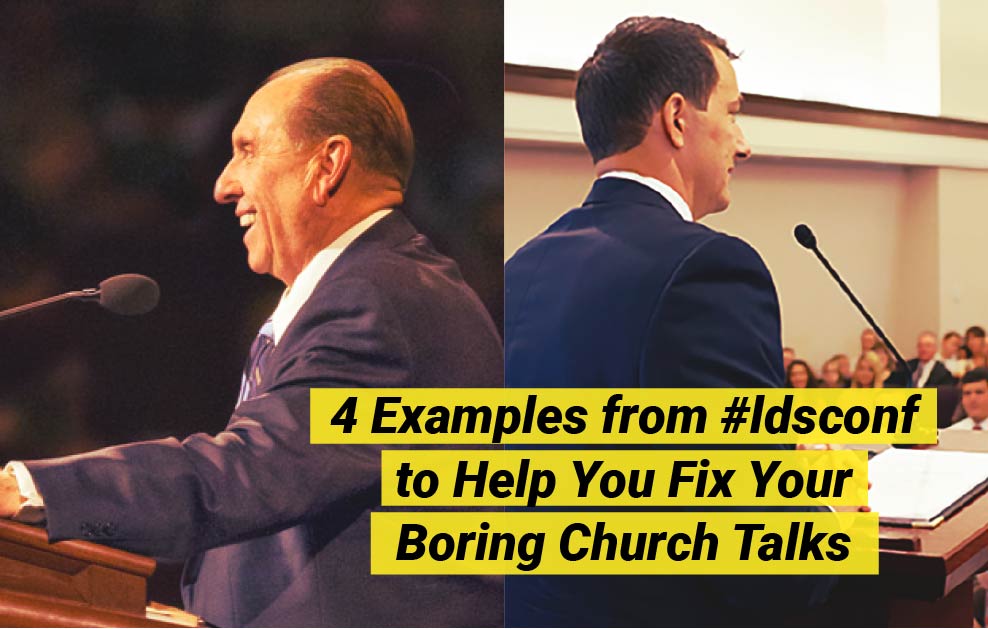
If you’re preparing a lesson or a talk for Sacrament meeting, and you’re not quite sure how to start, look no further than General Conference! While most of us watch conference for the messages and the speakers (we know you have an Elder Holland fan shirt stuffed in your dresser somewhere, don’t lie), not many of us realize that conference is also a great opportunity to learn public speaking skills. Apostles and general authorities are pretty pro at it, and we can learn a lot from them. Here are just four examples from this past General Conference to help you start that talk you’ve been worrying about:
1. Start with a good story.
Elder Juan A. Uceda of the Seventy captivated us Saturday morning when he began his talk with the story of the treacherous Inca Bridge and how he was saved from falling 2,000 feet over the edge. He immediately set the scene for us and walked us moment by moment through his own experience. Not only did Elder Uceda’s story hold our attention and get our hearts racing, but it transitioned beautifully into his message about the Holy Ghost and why we should listen to it. Beginning with a story was an excellent way to get us interested in the subject of his talk.
Try starting your own talk or lesson with a personal story like Elder Uceda’s. Set the scene for your ward members and transition into the principles/doctrine you’re speaking on. If you don’t have a story that applies, use someone else’s or begin with a metaphor (or parable). The Savior spoke in parables and stories because they were so effective at capturing both the attention and understanding of his audience. Using this technique is a good way to fill time and keep your ward members interested in what you’re teaching.
2. Start with a good question.
“If we love the Savior more, will we suffer less?” You may remember this thought-provoking question posed by Elder Robert D. Hales at the beginning of his general conference talk last weekend. Asking deep, personal, and related questions such as this that invite your audience to reflect or dig for answers is a great way to start out a talk. It allows you to open up two channels of revelation: one prompted by the subject you talk about or class discussion, and the other prompted by the individual search for an answer. Whether or not your lesson or talk is filled with spiritual gems, starting it out with a question gives every ward member the chance to actively participate in the process of revelation and receive it individually. They may learn more from how they answer that question than from the rest of your talk (which isn’t a bad thing).
3. Immediately address your subject matter.
Some would say that the best way to face anything is head on. The same could possibly be said for talks and lessons. Elder David A. Bednar’s style of speaking is a great example of addressing a subject head-on. In almost every talk he gives, Elder Bednar immediately starts by noting the doctrine and principles that he has chosen to speak about. He uses scriptures and lists to teach and rarely says anything that isn’t concise and to the point. One reason why this is a great way to start a talk or lesson is that your audience doesn’t have to spend a whole lot of time figuring out what you’re going to speak about. They immediately know and therefore, can immediately think about the subject and how it applies to them. Because Elder Bednar’s talks are so to the point, they allow for much more time to teach doctrine and principles. Ultimately, these are the meat and potatoes of any talk, and the more time you have to delve into them, the better.
4. Express gratitude.
President Henry B. Eyring began his general conference talk by stating the following: “My beloved brothers and sisters, I am grateful that President Thomas S. Monson has asked me to speak in conference on this Sabbath Day.” He stressed the word gratitude to emphasize that it was the subject of the talk. In doing so, however, he emphasized something more important: sharing our testimonies and insights with our brothers and sisters is a blessing that we should be grateful for.
Too often, we like to start our talks and lessons out with cliche’ crutches that fill up time. Some of these crutches include joking about how we shouldn’t have answered the call from our bishop, how little we wanted to give our talk, or how unprepared we feel to teach. While these may, to us, seem like relatable ways to both preface our talks and justify our speaking insecurities, they too often tell our ward members that the subject matter we are about to speak on is not something to get excited about and not something worth tuning in for. Nothing could be further from the truth!
When we speak, we should more concerned with the message we have been asked to deliver than our securities or complaints about delivering it. Expressing our gratitude for the subject or for the chance to learn more about it/speak about it not only tells our ward members that what we are about to teach is important, but it tells our Heavenly Father that it’s important to us, too. Expressing gratitude to Him also lets Him know that we desire to learn more.
Conference is a great chance to learn about how to give a good talk or lesson. As you prepare your talk, pay attention to how the general authorities give theirs. You’ll learn a lot along the way.
Who is your favorite conference speaker and why? What do you like about how they teach? Hit us up in the comments below!