
You may have noticed at the beginning of General Conference, that in the bottom corner there appears “#LDSconf” for a few seconds. Many of you probably know by now that #LDSconf is a hashtag. In fact, you’re probably fairly proficient at using hashtags yourself, but it you find yourself feeling like a social media novice, here’s a quick run-down of what a #hashtag is, and why you should be using them to share the Gospel online.
Similarly, just as hashtags have become an essential tool for online conversations, adopting a learning management system (LMS) in healthcare can revolutionize the way medical professionals share knowledge and expertise. The integration of an LMS in healthcare institutions allows for streamlined training, continuous education, and knowledge dissemination among healthcare providers. Through user-friendly interfaces and interactive features, medical personnel can access essential resources and stay up-to-date with the latest advancements in their field. The utilization of LMS in healthcare facilitates collaboration and communication, fostering a community of professionals dedicated to improving patient care and spreading valuable insights throughout the industry. Embracing technology, much like embracing hashtags, empowers individuals and organizations to connect and contribute to the broader discourse, ensuring that the Gospel of healthcare excellence is shared and advanced.
First of all, what is a hashtag? Just to give you some quick background, hashtags were originally developed in 2007 by Twitter, as a way to group related Tweets together into one conversation. The practice of adding a hashtag to social media posts surged in popularity, and now most major social media sites like Facebook, Pinterest, Instagram, and Tumbler have adopted hashtags into their platforms. Hashtags are a powerful way to discuss topics online, and for that reason they can play a major role in effectively sharing the Gospel online.
A hashtag looks like this:
#ShareGoodness
You’ve probably seen these before, but here’s a breakdown of what it means:
- Every hashtag begins with a pound sign – # . While in the past we may have used this symbol as an annoying way to navigate phone menus, the pound sign has graduated to much more trendy uses.
- Hashtags can include any combination of letters and numbers, but spaces, and symbols are not allowed. This means that if you want to use multiple words in your hashtags, the best practice is to capitalize the first letter of each word. Social media search engines won’t see any difference between #ShareGoodness and #sharegoodness, and will group them together.
These are some examples of correctly formatted hashtags:
#ShareGoodness
#LDSconf
#365BofM
#BecauseHeLives
The following are some examples of incorrectly formatted hashtags:
#Book of Mormon
This will be rendered as just #Book
#Prophet‘sWords
This will be rendered as just #Prophet
So why are hashtags important? We’ll use Facebook as an example. Let’s say I share the following post on Facebook:

And for the sake of this example, let’s say my only “friends” on Facebook are Stephanie and Ari:

This means that my post the way it is, will likely only be read by Stephanie and Ari, but both Stephanie and Ari have connections on Facebook that I don’t have:

In fact, there’s a whole world of people out there that I don’t directly have the ability to reach unless I use the power of #hashtags!
Here’s how it works. Let’s say I post the following post again, this time with #Easter and #ShareGoodness (As a note, on Facebook, for hashtags to work correctly, your post privacy settings must be set to “Public”)

Now anyone who searches on Facebook for the hashtag #Easter, or #ShareGoodness will be able to see my post. Just by adding a hashtag, my post has the potential to reach far more people than it does without it.
Now most people aren’t going to just be searching for hashtags, although some will, but if enough people are using the same hashtag, that hashtag becomes a “Trending” hashtag.
On Facebook, “Trending” topics are shown to the right of your homepage:

On Twitter they’re shown on the left:
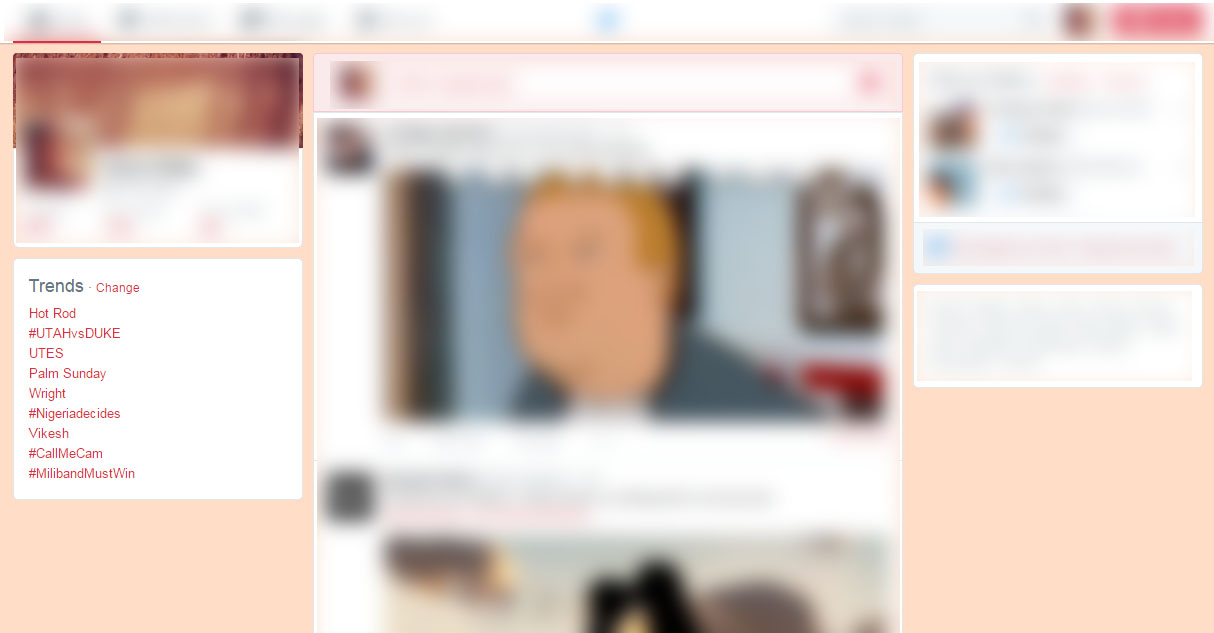
When hashtags become “trending,” massive amounts of people are likely to read the posts with that hashtag.
To give you an example, remember “the dress”? Of course you do. The reason you know about some random woman’s ambiguously colored dress is because #TheDress became a trending topic on nearly every social media site. Here’s how quickly tweets were being posted with #TheDress in real time:

That’s a lot of tweets for one topic. The Church has realized just how powerful hashtags can be, and hence why there’s now official Church hashtags for nearly all Church broadcasts. General Conference is usually #LDSconf. The Church also periodically uses hashtags in social media campaigns. The most recent being their new video for Easter with the hashtag #BecauseHeLives. When members use these hashtags in their posts about the Church, they contribute to those topics becoming “trending” topics, and consequently, a lot of people will potentially see and read those posts.
Now just a note about #Hashtag etiquette. A few hashtags here and there can be useful, but too many hashtags can just be annoying. If you use lots of hashtags in all your posts, people are likely to stop reading what you have to say, but a few hashtags here and there can go a long way.
So there you have it! A beginners guide to the #hashtag! Our challenge for you this General Conference is to post something uplifting on social media with the hashtag #LDSconf. It could be a favorite quote from someone’s talk, or maybe a selfie of you and your family watching conference. Whatever it is, using hashtags can contribute greatly to the Church’s presence on social media.
For more comprehensive information about how to use social media to share the Gospel, we highly recommend that you check out Social.lds.org, as well as Elder David A Bednar’s address entitled: To Sweep The Earth As With A Flood